
A Journal for Western Man-- Issue II

G. Stolyarov II
"Go hence and seek yourself another slave!
What! Shall the poet take that highest right,
The Right of Man, the Right which Nature gave,
And wantonly for your sake trifle it away?
How doth he over every heart hold sway?
How doth he every element enslave?
Is it not harmony that from his breast doth start,
Then winds the world in turn back in his heart?
When Nature forces lengths of thread unending
In careless whirling on the spindle round,
When all Life's inharmonic throngs unblending
In sullen, harsh confusion sound,
Who parts the changeless series of creation,
That each, enlivened, moves in rhythmic time?
Who summons each to join the general ordination,
In consecrated, noble harmonies to chime?
Who bids the storm with raging passion lower?
The sunset with a solemn meaning glow?
Who scatters Springtime's every lovely flower
Along the pathway where his love may go?
Who twines the verdant leaves, unmeaning, slighted,
Into a wreath of honor, meed of every field?
Who makes Olympus sure, the gods united?
The power of Man the Poet has revealed!"
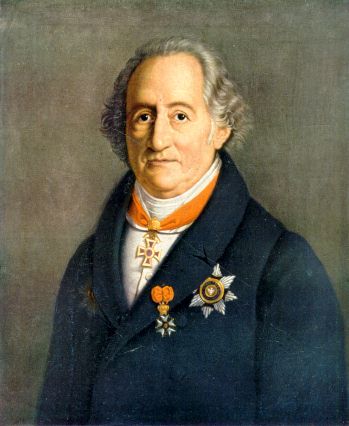
According to Encyclopedia Britannica, Goethe, during his final years, achieved "a wisdom often termed Olympian, even inhuman", and to the end possessed a warm, compassionate, and prying disposition toward the streams of visitors to his estate in Weimar. When the great Napoleon Bonaparte met and conversed with Goethe in 1807 at Erfurt, he exclaimed, "Voila, un homme!" (There is a man!) Goethe, in his love for humankind, referred to himself as "an extraordinarily ordinary man in whom ordinary men might see themselves reflected." Some of his final and most profound works range from Wilhelm Meister's Travels (1821-1829), which reveals the great man's visions of a progressive future, to his autobiography, Poetry and Truth, to a collection of words of wisdom in "Maxims" and "Conversations". Some of the most profound of Goethe's lessons to posterity deserve mention here. "To be pleased with one's limits is a wretched state," the genius instructs us to constantly expand our capacities, for "that which moves not forward, goes backward." He advises each person to follow their own path to comprehension, for "everything great and intelligent is in the minority" and "daring ideas are like chessmen moved forward; they may be beaten, but they may start a winning game." To be a follower of Goethe is to achieve the capacity to work wonders, as he himself had, and to become a true man of the Enlightenment.
G. Stolyarov II is a science fiction novelist, independent philosophical essayist, poet, contributor to Enter Stage Right Internet Magazine, and Editor-in-Chief of The Rational Argumentator. He can be contacted at [email protected].
