A Jounal for Western Man-- Issue IX
G. Stolyarov II
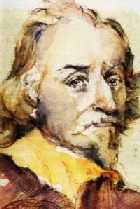
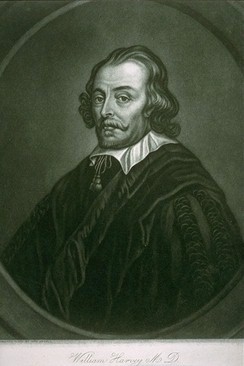
Harvey �s contributions to the progress of medicine and the cohesion that he established between descriptive observation and extrapolative theory are best documented by Sir William Osler, who notes that after Harvey �no longer were men to rest content with careful observation and with accurate description; no longer were men to be content with finely spun theories and dreams, which �serve as a common subterfuge of ignorance�; but here for the first time a great physiological problem was approached from the experimental side by a man with a modern scientific mind, who could weigh evidence and not go beyond it, and who had the sense to let the conclusions emerge naturally but firmly from the observations." As is evident, Harvey was the essential bridge between Aristotle and Descartes, between the ancient and modern worlds, whose re-evaluation of ancient techniques and their refinement marked a waypoint on the path of advancement, beyond which medical discoveries and technologies accelerated with never-before-seen swiftness. And to think that one of Harvey�s contemporaries wrote that "'twas believed by the vulgar that he was crack-brained, and all the physicians were against him"! The Galenic physicians, who elevated authority above objectivity, are long dead and forgotten. So are the grimy, jeering mobs that mocked Harvey in slum taverns and to whom Harvey rightly paid no heed. Harvey, an illustrious example of a man who deemed his own cognition an adequate means of comprehending reality, not needing the sanction of a committee of witch doctors and orthodox medievalists, remains a prominent name in the field of medicine, as his discoveries are not mere temporary paradigms, but rather eternal truths that will be just as valid in the twenty-second century as they had been in the seventeenth.
Harvey was one of the forebears of rational, absolute, Western medicine. Can we today preserve his legacy in a sea of statism, subjectivism, and collective delusion?
Sources:
Gregory, Andrew. �William Harvey�s Reception.� Available December 20, 2002: http://www.ucl.ac.uk/sts/gregory/215/handouts/h04_wh2.doc.
J. Johnson, W. Hepburn, J. Crawford. �William Harvey.� Available December 20, 2002: http://www.sjsu.edu/depts/Museum/harvey.html.
Landry, Peter. �William Harvey (1578-1657).� Available December 21, 2002: http://www.blupete.com/Literature/Biographies/Science/Harvey.htm.
Wiegand, Susan. �William Harvey (1578-1657).� Available December 20, 2002: http://www.accessexcellence.org/AB/BC/William_Harvey.html.