 |
|
|
|
|
|
|
|
|
|
|
|
|
|
|
|
|
|
|
|
|
|
|
|
|
|
|
|
|
|
|
|
|
|
|
|
|
|
|
|
|
|
|
|
|
|
|
|
|
|
|
|
|
|
|
| Abamectin ? Cancerous Properties |
|
|
|
Abamectin differs from ivermectin by a single double bond at the C22-23 position.�� Abamectin is a pesticide with many different agricultural uses.� It has been tested in acute, subacute*, and geno toxicity assays similar to those for ivermectin with similar results, except that abamectin is slightly more toxic than ivermectin. Neither compound is geno toxic. |
|
|
Abamectin was recorded in toxicology studies as not being carcinogenic (cancerous) in rats when given in the diet at varying doses. |
|
|
Abamectin was recorded in toxicology studies as not being carcinogenic (cancerous) in mice when given in the diet at varying doses. |
|
|
A lot of the parasites listed either do no occur in Australia or only occur only in wild rodents.� The main nematode in Australia is the Aspiculuris and possibly Syphacia and Hymenolepis.� I would also have liked to record the actual doses mentioned in trials to treat the parasites but there is some question as to their accuracy, i.e. the ug/mg as opposed to the mg/k rate so I will list the parasite but the findings will be without dose rates used, until such time as it is clarified. Editor |
|
|
|
Mice |
|
|
|
1.���� Endoparasites |
|
|
|
tetraptera- Ivermectin added to drinking water for 24 hours only. Hasslinger and Wiethe 1987. |
|
|
|
Syphacia obvelata ? Ostlind, Nartowicz, and Mickle (1985) reported that feeding a diet containing ivermectin for 6 days to mice naturally infested with pinworms was more than 99% effective against both adult and immature worms. Other dose rates recorded varying effectiveness. |
|
|
Nematospiroides dubius ? oral treatment on days 3 or 6 post infection was reported to remove all worms present Sayles and Jacobson 1983; Rajasekariah and colleagues (1986) reported that a much lower dose than that of Sayles and Jacobson completely eliminated adult worms from mice. |
|
|
Strongyloides spp ? Grove 1983 reported that a single dose 6 days after infection eradicated intestinal adult worms.� Others gave other smaller more regular doses like Rajasekariah and colleagues and Grove (1983) also with good results. |
|
|
A Toxocara canis- treating mouse with Ivermectin does not completely eradicate the larvae.� It alters the distribution of the larvae:� The larvae are retained in the liver and lungs and fewer migrate to the brain. None of the dose rates completely eradicate the parasite from the tissues.� Doses of Ivermectin for 2 to 7 days after infection and smaller doses on days 15 to 28 after infection |
|
|
Trichinella spp ? Treating the mice with avermectin reduced the number of intestinal T. spiralis 80% to 90%Campbell, Blair, and Lotti 1979).� The number of parasites was not reduced significantly, However, it was effective against intestinal forms of T. nelsoni and T. nativa in this study reducing their number by 91% to 96%(relative to controls), following other treatments on Days 1 and 6 post infection. |
|
|
Trichuris muris ? after repeated doses of ivermectin, mice treated for T. muris infestation were not completely cured Rajasekariahet al.1986. |
|
|
|
2. Microfilariae |
|
|
|
Ivermectin?s microfilaricidal activity has been demonstrated against immature stages of a number of filarial parasites in mice. |
|
|
Single low doses of ivermectin destroyed 100% of Onchocerca lienalis microfilariae within 5 days after treatment.� The same dose, administered at various times prior to microfilariae infection, reduced parasite recoveries by 92% for infection 4 days after treatment (Bianco et al 1986) |
|
|
Devaney and Howells (1984) reported that Bugia pahangi microfilaremia was reduced by 87% 24 hours after treatment of mice orally; the peritoneal microfilariae of this species were unaffected.� O.lienalis larvae in the cutaneous and subcutaneous tissues, and Dirofilaria immitis microfilariae in the blood of mice were also killed at this dose. |
|
|
Zahner and colleagues (1987) reported that subcutaneous treatment of dipetalonema viteae-infected Mastomys natalensis with ivermectin once or less on 5 consecutive days reduced microfilaremia 100% over a 42-day trial period.� Higher doses were required to remove microfilariae of Litomosoides carinii.� Lower doses removed circulating microfilariae of both species for shorter period of time.� Activity against adult D.viteae was demonstrated following 5 consecutive daily treatments at a lower dose, then higher doses of ivermectin and this did not affect the numbers of adult L. carinni at these dose rates. |
|
|
|
3. Ectoparasites |
|
|
|
The efficacy of ivermectin has been evaluated against some parasitic arthropod species in the mouse. |
|
|
|
a. Mites |
|
|
|
Silverman, Blatt, and Lerro (1983) reported that feeding mice a commercial diet containing ivermectin/kg of feed for two 6-day periods, 1 week apart, effectively eliminated Myobia musculi mites.� Efficacy of the product against murine mites, was confirmed by Wing, Courtney, and Young (1985), who demonstrated that 2 subcutaneous injections, given 1 week apart, effectively eliminated Mycoptes musculinus and Myobia musculi from laboratory mice.� Single treatments reduced infections only temporarily.� Rad fordia Afinis are not mentioned in this study.� Often, the only indications of pinworms in the mouse are a prolapsed rectum from straining.)� Baumanset al. (1988) reported that spraying mice with a .01% solution of ivermectin was effective in eliminating symptoms of mite infection for 12 weeks after treatment. |
|
|
b. Triatomid bugs. Treating mice with ivermectin at 0.2 mg/kg was reported to have caused high mortality and a reduction in egg-laying potential of Rhodnius prolixus and Hemiptera triatominae feeding on these animals (Azambuja et al. 1985). |
|
|
c. Cuterebra fontinella.� The C. fontinella mouse model was used to demonstrate the systematic insecticidal efficacy of the avermectins.� Ostlind, Cifelli, and Lang (1979) reported an avermectin mixture to be effective.� Drummond (1980) subsequently confirmed this activity using ivermectin in mice with induced C. fontinella infections. |
|
|
|
Rats |
|
|
|
Rats have been used as a model system to assess ivermectin?s basic toxicology, as well as for extensive studies on the drug?s mode of action, pharmacology, and pharmacokinetics (Calcott and Fatig 1984; chiu et al. 1986; Olsen and Snowman 1985; Pong and Wang 1980; Pong, Wang, and Fritz 1980; Williams and Yarbrough 1979). |
|
|
Antiparasitic evaluation has been limited to a few endoparasites ? rat models, although efficacy has been demonstrated against natural pinworm infestations. |
|
|
|
a. Syphacia muris.� Treatment of rats with ivermectin for 5 consecutive days was 99% effective against natural infections of this parasite (Battles et al. 1987).� There was no difference in body weight between treated and control animals, and no toxic signs were observed after treatment. |
|
|
b. Angiostrongylus cantonensis. Although treatment of 6-week-old infections of A. cantonensis resulted in a lower fecal egg and larval count in rats (indicating an effect on the fecundityfertility of the parasite), ivermectin did not have a demonstrable vermicidal effect at this level.� Oral treatment at a higher dose 3 days after induced infection did result in a significant reduction in the number of worms recovered (Ishii et al. 1983). |
|
|
c. Hymenolepis (the dwarf tapeworm) common in Australia is not mentioned in this study. |
|
|
|
d. Trichinella spiralis |
|
|
|
Although treatment was only 84% effective against migrating larvae and 83% effective against encysted worms, increasing the dose rate was reported to increase efficacy to 94% and 99% respectively, against these 2 stages of T. spiralis (Rapic, Dzakula, and Matic-Piantanida effective against intestinal T. spiralis (Alcaino, Gorman, and Imbert 1984) |
|
|
|
e. Syphacia muris |
|
|
|
Treatment of rats with ivermectin for 5 consecutive days was 99% effective against natural infections of this parasite (Battles et al. 1987).� There was no difference in body weight between treated and control animals, and no toxic signs were observed after treatment. |
|
|
|
Ectoparasites in Rats |
|
|
|
Mites |
|
|
|
a.���� Radfordiaensiferia (fur mites) are not tested in this study. |
|
|
|
*subacute ? describes a disease that progresses more rapidly than a chronic condition but does not become acute. |
|
|
|
LIST OF REGISTRATIONS |
|
|
|
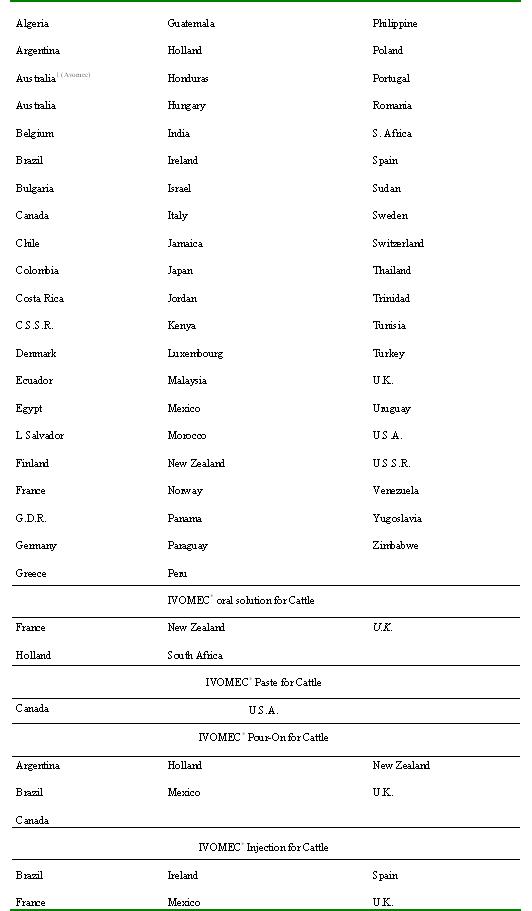
Ivermectin was released for registration by Merck & Co., Inc., in 1981 and first registered in France as IVOMEC injection for Cattle that same year. |
|
|
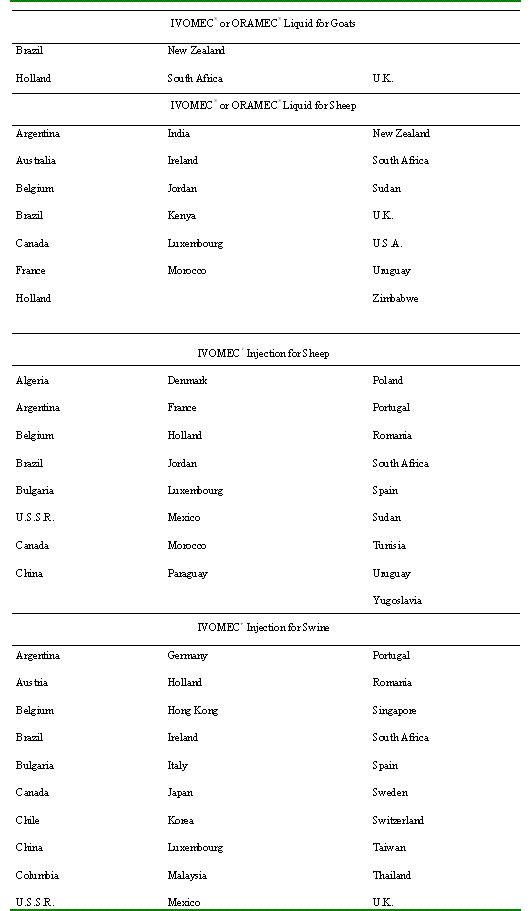
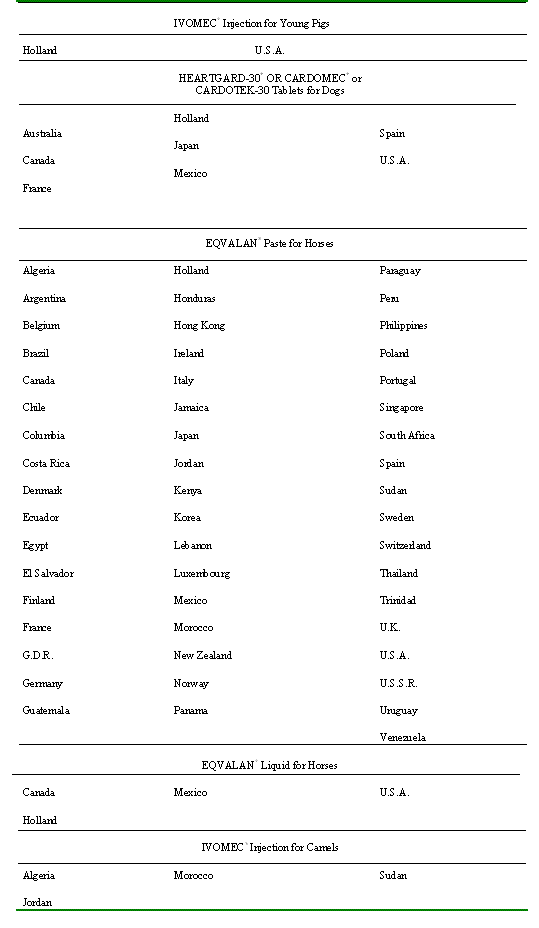
Since that time ivermectin has been approved for use in over 60 countries.� It is currently registered for use in cattle, sheep, horses, goats, swine, dogs, camels, reindeer, and bison. |
|
|
|
The following lists the products and the countries in which ivermectin is registered. |
|
|
|
IVERMECTIN APPROVAL |
|
|
|
IVOMEC* Injection for Cattle |
|
|
|
|
 |
|
|
|
|
|
 |
|
|
|
 |
|
|
|
 |
|
|
|
AVOMEC |
|
|
|
* Trademark of Merck & Co. Inc. Rahway, New Jersey U.S.A. |
|
|
|
Information was taken from the book, Ivermectin and Abamectin by William C. Campbell Editor - ISBN 0-387-96944-6 Springer-verlag Publishers. Data saftey sheets for the various products, Tom Donelly, University of Sydney, 2003 IVS No. 1033-2863 and i would like to thank Peter K Ward, Vibrac (Australia) P/L and Dr. Ian Beveridge BVSc PhDDVSc Melbourne Veterinarian Science University for their time and expertise in putting together this paper |
|
|
|
Back to index page |
|
|
|
Back to previous page |
|
|
|