 F O R E I G N
 F O R E I G N
 ecret
-ocieties
ecret
-ocieties
U.S.
Officials
Demonic Vessels
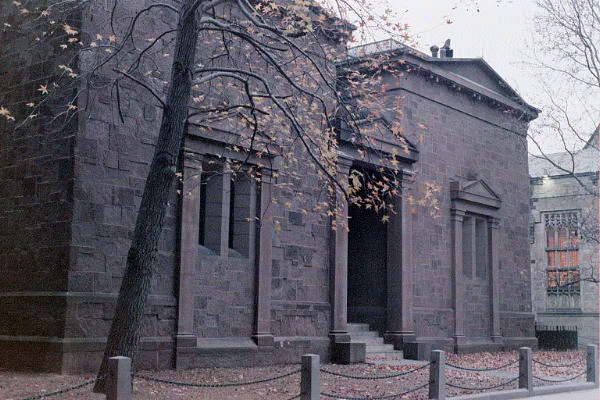
Skull
& Bones
 Chapel
St. at High St., New Haven, Connecticut
Chapel
St. at High St., New Haven, Connecticut
 To be a member of the
ruling elite, George Bush must meet certain criteria. He must be
white, he must be male, and he must be rich. He must also belong
to certain elite clubs and institutions which help to distinguish
him from those he is called upon to rule.
To be a member of the
ruling elite, George Bush must meet certain criteria. He must be
white, he must be male, and he must be rich. He must also belong
to certain elite clubs and institutions which help to distinguish
him from those he is called upon to rule.
George Bush is a member of Skull and Bones, an elite secret society open only to an elect 15 males in their senior year at Yale University. If this club appears somewhat exclusionary, don't worry; they have made great strides in the past few years. Recent Bones inductees include a few blacks, gays, and even some foreign students. However, it has been said that if women were ever allowed into the secret "tomb" (meeting place) of Skull and Bones, the tomb would "have to be bulldozed."
The importance of Skull and Bones is not that it provides good gossip about young males doing strange things in tombs, but that it provides a certain bond between members which they carry for life. Membership to Skull and Bones is the first initiation into the world of power politics and capitalism. It is somewhat akin to a "junior" old boy's network.
One of the interesting aspects
of this secret society is the number of Bones members, who, after
graduation, move on to do intelligence work. There has even been
informed speculations that there is a "Bones cell" in
the C.I.A. Wheather there is a Bones cell or not in the C.I.A. is
open to interesting debate. We can, however, examine the
histories of several Bonesmen who have gone on to illustrious
careers in intelligence work.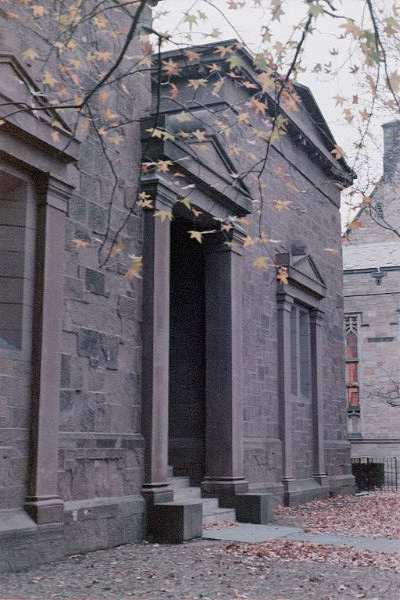
One of the most unusual Bonesmen is the Reverend William Sloane Coffin, Jr. Known best for his anti-Vietnam war activities and his political activism at Riverside Church in New York City, Sloane Coffin was recruited by the C.I.A. shortly after he graduated from Yale in 1949. Although his tenure at the Agency was short, he is one example of the C.I.A.'s use of the secret society to fill their ranks.
Another illustrious Skull and Bones member with close ties to the C.I.A. is arch conservative and renowned propagandist, William F. Buckley. According to several experts on the C.I.A., Buckley began his cooperation with the Agency while he was in Mexico City in 1952, where his good friend, E. Howard Hunt, the C.I.A. station chief at the time.
As an interesting aside, Buckley and Bush (as well as many other Washington and business elite) are members of the "prestigious" older -boys California getaway, "The Bohemian Club".
It is not surprising, given the Buckley family's wealth and status, that Bill's older brother, James Buckley, is also a member of Skull and Bones. From 1981-82 Buckley was Under Secretary of State for Security Assistance, Science, and Technology where it was his job to see that U.S. military aid went to support the right regimes.
He once stated
that C.I.A. covert activities in Chile, which led to the
overthrow of democratically-elected Salvador Allende, were
necessary because, "It was only by virtue of covert help by
the United States that these free institutions were able to
survive in the face of increasingly repressive measures by the
Allende regime.
 Buckley was
also directly connected to the work of the Chilean secret police,
DINA. In September 1976, DINA agents assassinated former Chilean
diplomat Orlando Leterlier and his colleague, Ronni Moffitt in
Washington D.C. "Independent researchers verified through
the F.B.I. and Department of Justice - that on September 14,
1976, one week before the Letelier assassination, Michael Townley
and Guillermo Novo [two DINA agents involved in the
assassination] drove to the office of Senator James Buckley in
New York City for a meeting. Buckley had helped finance trips to
Chile for Novo and others close to the killling.
Buckley was
also directly connected to the work of the Chilean secret police,
DINA. In September 1976, DINA agents assassinated former Chilean
diplomat Orlando Leterlier and his colleague, Ronni Moffitt in
Washington D.C. "Independent researchers verified through
the F.B.I. and Department of Justice - that on September 14,
1976, one week before the Letelier assassination, Michael Townley
and Guillermo Novo [two DINA agents involved in the
assassination] drove to the office of Senator James Buckley in
New York City for a meeting. Buckley had helped finance trips to
Chile for Novo and others close to the killling.
When C.I.A. agent David Atlee Phillips was accused of being involved in assassination he started an organization entitled "Challenge: An Intelligence Officers' Legal Action Fund." The board of "Challenge" included former C.I.A. director William Colby, former C.I.A. Inspector General Lyman Kirkpatrick, former intelligence officer Richard Stillwell, and interestingly, James Buckley.
Hugh Cunningham, Bonesman from the class of 1934, is a Rhodes Scholar with a lengthy career in C.I.A. He was in the Agency from 1947 to 1973 during which time he served in top positions with the Clandestine Services, the Board of National Estimates, and was the Director of Training from 1969-73. He also served with the C.I.A.'s precursor, the Central Intelligence Group from 1945-47.
William Bundy is a Bonesman
from the class of 1939. Bundy began his intelligence career in
the OSS during 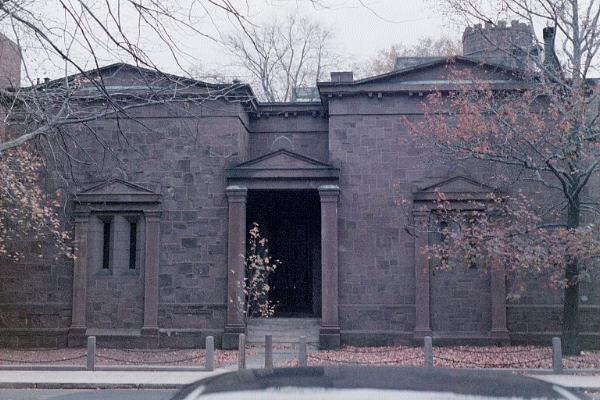 World War II.
From 1951-61 he worked at the C.I.A., including at its Office of
National Estimates. During the Vietnam War, he was the Assistant
Secretary for Asian Affairs and a vocal advocate for escalating
the war.
World War II.
From 1951-61 he worked at the C.I.A., including at its Office of
National Estimates. During the Vietnam War, he was the Assistant
Secretary for Asian Affairs and a vocal advocate for escalating
the war.
A true Cold War liberal, Bundy expressed his belief in the necessity of C.I.A. covert actions in his foreword to the book "The Counter-Insurgency Era: "The preservation of liberal values, for America and other nations, required the use of the full range of U.S. power, inlcuding if necessary, its more shady applications." "Shady applications" is a veiled euphemism for covert activities which support dictators, overthrow legitimate governments, and contribute to the destabilization of world order.
From the class of 1950 comes Bonesman Dino Pionzio. His claim to fame was the time he spent as C.I.A. deputy chief of station in Santiago, Chile in 1970, during the massive C.I.A. destabilization of the Allende government. He is also a member of the Assocation of Former Intelligence Officers. The C.I.A. proved not to be lucrative enough for Pionzio so he left his intelligence career behind and became an investment banker. As of 1983, he was vice president at the investment firm Dillion, Read. (Just to illustrate how small circles really are - Nicholas Brady, however, was not a Bonesman. He belonged to another Yale secret society called "Book and Snake."
 From the days
of George Bush's father, Prescott Bush, comes former spook F.
Trubee Davidson, a Bonesman from the class of 1918, was the
Director of Personnel at the C.I.A. in 1951. Davidson then begot
little Bonesmen, Endicott Peabody Davidson and Daniel Pomeroy
Davidson. Endicott Davidson went to work at the law firm of
Winthrop, Stimson, Putnam, and Roberts (Henry Stimson was the
Secretary of War during World War II and also a Bonesman).
From the days
of George Bush's father, Prescott Bush, comes former spook F.
Trubee Davidson, a Bonesman from the class of 1918, was the
Director of Personnel at the C.I.A. in 1951. Davidson then begot
little Bonesmen, Endicott Peabody Davidson and Daniel Pomeroy
Davidson. Endicott Davidson went to work at the law firm of
Winthrop, Stimson, Putnam, and Roberts (Henry Stimson was the
Secretary of War during World War II and also a Bonesman).
Another interesting Bonesman is David Lyle Boren, the Senate Democrat from Oklahoma. While he is not an employee of the C.I.A. (some say this is open to question) Boren nevertheless is part of the intelligence community because he is the chair of the Select Committee on Intelligence.
Finally, but certainly not at
the end of the list, comes Richard A. Moore. Moore began his
intelligence career in World War II where he served as a special
assistant to the chief of military intelligence. He was rewarded
for this service with the Legion of Merit for Intelligence Work.
In the 1970's, Moore was special assistant to President Nixon and in the thick of things during the Watergate scandal. At his recent congressional confirmation hearing for the post of Ambassador to Ireland, Moore was asked by one of the committee members if he was one of the 14 unnamed and unindicted co-conspirators of the Watergate scandal. Moore, however, emphatically denied the accusation. It is interesting to note that Moore, a Bonesman from 1936, was recently appointed to a high-level State Department post by George Bush, Bonesman, 1948.
The list of Bonesmen-made-good goes on and on and includes McGeorge Bundy (National Security Adviser to Kennedy and Johnson), William Draper (Defense Department Import-Export Bank, etc.), Dean Witter, Jr. (investment banker), Potter Stewart (Supreme Court Justice who swore in George Bush as Vice President in 1981), John Forbes Kerry (Senator from Massachussetts), Winston Lord (Kissinger protege and former Ambassador to China), Robert H. Gow (president of Zapata Oil, once owned by Bush and which had possible links to the C.I.A.), and Henry Luce of Time-Life fame.
This old (and
new) boys network helps to illustrate the old adage "it's
not what you know, it's who you know." Given the extent of
Bones members in intelligence, it is also "how you come to
know it."
(The above article appeared in Covert Action - Number 33, Winter 1990)
.