

| Home |
| Games |
| Msn World |
| Islam |
| Pictures |
| Faisalabad |
| Weather |
| Funny Pictures |


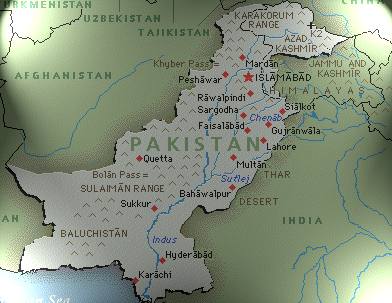
Islamic Republic of Pakistan
Official Religion
Islam
National Anthem
approved in June, 1954
Verses Composed by: Abul Asar Hafeez Jullundhri
Tune Composed by: Ahmed G. Chagla
Duration: 80 seconds
Pakistan National Flag
Dark green with a white vertical bar, a white crescent and a five-pointed star in the middle.
The Flag symbolises Pakistan's profound commitment to Islam and Islamic world.
Father of the Nation
Quaid-E-Azam Muhammad ali Jinnah
Head of the State
General Pervaz Musherraf
Head of Government
General Pervaz Musherraf
Capital
Islamabad
History
Pakistan traces its history back to 2,500 years B.C., when a highly developed civilization flourished in the Indus Valley.
Excavations at Harrappa, Moenjodaro, Kot Diji and Mehr Garh have brought to light, the evidence of an advanced
civilization existing even in more ancient times. Around 1,500 B.C., the Aryans overwhelmed this region and influenced the
Hindu civilization, whose centre moved to Ganges valley, further east. Later, the Persians occupied the northern region in the
5th century B.C. up to the 2nd century AD. The Greeks came in 327 B.C., under Alexander of Macedonia, and passed
away like a meteor. In 712 AD, the Arabs, led by Muhammad Bin Qasim, landed somewhere near modern Karachi and
ruled the lower half of Pakistan for 200 years. During this time, Islam took roots in the soil and influenced the life, culture and
traditions of the people.
In the 10th century AD, began the systematic conquest of South Asia by the Muslims from Central Asia, who ruled here up to
the 18th century. Then the British came and ruled for nearly 100 years over what is Pakistan now. The Muslim revival began
towards the end of the last century when Sir Syed Ahmed Khan, a renowned Muslim leader and educationist, launched a
movement for intellectual renaissance of the Muslims of South Asia. In 1930, the well-known poet-philosopher, Allama
Muhammad Iqbal, conceived the idea of a separate state for the Muslims of South Asia. In 1940, a resolution was adopted
by the All-India Muslim League, demanding a separate independent home land for the Muslims. After 07 years of un-tiring
struggle under the brilliant leadership of Quaid-e-Azam (the great leader) Muhammad Ali Jinnah, Pakistan emerged on the
world map as a sovereign state, on 14th August, 1947.
Languages
National Language Urdu
Official Language: English
Main Regional Languages
Sindhi, Balochi, Punjabi and Pashto
Area
796,095 Sq. km.
Provinces and their Areas
Punjab: 205,344
Sindh: 140,914
North West Frontier Province: 74,521
Balochistan: 347,190
Federally Administered Tribal Areas: 27,220
Islamabad(Capital): 906
Time Zone
Pakistan Standard Time is GMT plus 5 hours. It gets dark at about 5 p.m. in winter and at 7.30 p.m. in summer.
Telephone Information
Inward: +92, Faisalabad: 411, Hyderabad: 221, Islamabad: 51, Karachi: 21, Lahore: 42, Multan:
61, Rawalpindi: 51, Gilgit: 572, Skardu: 575, Peshawar: 91; Outward via operator or from ISD Public Call Offices (PCO).
For internal calls, Card Phone booths are installed at all airport lounges and main business centres in most cities and towns.
Public telephone, telex and fax facilities are available at the Customers Service Centres (CSC) or at private general stores and
shops, identified by a sign displaying ‘PCO’ on green boards/lettering. Mobile phone can also be obtained from private
companies on rental basis for short periods. Radio paging service is provided by DC Pager service at Lahore, Rawalpindi,
Islamabad, Karachi and Peshawar.
Population
Muslim (97%),
Hindu (1.5%),
Christian (1%)
and ;other minorities
Ethnic composition
95% Muslims,
5% others
Per capita income
US$ 460
Currency
Pak Rupee
Exports
Cotton, textile goods, rice, leather items carpets, sports goods, fruits, handicrafts Sea Food (Fisheries)
Imports
dustrial equipInment, vehicles, iron ore, petroleum, edible oil
Government Parliamentary form
Parliament It consists of two Houses i.e.,
the Senate (Upper House)
and the National Assembly (Lower House).
The Senate is a permanent legislative body and symbolises a process of continuity in the national affairs. It consists of 87 members. The four Provincial Assemblies, Federally Administered Tribal Areas and Federal Capital form its electoral college.
The National Assembly has a total membership of 217 elected through adult suffrage (Muslim 207 and Minorities 10).
National Flower
Jasmine
Major Cities
Islamabad, Karachi, Lahore, Peshawar, Quetta, Rawalpindi, Hyderabad, Multan, Sialkot and Faisalabad
Agriculture
Major crops are cotton, wheat, rice and sugarcane
Total cropped area
22.14 million hectares
Industry
Textiles, cement, fertiliser, steel, sugar, electric goods, shipbuilding
Energy Major sources:
Oil, Coal, Hydel, Thermal, Nuclear and Liquid Petroleum Gas
WAPDA's total installed power generating capacity: 11,246 MW
Health
Hospitals 830
Beds: 86,921
Doctors(registered): 74,229
Dentists(registered): 2,938
Nurses(registered: 22,810
Education
Primary schools: 150,963
Middle schools: 14,595
High schools: 9,808
Arts science colleges: 798
Professional colleges: 161
Universities: 35 (10 in Private sector)
Transport Communication
Total length of roads: 228,206 km
Pakistan Railway network: 8,775 km
Railway stations: 781
Pakistan International Airlines: Covers 55 international and 38 domestic stations
Major Airports: 6 - Islamabad, Karachi, Lahore, Quetta, Peshawar and Gwadar
Seaports
International :
2 - Karachi and Bin Qasim
Domestic
: 3 - Minora, Gwadar and Pasni
Communications
;Post Offices: 13,419
Telephone connections: 2.47 million
Public Call Offices: 10,000
Telegraph offices: 427
Employment
Total Labour force: 37.15 million
Agriculture sector: 47%
Manufacturing/ Mining sector: 10.50%
Others: 42.50%
Media Entertainment
Pakistan Television (PTV) telecast entertainment programmes of music, plays/dramas and stage
shows/talks from 05 TV Stations; Karachi, Quetta, Lahore, Islamabad and Peshawar. PTV has also started Ptv World which can be viewed in the Middle East and South Asia. A private Channel, Shalimar Television Network (STN), besides telecast of similar programmes, also re-telecast programmes of BBC, CNN, TNT Movies etc.
Pakistan Broadcasting Corporation (PBC) has 22 radio stations throughout Pakistan which offer music, plays, news and talks
in national and local languages. A PBC World Service from Islamabad presents programmes in a number of international
languages. A private music channel, “FM100” has 24 hours music service from 04 major cities of Pakistan. All urban areas
have cinema houses which run daily 03 shows of feature films in Urdu and other local languages. Some cinema houses in
major cities run English movies also
Banks
Central Bank: State Bank of Pakistan
Other Banks: National Bank of Pakistan, Habib Bank Ltd., Muslim Commercial Bank Ltd., Allied Bank of Pakistan Ltd.,
First Woman Bank, Mehran Bank and the Bank of Punjab
Specialised Banks: Agricultural Development Bank of Pakistan, Federal Bank for Co-operatives, Industrial Development
Bank of Pakistan, The Punjab Provincial Co-operative Bank, Banker's Equity and National Development Finance
Corporation
Popular games
Cricket, Hockey, Football
Famous Mountain Peaks
K-2 (Mt. Godwin Austin): 28,250 ft./8611 m (2nd in World)
Nanga Parbat : 26,660 ft./8126 m (8th in World)
Gasherbrum-I: 26,470 ft./8068 m (11th in World)
Famous Mountain Passes
The Khyber Pass
The Kurram Pass
The Tochi Pass
The Gomal Pass
The Bolan Pass
The Lowari Pass
The Khunjrab Pass
Rivers
There are five main rivers in Pakistan
Ravi 901 km in length
Jhelum 825 km
Chenab 1242 km
Rivers The Indus 2896 km
Sutlej 1551 km
Beas (tributary of Sutlej) 398 km
Deserts
Thar: Sindh
Cholistan: Punjab
Thal: Punjab
Dams
Mangla Dam Punjab
Major Dams North West Frontier Province
Warsak Dam North West Frontier Province
Keenjar Sindh
Manchar Sindh
Lakes
Saif-ul-Maluk NWFP
Hanna Balochistan
Satpara Northern Areas
Kachura Northern Areas
Where to Stay ?
Pakistan offers a wide range of accommodation. Modern, well equipped chain hotels like Sheraton and
Avari (at Karachi & Lahore), Pearl Continental Hotels (at Lahore, Peshawar, Rawalpindi, Bhurban and Abbottabad),
Marriott (Karachi & Islamabad), Holiday Inn (Karachi, Lahore, Multan and Islamabad), Serena Hotels (Faisalabad, Quetta,
Gilgit, Hunza and Saidu Sharif), Pine Park Hotels (Naran, Khannian & Shogran), Green Hotels (Nathiagali, Abbottabad,
Peshawar), Shangrila Resorts & Hotels (Naran, Chilas, Skardu) offer good services and facilities. A government tax/duty up
to o 17.5% is added to the rent at most places. There are official Dak Bungalows and Rest Houses at most of the hill stations
and valleys, maintained by either Provincial Forest Department, Public Works Department (PWD) or by the local
administration. Advance booking is recommended.
What to see ?
Pakistan is a special interest destination. Its main attractions include adventure tourism in the Northern Areas,
cultural and archaeological tourism as found at Taxila, Moenjodaro, Harappa and Swat and early Muslim and Mughal heritage of Multan, Lahore, Thatta and Peshawar. From the mighty Karakorams in the North to the vast alluvial delta of the Indus river in the South, Pakistan remains a land of high adventure and nature. Trekking, mountaineering, white water rafting, wild boar hunting, mountain and desert jeep, Camel and Yak safaris, trout fishing and bird watching, are a few activities which entice the adventure and nature lovers to Pakistan.