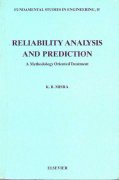
Reviews and Comments
" Apart from some early work on the reliability of telephone
systems, emphasis is placed on reliability during 1940/45 war, where failure could be
disastrous for the last thirty years there have been numerous books published on "
Reliability"( some 130 are listed in K.B.Misra’s book ). The vast majority have
been largely mathematical and usually specific to one section or aspect of reliability.
For many years there has been the need for a comprehensive volume which would collate and
summarize all the knowledge which has been accumulated by experience in reliability
movement over this period.
Such a book is now available in K.B.Misra’s " Reliability
Analysis and Prediction : A Methodology Oriented Treatment ". This book now provides
the student, researcher or practical engineer, with all the knowledge he requires for his
particular application. As a reviewer who pioneered reliability work in electronics for
the Armed Forces in the 1940s; has lectured extensively worldwide and has written numerous
books, including three books on reliability, the reviewer has studied this book
extensively and in his opinion it contains the most complete coverage of any book on
reliability yet written. This is illustrated by the chapter headings, as follows:
-Reliability Engineering: An Overview; Reliability Mathematics; Reliability Data Analysis
and Management; Reliability Prediction from Stress Strength Models; System Reliability
Modelling; Reliability Evaluation Techniques; Maintainability Analysis and finally, System
Analysis through Fault Tree.
It may be argued that the book is too ‘voluminous’, but there
are few books published which are regarded as "landmarks" or
"milestones" in any technique or subject. Colloquially, they are known as
‘the Bible’ or fount of knowledge. Such a book for many years was
F.E.Terman’s " Radio Engineering". We now have a new ‘Bible’-
K.B.Misra’s "Reliability Analysis and Prediction: A Methodology Oriented
Treatment". The author is modest in claiming that this book, which is the outcome of
his more than 25 years of teaching and researching in the area, is going to fill the gap
which has been widely felt by practicing engineers, but there is no doubt that this will
be so. The appendices on ‘Some Useful Definitions’ and on ‘ Description
Computer Codes’ are particularly valuable.
In summary, reliability analysis, prediction, reliability mathematics,
algorithm organization and analysis of data, reliability modelling and system reliability
evaluation, system modelling and maintainability analysis, plus four appendices of
mathematical tables, all add up to the most comprehensive and up-to-date information on
the "state-of-the-art" in reliability. Its should be on every engineer’s
book shelf. "
- G.W.A.Dummer, Editor-in Chief,
Microelectronics and Reliability,Pergamon Press, U.K., 1992
.
"… the book of K.B.Misra who is an internationally leading
specialist in reliability engineering is an outstanding and up to now surely the most
comprehensive text on the subject and will find numerous satisfying readers. "
- F. Beichelt, Germany, published in Optimization, 1992.
"This timely book by an expert with 25 years experience,
summarizes the latest developments in a subject that has advanced phenomenally in the last
three decades and provides the reader with all the methodological tools necessary in one
volume. Limitations of models, methods, procedures, algorithms, and programmes are
described. The latest developments in fault tree analysis are well covered. Although the
necessity, having a high mathematical content, it will be a great value to a wide range of
practicing engineers, lectures and students. Each chapter has a comprehensive list of
references. "
- ASLIB BOOK GUIDE, 1992 .
" This is a beautiful textbook devoted to reliability
fundamentals. This book is intended to researchers, students and especially engineers that
do not have a previous background of basic reliability knowledge. The effort is made
towards presentation of methodologies for reliability analysis and prediction. For
example, after laying the basis of reliability mathematics, the author uses the concept to
present models for reliability prediction by means of stress –strength approach, then
passes from units to systems and reviews the general Markov model among other models.
A complete chapter is devoted to one of the most recently and
frequently used method for reliability analysis and prediction: fault tree analysis.
Construction, simplification, evaluation of fault trees are the basic steps. The analysis
of the results of evaluations, using measures of importance and sensitivity, plays a major
role. Example of 45 computer programmes with description of the target computer type,
performances and constraints end the book.
The references are very good, oriented mainly to the Anglo-Saxon
literature. Each chapter contains references arranged chronologically. At the end of the
book there is main list of references. Each chapter has several examples, most of them
with numerical calculations. This improves readablity and deepens the understanding of
methods. There is good index list oriented to the main topics covered in the book. A final
comment contains a less usual but very nice comparison between reliability phenomena and
Indian philosophy.
- A. Pasculescu , Bucuresti,
published in Zentral Blatt fur Mathematik, 1995
. |