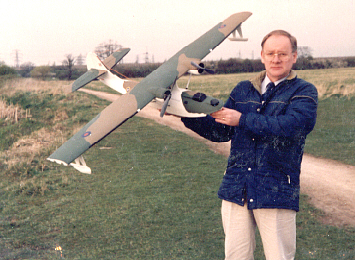
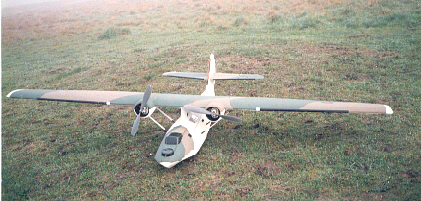
Catalina, actually flown off
water, (eventually, on the second cell charge, and after
racing round like a duck with a broken wing). Acom
motors/gearboxes/props, (anyone remember those thin
plastic props?), on 12 cells.
Used to fly quite nice, but needed coordinated aileron
and rudder. The ground jumped up and smote it one day
Got partially repaired but not reflown.
From a plan, control line I think.
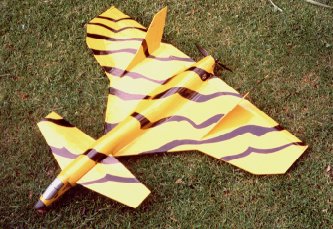
Experimental Canard O.D. scratch built.
This was going to be one of those 'wow! look at that', models. Well in a sense she was, but not at flying. She has traveled through the air from a 'throw', (and through the ground), but could not be classed as 'flying'. But for flat stalls, right way up or inverted, she's a winner. I really must stick one of those CG thingy symbols on experimental planes, (and perhaps a arrow showing proposed flight direction).
Its the fastest looking static plane I have designed and built.
Status - in a council skip.
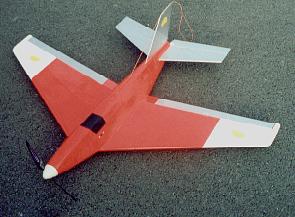
Stealth Thing, so named because of the angled fuz.
I fancied something simple and fast for those windier days, and as I was sorting out my balsa box I though '...how about an all sheet wing jet looking thing..' Magnetic Mayhem motor,7 cell. Fast, but also lands fast, not particularly nice to fly, but it made the weather calm down. Scratch built, 30" span.
Going 'loft' wrinkles, but undamaged, till it landed in that skip.
There just wasn't room for everything in our move to Wales, and a lot of bits I knew would never get in the air again by me.
You certainly learn to stop hoarding thing that you will never use, when you have to pack for a house move.
Also in the loft prior to our move, but no photos -
Macchi
M7 - biplane flying boat, semi scale, scratch built.
Now that was a pig to sort out. I used a wheeled trolley
to launch it off grass as it was too wide to hold for
hand launching. After many attempts it did actually leave
the ground' (and the trolley), from there on it was a
fight to stop the ground from snatching it back. It
probably looked spectacular, gyrating about the sky,
except I knew that 90% of the maneuvers were not mine. By
about the third major repair, I was coming to terms with
where the thrust line should really point. The ML7 has a
high thrust line and pusher prop. I finally found the
correct amount of up thrust, except this brought the prop
very close to the trailing edge. Now I have never heard a
noise like that before, it wasn't touching the T.E., it
must have been something to do with the way the air was
cut by the blades so close to the T.E. It flew, but was a
pig to land and got repaired too many time.
Into that skip also went - A sort of mini Speedy Bee look alike for a 400 motor and small batteries. An 'Eagle', and 'Swift' bird gliders, an O.D. aerobatic job, and a few good wings from 'dead' fuselarges.
Oh and wings from an experimental V tailed (my
first), electric glider that had rotating wings instead
of ailerons, (another first). The cine film clearly shows
that the ailer-wings?, where going the wrong way as I
bent the stick the other way. The fuselage wasn't worth
repairing, but the wings survived.
Check, double check, ask some one else to check. been
there done that, got the failed T-shirt.
One thing about learning from your mistakes, you learn to make better ones.