| History |
| Year W L T PCT Place Playoff PCT Playoff Result 2004 4 12 0 .250 5th 2003 10 6 0 .625 2nd 2002 9 7 0 .563 3th 2001 11 5 0 .688 2nd 0-1 .000 L-Baltimore L 3-20 2000 11 5 0 .688 1st 1-1 .500 W-Indianapolis W 23-17 L-Oakland W 0-27 1999 9 7 0 .563 3rd 1-1 .500 W-Seattle W 20-17 L-Jacksonville 7-62 1998 10 6 0 .625 2nd 1-1 .500 W-Buffalo W 34-24 L-Denver L 38- 3 1997 9 7 0 .563 2nd 0-1 .000 L-New England 17-3 1996 8 8 0 .500 3rd 1995 9 7 0 .563 3rd 0-1 .000 L-Buffalo 37-22 1994 10 6 0 .625 1st 1-1 .500 W-Kansas City 27-17 L-San Diego 22-21 1993 9 7 0 .563 2nd 1992 11 5 0 .688 1st 1-1 .500 Bye W-San Diego 31-0 L-Buffalo 29-10 1991 8 8 0 .500 3rd 1990 12 4 0 .750 2nd 1-1 .500 W-Kansas City 17-16 L-Buffalo 44-34 1989 8 8 0 .500 3rd 1988 6 10 0 .375 5th 1987 8 7 0 .533 3rd 1986 8 8 0 .500 3rd 1985 12 4 0 .750 2nd 1-1 .500 Bye W-Cleveland 24-21 L-New England 31-14 1984 14 2 0 .875 1st 2-1 .667 Bye W-Seattle 31-10 W-Pittsburgh 45-25 L-San Francisco 38-16 1983 12 4 0 .750 1st 0-1 .000 Bye L-Seattle 27-20 1982 8 2 0 .800 1st 3-1 .750 W-New England 28-13 W-San Diego 34-13 W-NY Jets 14-10 L-Washington 27-17 1981 11 4 1 .719 1st 0-1 .000 Bye L-San Diego 41-38 1980 8 8 0 .500 3rd 1979 10 6 0 .625 1st 0-1 .000 Bye L-Pittsburgh 34-14 1978 11 5 0 .688 2nd 0-1 .000 L-Houston 17-9 1977 10 4 0 .714 2nd 1976 7 7 0 .500 3rd 1975 10 4 0 .714 2nd 1974 11 3 0 .786 1st 0-1 .000 L-Oakland 28-26 1973 12 2 0 .857 1st 3-01.000 W-Cincinnati 34-16 W-Oakland 27-10 W-Minnesota 24-7 1972 14 0 0 1.000 1st 3-01.000 W-Cleveland 20-14 W-Pittsburgh 21-17 W-Washington 14-7 1971 10 3 1 .769 1st 2-1 .667 W-Kansas City 27-24 W-Baltimore 21-0 L-Dallas 24-3 1970 10 4 0 .714 1st 0-1 .000 L-Oakland 21-14 1969 3 10 1 .231 5th 1968 5 8 1 .385 3rd 1967 4 10 0 .286 4th 1966 3 11 0 .214 5th |
 |
| No pro football club in history ever advanced more quickly from the first-year dregs every expansion team faces to the ultimate achievement in its sport than the Miami Dolphins did in the six-year period between 1966 and 1972. In 1966, they began their pro football life as the ninth member of the American Football League. Six years later, Miami became the only National Football League team ever to record a perfect season. The 1972 Miami Dolphins won the AFC Eastern division and AFC championships and then defeated the Washington Redskins 14-7 in Super Bowl VII to complete an unblemished 17-0-0 record. The Dolphins, who were founded by Joseph Robbie, also got off to a perfect start in the first game of their first AFL season when running back Joe Auer returned the opening kickoff for a 95-yard touchdown against the Oakland Raiders. But the Miami team returned to reality even before the end of its first game. Oakland rallied to win and the Dolphins finished their first season with a 4-10 record. George Wilson was the Dolphins' first coach. He finished his four-year AFL tenure after the 1969 season with a 15-39-2 record. But those were not wasted years for the Dolphins because they were steadily adding new talent -- quarterback Bob Griese in 1967, running back Larry Csonka in 1968 and guard Larry Little in 1969 -- that would eventually turn them into winners. The transition from losing to winning came in just one season in 1970 when new coach Don Shula led the Dolphins to an AFC wild-card playoff berth with a 10-4 record. Miami then followed with three straight AFC championships in 1971, 1972 and 1973 and victories in Super Bowls VII and VIII. Their combined 1972-1973 record was 32-2, also an all-time mark. From 1970 to 1974, their cumulative record was 65-15-1. There is no telling what heights the Dolphins might have reached had not three of their finest stars, Csonka, Jim Kiick and Paul Warfield, defected to the rival World Football League after the 1974 season. Miami never again reached the world championship level the Dolphins attained in 1972 and 1973. But Shula, who in 1993 surpassed George Halas' record of 324 coaching victories to become the all-time leader, kept the Dolphins among the league's elite year after year. The Dolphins since 1970 have won 11 AFC Eastern division championships and five AFC titles, the last two coming in 1982 and 1984. In the 1984 season, quarterback Dan Marino threw an all-time record 48 touchdown passes. Since 1970, Miami has had losing seasons only in 1976 and 1988. The Dolphins first playing home was the Orange Bowl in Miami. Fan support was excellent ... in 1973, the Dolphins established an NFL record with 74,961 season ticket sales. But Robbie had long dreamed of his own privately-funded stadium and, on August 16, 1987, he proudly unveiled a spanking new 73,000-seat stadium. Two years later, the stadium served as the site for Super Bowl XXIII and again hosted a Super Bowl in January, 1995. The Joe Robbie era ended with his death on January 7, 1990. Early in 1994, the NFL approved the acquisition of the Dolphins by H. Wayne Huizenga, a well-known Florida sportsman. Following the 1995 season, the legendary Shula retired as coach of the Dolphins. Jimmy Johnson succeeded the all-time winningest coach, but after four years with the Dolphins, he retired. The coaching reigns were handed to Dave Wannstedt, the former head coach of the Chicago Bears. |
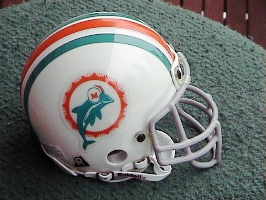
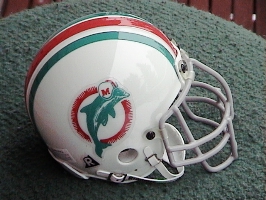
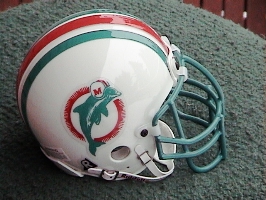
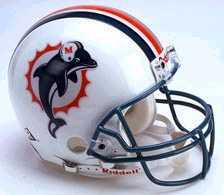
| Dolphins Helmets |
 |
 |
 |
| 1966-1972 |
| 1973-1979 |
| 1980-1996 |
 |
| 1997-Present |
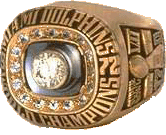
| Super Bowl VII Ring |
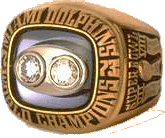
| Super Bowl VIII Ring |
 |
 |
 |