Salama Moussa
His Life and Effect on the
Future
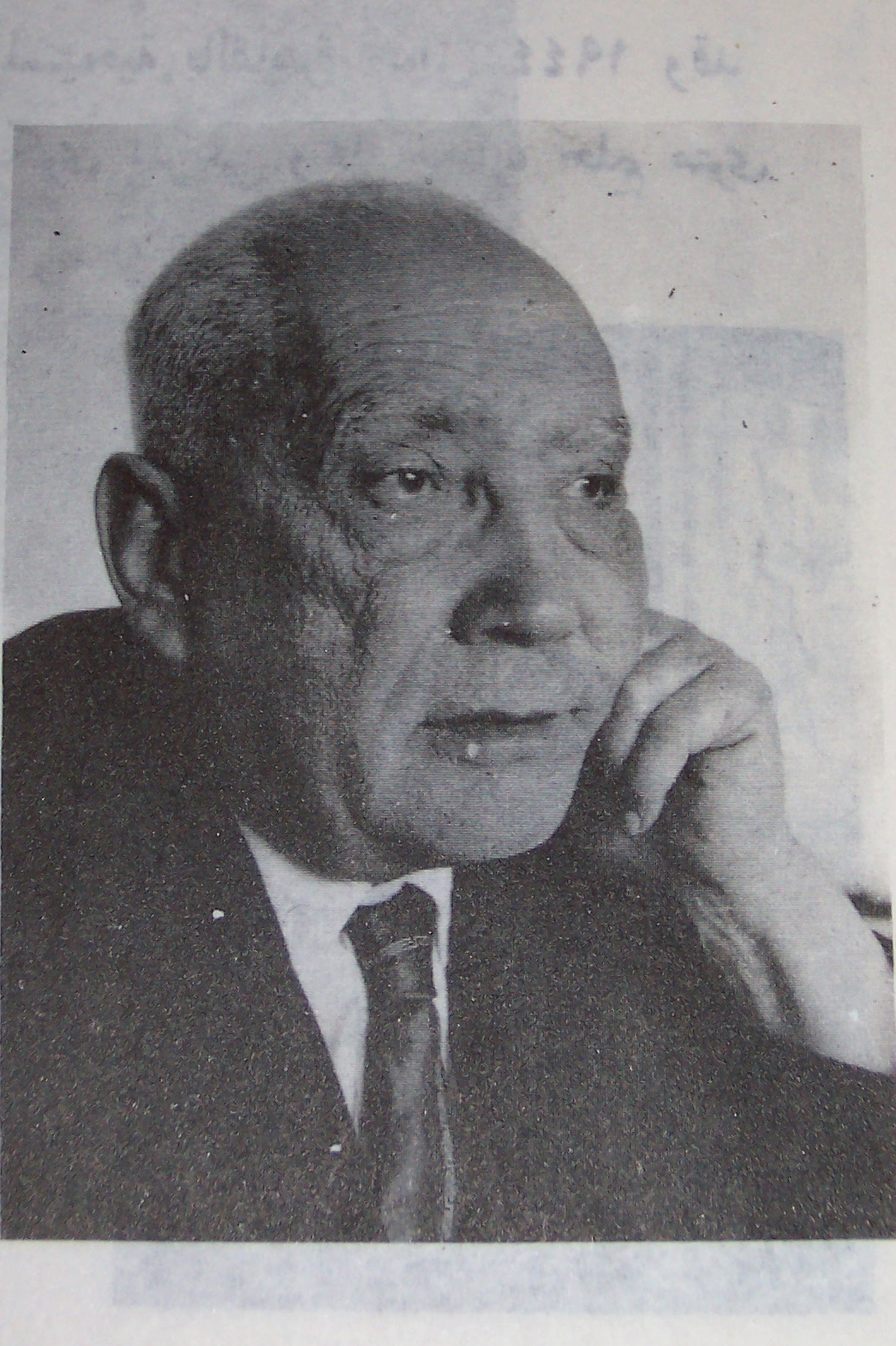
Salama Moussa, a famous literate and thinker of the Arabian World, was known for his wide interest in science and culture as well as his firm belief in the inexhaustible powers in the human intellect as a guarantee for progress and prosperity.
Salama Moussa was born in Zagazig, a small rural town approximately 60 km north-east of Cairo, in 1889. However, the date of birth cannot be proved for certain. When he was two years of age his beloved father died, and his mother was confronted with great difficulties giving her son a strict and yet a liberal upbringing. Various lucrative estates left by his father meant little consolation to his mother.
In 1908, Salama Moussa travelled to London and Paris, where he studied literature, philosophy, social and natural sciences. All his life he made critical studies of these subjects. He was an uncompromising advocate of scientific and social reforms and saw a firm basis in further developments in the society as well as in the industrial and cultural revolutions. Despite this background, he made every endeavour to keep up the Arabian identity and differentiate it from the West.
Salama Moussa was not always able to maintain his position in Egypt � an Islamic-oriented country � because he himself belonged to the Copts, a Christian minority. At that time Egypt was a colony of Britain, and the Egyptian king was a puppet of the occupying forces. Simultaneously, Salama Moussa sympathised with the cultural and industrial achievements of the European continents as well as the ideas of the Russian revolution.
Salama Moussa vehemently demanded the simplification of the Arabic language and its grammar and thus, stimulated the criticism of his conservative opposition in the Arabian World. He did not only ruthlessly criticise the manifold dialects in all Arabian countries, but also the classic Arabic because it had not been changed for generations and made the average citizens, the majority of which is illiterate, not understand it. Even today the simplification of the Arabic language is under discussion.
Salama Moussa published his first book "Introduction to Superman" by Dar Al-Hilal in 1910. In those days, it was a sensation that this publishing house � rich in tradition � printed such "a tolerant and liberal piece of work".
Further 46 books followed, however, in Arabic. As far as the author of this article knows, only few books have been translated into English (less into French and much more less into German, in spite of Salama Moussa�s admiration for this country, its culture and achievements). His most important books are listed hereafter. Even the titles of his books have not lost anything of their relevance and give the necessary information and answer possible questions on his wide spectrum of his interests as well as the development of this admirable man (in brackets years of publication):
Divine Thoughts and Their Origin 1912)
Treatise about Socialism (1913)
The Most Well-known Love Affairs in History (1925, revised and renamed "Love in History" around 1949)
Reading Matters on Elections (1926)
Dreams of a Philosopher (1926)
Freedom of Thought and Its Representatives (1927)
Secrets of the Inner Life (1927, revised in 1948)
History of Art and the Most Well-known Pieces of Work (1927)
Today and Tomorrow (1928)
Descent and Development of Mankind (1928, revised in 19523)
Stories (1939)
About Life and Culture (1930, revised and renamed in 1956: Culture and Life)
Our Duties and the Tasks of Foreign Countries (1931)
Gandhi and the Indian Revolution (1934)
Renaissance in Europe (1935, in 1962 posthumously revised and renamed "What Is Renaissance")
Egypt, a Place Where Civilization Began (1935, expanded edition in 1948)
The World in 30 Years (1936)
Modern English Culture (1936, expanded ed. in 1956)
Our Life as from 50 (1944, expanded ed. in 1956)
Freedom of Thought in Egypt (1945, this piece of work clearly shows, how much Salama Moussa was influenced by the European culture, in particular by Voltaire.)
Eloquence and the Arabic Language (1945, expanded ed. in 1953 as well as posthumously in 1964)
My and Your Intellect (1947, expanded ed. 1953)
The Years of Salama Moussa�s Apprenticeship (1947, posthumously expanded 3ed. in 19589 This piece of work is of the first renowned autobiographies of the Arabic Language Area)
The True Path of the Young People (1949)
Psychological Attempts (1953, changed to Attempts in1963)
These are My Mentors (1953, among them a very obstinate discussion on Goethe�s works, posthumously expanded ed. in 1965)
The Book of Revolutions (1955)
Psychological Studies (1956)
The Woman Is not the Plaything of the Man (1956, a very early dispute about the liberation (emancipation) of the woman at that time, especially in the orient)
George Bernhard Shaw (1957, who he has met and got to know in England, posthumously expanded ed. in 1977)
Attempts of the Young People (posthumously 1959)
Forbidden writings (posthumously 1959)
Mankind is the Pride of Creation (posthumously 1961)
The above posthumously quoted books as well as the revised editions are strongly oriented towards the writings that Salama Moussa has left to posterity. Numerous essays, newspaper articles or forum discussions with young people, a novelty in Egypt, must remain unanswered due to further analyses for the time being.
The forum discussions with young people were founded in the twenties and thirties and are an expression of curiosity, youth and his tolerance. In his eyes, the activities and discussions with young people did not only provide a stimulus to achieve goals, but also reduced acts of violence of misunderstood young people. A lot of intelligent youngsters came out of those forum discussions, such as the Nobel prize winner Nagib Machfuz.
Today Salama Moussa�s writings are more in demand in the Arabian countries than ever before. The books are brought out continuously, his universal ideas sell like hot cakes and have been represented on free, uncensored fairs such as Egypt, Bahrain, Yemen, Jordan, Kuwait, Lebanon, Morocco, or Oman since years。
The books were explicitly published in the publishing house Al Mustaqbal which is chaired and managed by the family nowadays. The name Al Mustaqbal (the future) reminds of the first Egyptian weekly newspaper (1916) the founder of which was Salama Moussa, and after only 16 editions it ceased the publication because of the pressure by the British occupiers.
At the beginning of the twenties Salama Moussa founded, together with his supporters, the socialist party in Egypt, however, it is true though, that it was forbidden immediately.
From 1923 � 1929 Salama Moussa was chief editor with Dar Al Hilal. This publishing house published his first work "The Introduction of Superman" in 1910.
In 1930 he founded the journal "Egyptian Institute of Science", which ceased the publication due to political pressure. At the beginning of 2005, this idea was taken up and realised with the monthly journal "Science Digest". The publisher is his son Dr Raouf Salama Moussa.
Around 1932 Arabian democrats, among them Salama Moussa, joint the nationalists. With liberal and market-orientated convictions, they protested peacefully against the British mandate in spite of their closeness to western ideas and achievements.
Under the influence of Gandhi, Salama Moussa called publicly on trade restrictions: Egyptians should only purchase goods from their homeland, and avoid buying British goods by all means. In the books "Our Duties and the Tasks of Foreigners" as well as "Gandhi and the Indian Revolution", he describes the road of the economic nationalism as effective means to enforce the demands of political aims. The government did not wait with the answer long: Salama Moussa was taken into custody with like-minded people, his preparedness to fight for his ideals peacefully was thus strengthened tremendously.
Within a short time in 1949, he joint the "Egyptian Peace Movement" supported by a wide population. The supporters increased and showed their deep displeasure against the poverty in the country as well as the absolutist kingdom. During the course of this year Salama Moussa had to keep away from all cultural assemblies, organisations, or events.
After the July-Revolution in 1952, Salama Moussa was working for the renowned daily newspaper Achbar Al Yom (News of the Day) as chief editor of the Department of Scientific Activities and editor of the Sunday paper.
Naturally, the future generations give serious thoughts to Salama Moussa�s subjects and writings. During his lifetime he was often accused of having a tendency to arrogance because of his consequent far-sightedness and radical changes of existing subjects and problems: He of all people, he who favoured peaceableness, tolerance, and individuality to youth and minorities.
The publishing house Al Mustaqbal, represented by his son Dr Raouf Salama Moussa, gives even today serious thoughts, also critically, to his father and the situation in the Arabian world in form and contents in books, journals, and newspaper articles. In this connection, reference should be made to the book "Salama Moussa, my Father" (1992) by his son, which was used as valuable basis by the author of this article.
Salama Moussa was the mentor of the literate Nagib Machfuz who quoted his teacher with the following words: "You have much talent, but your essays are no good. After this incident, Nagib Machfuz chose his topics more carefully.
Salama Moussa became seriously ill and died on August 4, 1958. He was convinced to be as healthy as a horse and would have loved to become 100 years old. I wonder, what he would have said to the ending of socialism, the globalisation as well as the religious terrorism of our time.
___________________________________________________________________________
[email protected]Al Mustakbal:
32 Saphia Zaghloul Street, AlexandriaAl Fagala, Kairo
Weblinks:
http://de.wikipedia.org/wiki/Salama_Moussa http://www.arabicnews.com/ansub/Daily/Day/020429/2002042929.html http://weekly.ahram.org.eg/2001/525/chrncls.htm http://egyptianchronicles.freewebsitehosting.com/CulturalCommentaries.html