Two types of acoustic noise exist in the environment. One is caused by turbulence and is totally random.Turbulent noise distributes its energy evenly across the frequency bands. It is referred to as broadband noise, and examples are the low-frequency sounds of jet planes and the impulse noise of an explosion. Another type of noise, called narrowband noise, concentrates most of its energy at specific frequencies. This type of noise is related to rotating or repetitive machines, so it is periodic or nearly periodic. Examples of narrowband noise include the noise of internal combustion engines in transportation, compressors as auxiliary power sources and in refrigerators, and vacuum pumps used to transfer bulk materials in many industries.The General Concept of Acoustic Noise Control
There are two approaches to controlling acoustic noise: passive and active. The traditional approach to acoustic noise control uses passive techniques such as enclosures, barriers, and silencers to attenuate the undesired noise. Passive silencers use either the concept of impedance change caused by a combination of baffles and tubes to silence the undesired sound (reactive silencers) or the concept of energy loss caused by sound propagation in a duct lined with sound-absorbing material to provide the silencing (resistive silencers). Reactive silencers are commonly used as mufflers on internal combustion engines, while resistive silencers are used mostly for duct-borne fan noise. These passive silencers are valued for their high attenuation over a broad frequency range. However, they are relatively large, costly, and ineffective at low frequencies, making the passive approach to noise reduction often impractical. Furthermore, these silencers often create an undesired back pressure if there is airflow in the duct.
In an effort to overcome these problems, considerable interest
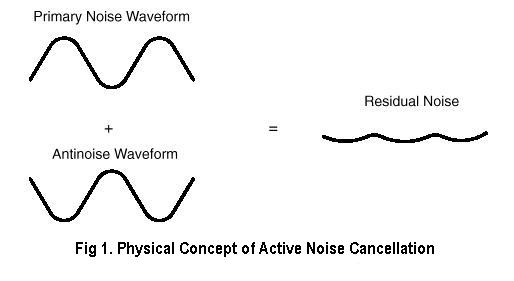
has been shown in active noise control. The active noise control system
contains an electroacoustic device that cancels the unwanted sound by generating
an antisound (antinoise) of equal amplitude and opposite phase. The original
unwanted sound and the antinoise acoustically combine, resulting
in the cancellation of both sounds. Figure 1 shows the waveforms of the
unwanted noise (the primary noise), the canceling noise (the antinoise),
and the residual noise that results when they superimpose. The effectiveness
of cancellation of the primary noise depends on the accuracy of the amplitude
and phase of the generated antinoise.