Algorithms for ANC
Broadband noise cancellation requires knowledge of the noise source (the primary noise) in order to generate the antinoise signal. The measurement of the primary noise is used as a reference input to the noise canceler. Primary noise that correlates with the reference input signal is canceled downstream of the noise generator (a loudspeaker) when phase and magnitude are correctly modeled in the digital controller.
For narrowband noise cancellation (reduction of periodic noise caused by rotational machinery), active techniques have been developed that are very effective and that do not rely on causality (having prior knowledge of the noise signal). Instead of using an input microphone, a tachometer signal provides information about the primary frequency of the noise generator. Because all of the repetitive noise occurs at harmonics of the machine’s basic rotational frequency, the control system can model these known noise frequencies and generate the antinoise signal. This type of control system is desirable in a vehicle cabin, because it will not affect vehicle warning signals, radio performance, or speech, which are not normally synchronized with the engine rotation.
Active noise control systems are based on one of two methods. Feedforward control is where a coherent reference noise input is sensed before it propagates past the canceling speaker. Feedback control is where the active noise controller attempts to cancel the noise without the benefit of an upstream reference input.
Feedforward ANC systems are the main techniques used today. Systems for feedforward ANC are further classified into two categories:
Adaptive broadband feedforward control with an acoustic input sensor
Adaptive narrowband feedforward control with a nonacoustic input sensor
The Broadband Feedforward System
A considerable amount of broadband noise is produced in ducts such as
exhaust pipes and ventilation systems. A relatively simple feedforward
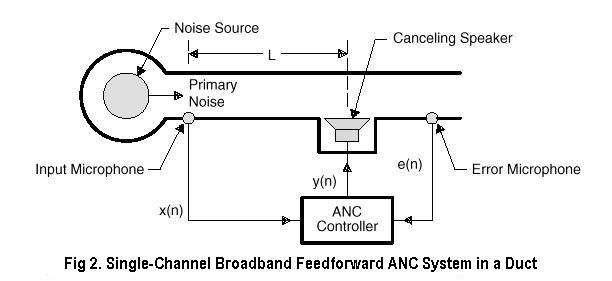
control system for a long, narrow duct is illustrated in Figure 2. A reference
signal x(n) is sensed by an input microphone close to the noise source
before it passes the loudspeaker. The noise canceler uses the reference
input signal to generate a signal y(n) of equal amplitude but 180°
out of phase. This antinoise signal is used to drive the loudspeaker to
produce a canceling sound that attenuates the primary acoustic noise in
the duct.
The basic principle of the broadband feedforward approach is that
the propagation time delay between the upstream noise sensor (input microphone)
and the active control source (speaker) offers the opportunity to electrically
reintroduce the noise at a position in the field where it will cause cancellation.
The spacing between the microphone and the loudspeaker must satisfy the
principles of causality and high coherence, meaning that the reference
must be measured early enough so that the antinoise signal can be generated
by the time the noise signal reaches the speaker. Also, the noise signal
at the speaker must be very similar to the measured noise at the input
microphone, meaning the acoustic channel cannot significantly change the
noise. The noise canceler uses the input signal to generate a signal y(n)
that is of equal amplitude and is 180° out of phase with x(n). This
noise is output to a loudspeaker and used to cancel the unwanted noise.
The error microphone measures the error (or residual) signal e(n), which is used to adapt the filter coefficients to minimize this error. The use of a downstream error signal to adjust the adaptive filter coefficients does not constitute feedback, because the error signal is not compared to the reference input.
Actual implementations require additional considerations to handle acoustic
effects in the duct.
The Narrowband Feedforward System
In applications where the primary noise is periodic (or nearly periodic) and is produced by rotating or reciprocating machines, the input microphone can be replaced by a nonacoustic sensor such as a tachometer, an accelerometer, or an optical sensor.
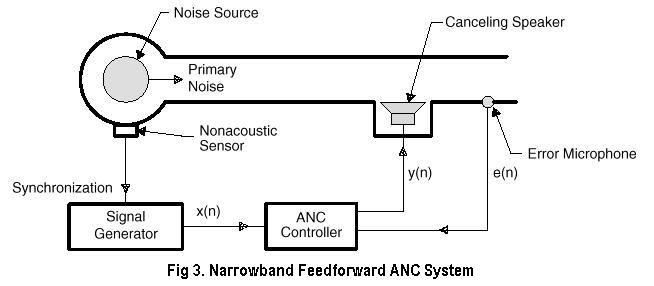
The block diagram of a narrowband feedforward active noise control system
is shown in Figure 3. The nonacoustic sensor signal is synchronous with
the noise source and is used to simulate an input signal that contains
the fundamental frequency and all the harmonics of the primary noise. This
type of system controls harmonic noises by adaptively filtering the synthesized
reference signal to produce a canceling signal. In many cars, trucks, earth
moving vehicles, etc., the revolutions per minute (RPM) signal is available
and can be used as the reference signal. An error microphone is still required
to measure the residual acoustic noise. This error signal is then used
to adjust the coefficients of the adaptive filter.
Generally, the advantage of narrowband ANC systems is that the nonacoustic
sensors are insensitive to the canceling sound, leading to very robust
control systems. Specifically, this technique has the following advantages:
Environmental and aging problems of the input microphone are automatically eliminated. This is especially important from the engineering viewpoint, because it is difficult to sense the reference noise in high temperatures and in turbulent gas ducts like an engine exhaust system.
The periodicity of the noise enables the causality constraint to be removed. The noise waveform frequency content is constant. Only adjustments for phase and magnitude are required. This results in more flexible positioning of the canceling speaker and allows longer delays to be introduced by the controller.
The use of a controller-generated reference signal has the advantage of selective cancellation; that is, it has the ability to control each harmonic independently.
It is necessary to model only the part of the acoustic plant transfer function relating to the harmonic tones. A lower-order FIR filter can be used, making the active periodic noise control system more computationally efficient.
The undesired acoustic feedback from the canceling speaker to the input
microphone is avoided.
The Feedback ANC System
Feedback active noise control was proposed by Olson and May in 1953.
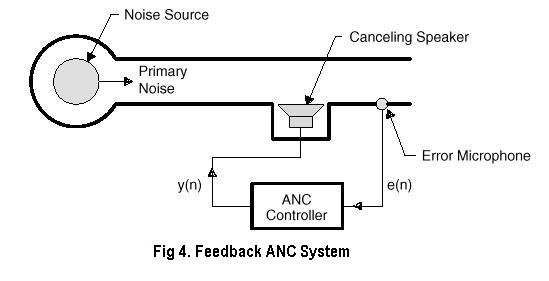
In this scheme, a microphone is used as an error sensor to detect the undesired
noise. The error sensor signal is returned through an amplifier (electronic
filter) with magnitude and phase response designed to produce cancellation
at the sensor via a loudspeaker located near the microphone. This configuration
provides only limited attenuation over a restricted frequency range for
periodic or band-limited noise. It also suffers from instability, because
of the possibility of positive feedback at high frequencies. However, due
to the predictable nature of the narrowband signals, a more robust system
that uses the error sensor’s output to predict the reference input has
been developed (see Figure 4). The regenerated reference input is combined
with the narrowband feedforward active noise control system.
One of the applications of feedback ANC recognized by Olson is controlling the sound field in headphones and hearing protectors. In this application, a system reduces the pressure fluctuations in the cavity close to a listener’s ear. This application has been developed and made commercially available.