|
Their Majesties' First Visit
to Israel |
||
| EILAT, Israel --
Jordan's new king on Sunday paid his first state visit to Israel,
underplaying the pomp and ceremony in a pointed reference to the
precarious state of Israeli-Palestinian peace talks.
King Abdullah II eschewed a high-profile reception for the visit, which had been scheduled for February but was delayed due to escalated fighting between Israel and Lebanese guerrillas. At his insistence, he met Prime Minister Ehud Barak for a scant four hours in Eilat, a southern Red Sea resort remote from Israel's bustling center. The young king, whose country concluded a peace agreement with Israel in 1994, made it clear that the collapsed talks with Syria and the troubled Palestinian track were making it harder for him to maintain warm ties. The concept of trading land for peace, he reminded Barak in his opening remarks, "has been accepted by all parties since 1991 and must continue to guide us." The Palestinians say Israel is not offering them enough of the West Bank, and Syria wants a prior commitment that Israel will return the disputed Golan Heights. Barak says he first wants to see the security arrangements the Syrians have to offer. Since taking power in March of last year, Abdullah has tried to restore Jordan's ties with the Arabs, strained by his late father King Hussein's pronounced pro-Western outlook. On Sunday, Barak appeared sensitive to his guest's position, and avoided pressing demands for warmer ties. "We are aware that social and economic processes are by definition slow and require determination and perseverance," he said. But some of Barak's ministers said they wished Abdullah would do more to warm up what has become Israel's showcase relationship with an Arab neighbor. "We wish it had been sooner," Regional Cooperation Minister Shimon Peres said of the visit, noting that Abdullah had waited more than a year since his coronation. He added: "We wish it were in Jerusalem." Abdullah said the circumstances had not been right while tensions were flaring. "I didn't want our visit to Israel to be used in such a way that it didn't promote peace," he said. Still, the sides radiated friendliness. Abdullah twice referred to Eilat as a "beautiful city." He and Barak discussed plans for an international airport that would serve Eilat and its Jordanian sister city, Aqaba. Barak's trade minister, Ran Cohen, met with his Jordanian counterpart during Sunday's mini-summit, and later announced that the countries agreed to launch free-trade zone negotiations. However, the king at the last minute chose not to bring business leaders along with him -- apparently further evidence of his efforts to downplay the importance of the visit. The king, who has served as a mediator between Israel and Syria, insisted that the prospect of renewed talks were not as bleak as recently portrayed by Barak, who has said that "the door is open, but only a crack." "We're on the threshold of a new beginning here in the Middle East, not only the Palestinian track, but the Syrian track," Abdullah told Israel television. Now that the Israeli-Palestinian talks are back on track -- with a third round starting in Eilat next Sunday -- the sides sounded upbeat. Still, the sides remain far apart, even on procedural issues. Palestinian leader Yasser Arafat insisted that the outline of a permanent agreement must be in place by the current May deadline. But Barak said he anticipated it would take "two to three months" to achieve the outline of an agreement. The difference is not just academic: delaying the outline of an agreement until June or July jeopardizes the Sept. 13 deadline for a full-fledged agreement. Arafat has promised the Palestinians their long-awaited statehood by then. If he misses the deadline -- it won't be the first time -- it would seriously undermine his credibility among the Palestinians. The sides remain apart on territorial issues as well. Barak's minister in charge of Jerusalem affairs, Haim Ramon, suggested Sunday that the future of Jerusalem -- one of the touchiest facing negotiators -- would not be settled this year, and should be left for a later date, along with the status of about 20 percent of West Bank territory. The Palestinians reject such compromises out of hand, demanding a
full agreement by September. |
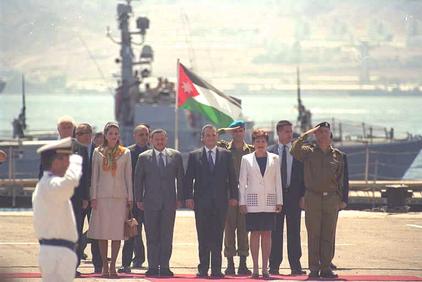 Reception ceremony for their majesties upon their arrival to the Israeli port city of Eilat |
|
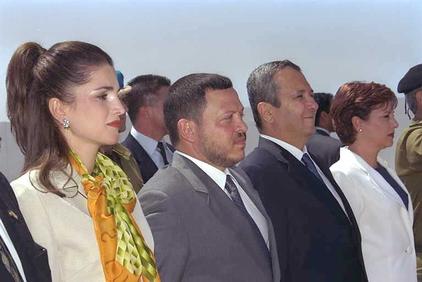 Reception ceremony L to R: Queen Rania, King Abdullah, Israeli Prime Minister Ehud Barak and his wife, Nava |
||
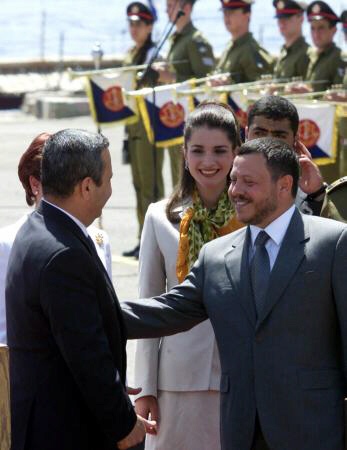 King Abdullah and Queen Rania greet the Israeli Prime Minister |
||
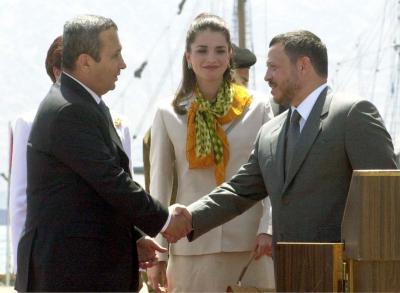 Prime MInister Barak and King Abdullah shake hands as their wives look on |
||
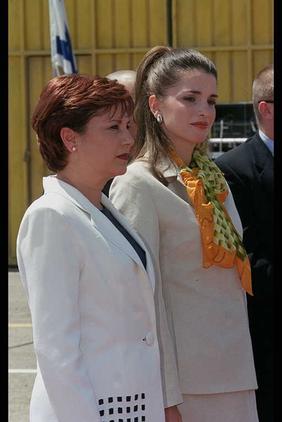 Her Majesty Queen Rania and the Prime Minister's wife, Nava Barak
|
||
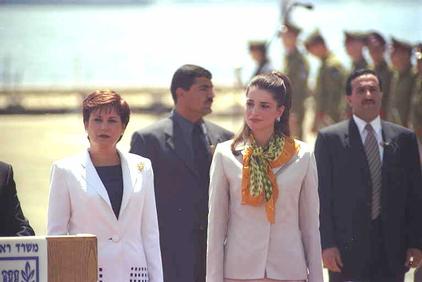 Another photo of Her Majesty and Mrs. Barak |
||
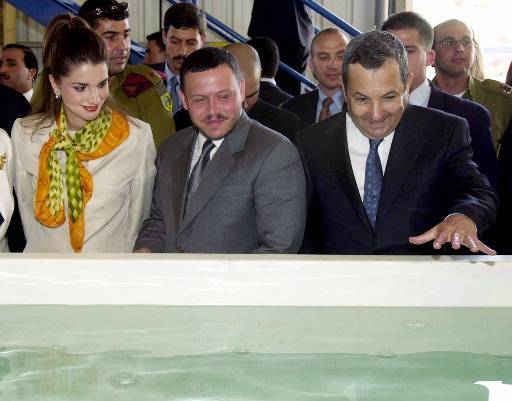 Prime Minister Barak and his wife, Nava, accompany King Abdullah and Queen Rania on a visit to an Eilat fish farm |
||
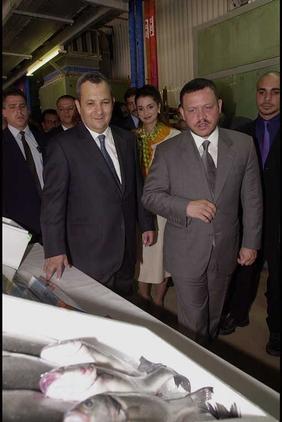 Prime MInister Barak and King Abdullah followed by Queen Rania |
||
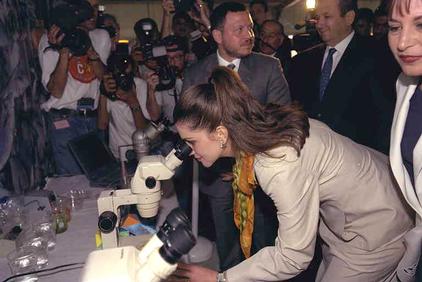 Queen Rania peers through a microscope at the Eilat fish farm |