Helpful Spray Finishing Hints & Problem Solving
1.Paint Preparation
Always prepare paint in a clean, dust-free enviroment. Paint has a remarkable
ability to pick up dirt. Dirty paint will not only clog your spray gun, but it
will also ruin your paint job. Get in the habit of always pouring paint into the
cup or tank through a paint strainer.
2.How should the air cap be cleaned?
Remove the air cap from the gun and immerse it in clean solvent. If necessary,
use a bristle brush to clean dried paint. Blow it dry with compressed air.
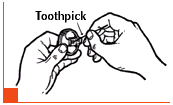
If the small holes become clogged, soak the cap in clean solvent. If reaming the
holes is necessary, use a toothpick, a broom straw, or some other soft
implement.
Cleaning holes with a wire, a nail or a similar hard object could permanently
damage the cap by enlarging the jets, resulting in a defective spray pattern.
3. What parts of the spray gun require lubrication?
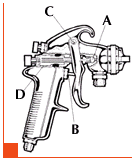
The fluid needle packing A, the air valve packing B and the
trigger bearing screw C require daily lubrication with a
non-silicone/non-petroleum gun lube.
The Fluid needle spring D should be coated lightly with petroleum jelly
or a non-silicone grease (ie. Lithium).
Lubricate each of these points after every cleaning in a gun washer.
4. Why is air control equipment necessary?
Raw air, piped directly from an air source to a spray gun, is of little use in
spray finishing. Raw air contains small, but harmful quantities of water, oil,
dirt and other contaminants that will alter the quality of the sprayed finish.
Air filters filter out these contaminants before they get on your paint job. Air
entering the filter is swirled to remove moisture that collects in the baffled
quiet zone. Accumulated liquid is carried away through either a manual or
automatic drain.
5. What causes excessive pressure drop on the main line gauge of the
filter/regulator?