Sridhar's
The Central Rice Research Institute is one of the three (India, Indonesia and the Philippines) founder members of the Asian Rice Biotechnology Network coordinated by the International Rice Research Institute (IRRI) with funds from the Asian Rice Biotechnology Network and support from the German Federal Ministry for Technical Cooperation (BMZ) and the Rockefeller Foundation.
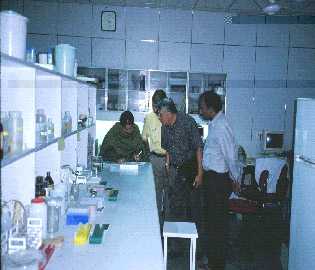 <<
Molecular Plant Pathology Laboratory at CRRI.
<<
Molecular Plant Pathology Laboratory at CRRI. The programme at the Central Rice Research Institute (CRRI) started off with the training of three scientists at IRRI during September-October 1993. Soon a Molecular Plant Pathology Laboratory (MPPL) began at CRRI with the installation of a temporary working laboratory which became fully functional in September 1996. As bacterial blight and blast are the major constraints for rice production in rainfed and irrigated environments, our priorities targeted at these two diseases.
Although fungicides are available for controlling blast of rice, it is quite expensive for the Asian farmers. Presently, no chemical control measure is available for bacterial blight. Growing resistant varieties is not only economical for minimizing the losses caused by the diseases, but it is also an environment friendly method.
Blast and bacterial blight pathogens are highly variable and their variability is influenced by crop varieties. It is not unusual often to encounter breakdown of resistance in cultivars. For effective deployment of resistance genes in different localities, knowledge on the pathogen population structure occurring in a particular area, usefulness of known disease resistance genes and an effective, precise method of selection of the breeding material are essential.
- Characterization of the population structure of bacterial blight and blast pathogens occurring in India.
- To develop varieties durably resistant to these pathogens using molecular techniques.
- How variable is the pathogen population?
- What are the phylogenetic relationships among pathogen groups/lineages?
- How are the pathogen groups/lineages distributed in time and space?
- What is the relationship between the lineages and virulence (pathotype)?
- Use of DNA marker technology for marker-aided pyramiding of bacterial blight and blast resistance genes in popular rice varieties.