
Sector 001 Starfleet Database
Weapons/Quantum Torpedos
| Introduced in the late 2360s, the quantum
torpedo was part of the range of projects which formed Starfleet’s
response to the threats represented by the Borg and renewed activity
by the Romulans. Although there is no theoretical upper limit on the
size of a matter/antimatter torpedo warhead - the Cardassian
‘Dreadnought’ type heavy penetrator carries a two thousand
kilogram m/am warhead for example - warheads beyond the 25 isoton
range tend to be too large and heavy for use as truly effective
anti-ship weapons. Starfleet wanted to develop a warhead which offered
firepower in the 50+ isoton range without penalising the agility of
the weapon.
Starfleet R&D quickly decided to focus on a zero point energy system. Initial testing yielded a negative energy balance – it took more energy to initiate the zero point reaction than that reaction generated in turn. This problem was eventually surmounted and a 52.3 isoton quantum warhead was detonated at the Groombridge 273-2A facility. The device works by generating an eleven dimensional space time membrane which is twisted into a string similar in structure to a superstring. This process calls large numbers of subatomic particles into existence, liberating correspondingly large amounts of energy in the form of an explosion. The production torpedo is of similar size to the standard photon torpedo and is made of a shell of densified tritanium and duranium foam coated in an ablative layer and an antiradiation polymer coating. Great attention has been paid to making the weapon stealthy in operation by minimising the number of penetrations through the casing and by treating those which have been made. The warhead itself comprises a zero-point field reaction chamber, which is formed from a teardrop shaped crystal of rodinium ditellenite jacketed with synthetic neutronium and dilithium. A zero-point initiator is attached to this; the initiator is made of an EM rectifier, a wave guide bundle, a subspace field amplifier, and a continuum distortion emitter. The emitter creates the actual pinch field from a conical spike 10-16 meters across at the tip. The zero-point initiator is powered by the detonation of an uprated photon torpedo warhead with a yield of 21.8 isotons. The m/am reaction occurs at four times the rate of a standard warhead; the detonation energy is channelled through the initiator within 10-7 seconds and energizes the emitter, which imparts a tension force upon the vacuum domain. As the vacuum membrane expands over a period of 10-4 seconds, an energy potential equivalent to at least 50 isotons is created. This energy is held by the chamber for 10-8 seconds and is then released by the controlled failure of the chamber wall. The propulsion and guidance systems of the quantum torpedo also represent improvements over the standard photon. The computer system is based around bio-neural gel packs, allowing more efficient data processing and so improved guidance capability. Fabrication of the quantum torpedo initially proved difficult,
since they contain many parts which are non replicatable. As a result
the quantum torpedo was issued to relatively few vessels. Over time
this problem has gradually been overcome, and the quantum torpedo is
now becoming available on a much wider scale. The Cardassians were almost certainly working on creating uprated quantum torpedoes similar to Starfleet's weapon, but during the war with the Klingons many of their main weapons research and production centres were destroyed, most with the loss of all personnel. Although details are unclear, this seems to have all but eliminated the Cardassian's ability to fabricate these weapons. Certainly the Dominion showed no signs of using quantum torpedoes during their war with the Federation. Most quantum torpedo launchers are simple modifications of photon launchers. The first model introduced on the Defiant was a quantum version of the Pulse fire torpedo tube, which can fire an average of one torpedo per second. The Sovereign class introduced a quantum burst fire tube - a variant on the type 4 photon burst fire model capable of launching a dozen torpedoes simultaneously. Also introduced on the Sovereign class is the rapid fire turret; this allows torpedoes to be fired directly at a target, rather than having to manoeuvre toward it after launch - a measure which cuts down the torpedo flight time against targets at short range. The Sovereign turret is capable of firing four torpedoes per second, a rate of fire higher than any other model of torpedo tube in service.
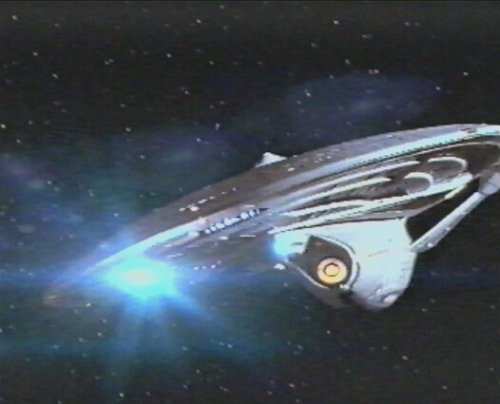
The USS Enterprise-E fires a volley of Quantum
torpedoes from her
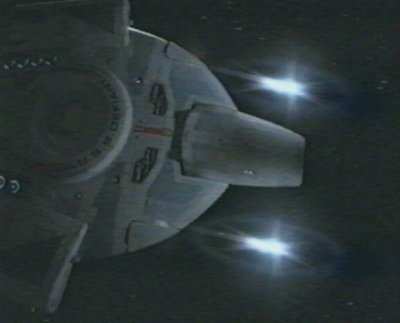
Defiant launches a pair of Quantum torpedoes. The
Defiant served
|
|