
Sector 001 Starfleet Database
Weapons/Phasers
| The phaser is the standard Federation beam
weapon system. This type of weapon came into common use c.2255,
replacing the laser weapons then in service. Phaser is an acronym for
PHASed Energy Rectification, a term which referred to the original
process by which stored or supplied energy was converted to another
form for release toward the target without any need for an
intermediate energy transformation. Although this term is something of
a holdover, it remains true in modern phaser systems.
Phaser energy is released by the rapid nadion effect. Rapid nadions are short lived subatomic particles which can liberate and transfer strong nuclear forces within a class of crystals called fushigi-no-umi. Phasers have three distinct effects on the target. At low power settings - setting 1 to 3 on a hand phaser - the impact of phaser energy is almost wholly limited to simple electromagnetic and mild thermal effects. These are concentrated on the nervous system of the target, causing pain and/or unconsciousness in most beings. At higher levels the thermal effect becomes prevalent, and the phaser will begin to cause physical damage to the target resulting in moderate or severe injuries. By the time the power level is at setting 7 the energy is distributed equally between thermal and nuclear disruption energy. Disruption effects become widespread, resulting in immediate death to most Humanoid life forms. At levels higher than 7 the majority of phaser energy is in the form of nuclear disruption. A large portion of the target is simultaneously vaporized and transitioned out of the continuum, a process which is instantly fatal. The higher power settings available with Type 3 phasers (setting 9+) cause severe damage over a wide area. These settings are rarely used because of the relatively high power consumption; a single setting 10 discharge uses more than twenty five times as much energy as a setting 7 discharge, while a setting 16 discharge uses over three hundred and fifteen times as much. Starfleet has used many models of phaser over the years, but all fall into distinct Types. Each of which represents a general classification of the energy the weapon is capable of releasing. The type of a phaser apparently does NOT refer to or limit its rate of fire or other factors. Most smaller phaser weapons are deployed in single emitters, also
known as a 'phaser bank'. Larger and more modern weapons group many
emitters into linear arrays. These use force coupling to allow the
energy of one emitter to be transferred almost instantly to another -
a process which can be repeated along arrays of almost limitless size.
This confers many major advantages : it allows a large group of
emitters to discharge their combined energy from any single emitter in
the array. This allows longer sustained beams to be fired, and greatly
reduces the recharge and cooling time since the energy is spread over
many emitters. In addition, redundant feeds to small groups of
emitters within the array increase the systems resistance to battle
damage since destroying part of the array will not disable the
remaining emitters. A long array can also bring the whole firepower of
every emitter to bear within one single beam - a vessel equipped with
many separate phaser banks must combine separate beams to accomplish
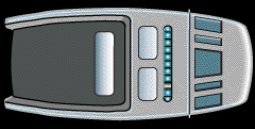
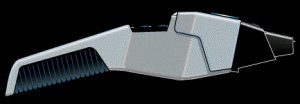
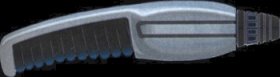
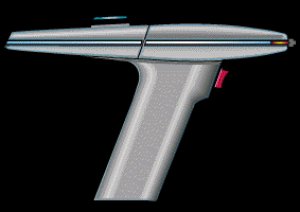
this, something which the firing arcs of the weapons may not allow. These are small hand units, approximately the size of a pack of cards. They can fire up to Setting 8, which causes total vaporization of humanoids as 50% of affected matter transitions out of the continuum.
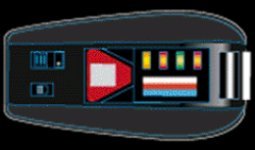
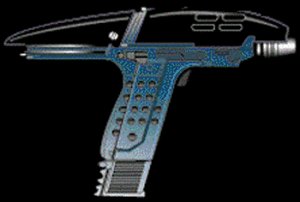
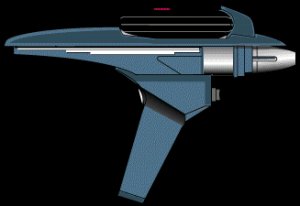
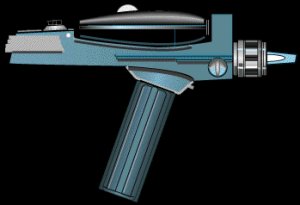
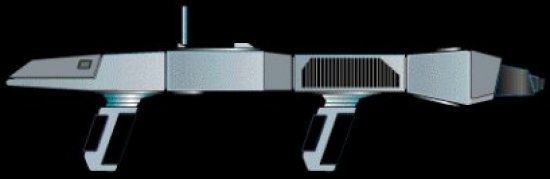
These are larger hand units. Early models of the type 2 phaser used a type 1 phaser clipped into a pistol grip, but modern weapons seem to have little in common with the smaller model. The modern type 2 phaser can fire up to setting 16, which causes the destruction of some 3,900 metric tons of rock per 0.28 second discharge.
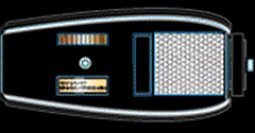
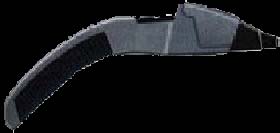
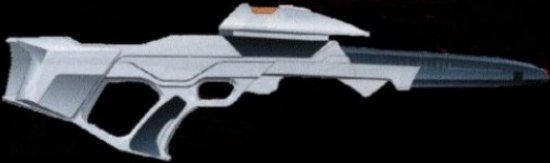
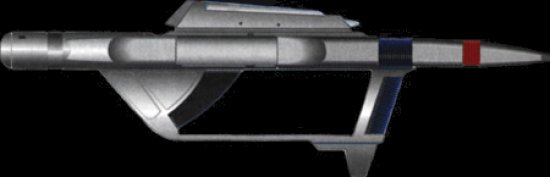
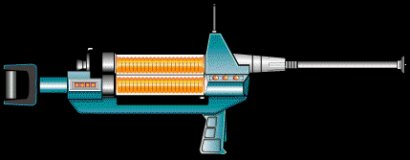
The type 3 is a rifle version of the type 2 phaser. It uses a nearly identical "business end" as the type 2, and is also capable of firing to setting 16. The advantages of the type 2 are a 50% greater energy reserve, a multiple target acquisition system and a gyrostabilizer system. Recently the standard type 3 phaser rifle has apparently received the same advanced targeting system as the Heavy phaser rifle. Compression Phaser Rifle : When the Dominion threat became urgent in late 2370, Starfleet decided to issue its forces with a new class of heavy rifles to increase the firepower available to them. The Modern Phaser Rifle project would evaluate two competing designs, the Heavy phaser rifle and the Compression phaser rifle. Both would be rushed into service as fast as possible. The Compression rifle concentrated on simplicity. The LiCu 521 discharge crystal was doped with arsenic atoms and trisilinate molecules in order to restrict the phaser energy discharge. The doping materials diverted a small part of the discharging energy to re-establish the charge barrier between the discharge crystal and the Sarium kelleride power crystal, limiting or compressing the beam to a maximum of 200 picoseconds of firing. This would fire the entire energy discharge in a beam of only 6 centimetres length, greatly increasing the intensity of the energy and so enhancing the effect on the target. Although it was by far the simpler of the two weapons, great difficulties were encountered during the development of the compression rifle. Most of these centred around thermal damage to the discharge crystal resulting from the very high energy intensities flowing through it. Average firing lifetime of an emitter crystal in the first model developed was only 9.6 nanoseconds - 48 discharges - a far from acceptable figure. Redesign of the shape of the emitter boosted this figure to 28 nanoseconds, still not sufficient for a field weapon. The solution arrived at was to install two high capacity cooling systems, one mounted on either side of the rifle. This boosted the emitter crystals lifetime to 600 nanoseconds, or 3,000 discharges. Starfleet deemed this just about acceptable and rushed the compression rifle into limited service. The weapon was never satisfactory - although the cooling systems worked reasonably well they made the weapon heavy and difficult to use properly at long ranges. The emitter crystal was also rather sensitive to adverse environmental conditions, and if not treated carefully cracking could occur - a breakdown which would lead to a thermal explosion on the next discharge. Although it was issued to some ground forces units and to the four units of the Intrepid class Starship then in service, several thermal explosion accidents forced Starfleet to withdraw the compression rifle shortly after it entered service in 2371. None now remain in use. Heavy Phaser Rifle : The heavy phaser rifle was to be a much larger, more sophisticated weapon than its compression rifle rival. It is capable of firing phaser energy in either beams or pulses of variable length. Rather than tamper with the materials in the discharge crystal, the design team built a small isolinear artificial intelligence unit into the rifle which had complete control of the energy discharge. This approach met with considerable success in a testing program that was surprisingly free of difficulties. The use of a computer control system also allows the beam characteristics to be modified much more easily than in previous phaser rifles, a measure clearly important when dealing with the Borg. The heavy rifle also includes a much more effective and elaborate targeting system, a more powerful gyrostabilizer, and a larger energy reserve. The rifle can fire to a maximum of Setting 18. The targeting unit is now being retro-fitted into earlier models of phaser rifle. The first model of heavy phaser rifle had a duranium alloy metal stiffening to the barrel, but in service this has proved to be unnecessary and a subsequent model was issued without this feature.
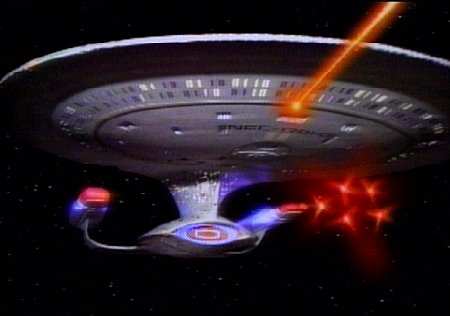
The USS Enterprise-D demonstrates the power of a Type 10 Phaser
array.
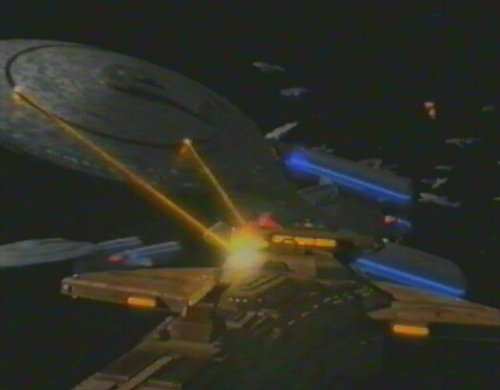
Here the Enterprise-D uses her main Type 10 array during her second
encounter
Each of the Type 10 phaser arrays of the Galaxy class can fire
single or multiple beams, Previously designated as the 'Type 10+' for security reasons, the Type 12 phaser has been used in dedicated planetary defence arrays and as the main armament of heavy fortified starbases since 2363. It was considered that the Type 12 was unsuitable for use on a starship platform because the energy requirements of the array where too high and the supporting hardware too bulky. However, by 2368 the power plant of the Sovereign class had grown large enough to support Type 12 arrays in place of the planned Type 10 models; technical improvements had also allowed for considerable shrinkage in the size of the equipment. The main phaser armament of the new Sovereign class starship therefore comprises Type 12 phaser arrays as does the armament of the Prometheus class currently under development. These are the most powerful phaser weapons currently in use by the Federation.
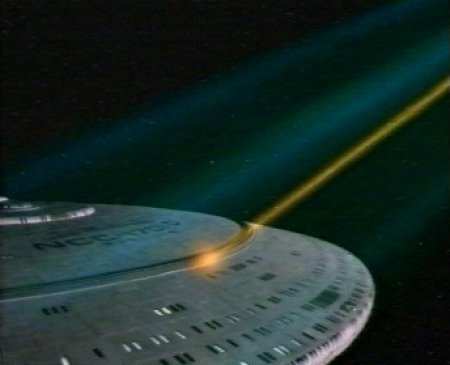
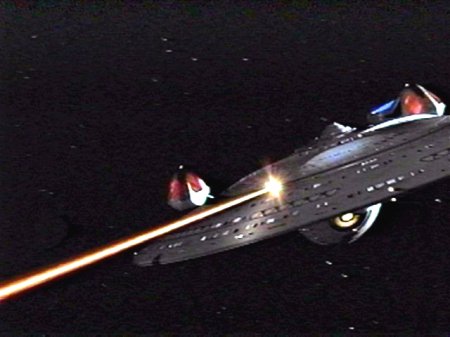
The USS Enterprise-E fires her main Type 12 Phaser array. The type
twelve was It has long been recognized that the initial impact of a phaser strike on a shield system is the most damaging part of the firing sequence. Many cultures have sought to increase weapon effectiveness against shields by developing pulse cannon - that is, weapons which fire large numbers of tightly packaged bursts rather than a continuous stream. Early Federation vessels such as the Constitution class where equipped with such pulse cannon, but the weapon is not without its drawbacks; the hardware involved tends to be very difficult to manage precisely, resulting in much poorer control over the beam characteristics. The Federations starship design ethic has always stressed that full control must be maintained over all weapons at all times, in order to allow non lethal force to be used in starship combat situations; in addition, many scientific experiments use weapon systems to apply energy in controlled amounts to external phenomena in order to study reactions. Given this, the Federation gradually moved away from pulse cannon. The refit given to the Constitutions in the 2270's removed the pulse firing feature from that class, equipping them with a 'rapid burst mode' which was something of a compromise between pulse and continuous phaser beams. Further designs continued to de-emphasize the pulse firing feature, although all basic phaser hardware is capable of firing relatively short bursts and this has remained a feature of Federation combat tactics. With the development of the USS Defiant, the pulse phaser cannon was finally reintroduced to Starfleet. Defiant is a warship, pure and simple; her designers had no real interest in conducting experiments, and the attitude towards the level of lethality of her armament could perhaps best be summed up by the phrase 'take no prisoners'! Defiants main armament comprises four heavy pulse cannon which fire very tightly confined bursts of phaser energy for maximum impact on shielding systems. High overall energy delivered over a very short period combines with a high firing rate to produce a performance against modern shield systems which can best be described as devastating. On her first active mission the Defiant faced a group of Dominion
Attack Ships; these vessels had successfully withstood several minutes
of fire fighting with a Galaxy cass starship, but Defiants phaser
cannon cut through their shields within moments. Subsequent combat
experience has shown the value of this weapons system, which is
currently being developed for use in other vessels.
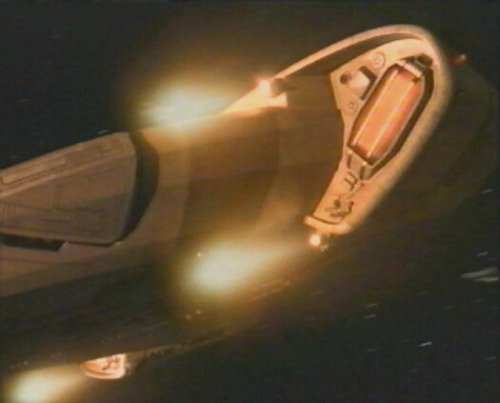
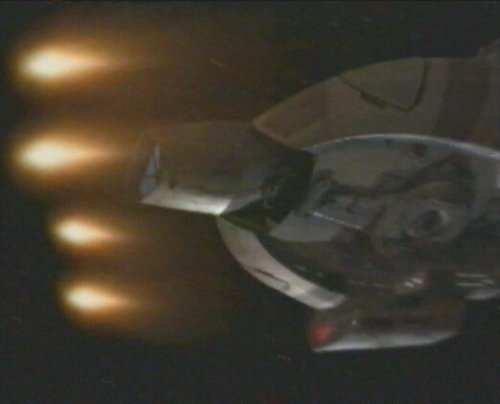
The USS Defiant fires a volley from her pulse phaser canon.
The Defiants pulse phaser armament is so far unique among
Federation Starships.
|
|