Welcome to RAmon NAvarro's HAP-KI-DO PANAMA and be blessed.
Just to clear out the meaning of this pages name RANA: The name to the Teacher/SabomNim and 4th Dan RA-mon NA-varro.
He has been in the Martial Arts for 47 years and has been teaching the martial arts around 34 years and have; Black-Belts in Tae-Kwon-Do (December-1971), Tang-Soo-Do(July-1975) and been teaching SongMooKwan HapKiDo for 30 years, a direct student under Grand Master Park, SongIL 9th DAN (a direct student of Grand Master and HapKiDo - founder Mr. Ji, Han-Jae).
Mr. RANA also was Master Park�s (back then 7th Dan-1977 now 9th Dan) assistant for 13 and a half years. Now, independent for the past 17 years is the first student of Grand Master Park with his own Academy or school/Do-Jang which is the 'Academia DE Hap-Ki-Do: Song Moo Kwan at Jose A. Arango Ave. in Marcasa Urbanization at the Los Alamos Building, Local #5 in front of the 99 Supermarket from Plaza Carolina Panama, is an affiliated member to the 'Panama HapKiDo Association' or 'Asociaci�n Paname�a de HapKiDo'
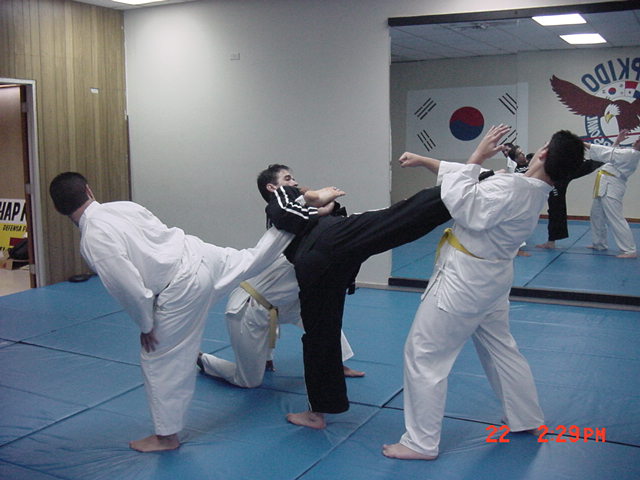
Hap-Ki-Do is a Korean Martial Art witch embodies exercises that specialize in Flexibility and stretching, all types of Kicks even flying plus special ones. Defensive and Offensive hand movements and techniques. Falls-Rolls with Acrobatic movements with Self-Defense applications and Combat sparring.
Weapons training from Red Belt level up.
G/m PARK having 2 Academies and directs the Association in our country
as Technical-Director and the new director for the Korea HapKiDo Federation in Latin America. Here in Panama there are 3 schools authorized to teach HapKiDo and the 3rd one belongs to 4th Dan Master: Ramon Navarro.
Panama is a Latin American Country in Central America and we have the Panama Canal.
Any one is welcome to train in our Academy, even with previous experience.
Classes are for all gender, age and sexes.
Class schedules are from Monday to Saturday. Groups are for 5 days or 3 days a week.
Children ages 4 to 12 from 4pm to 5pm on Monday, wednesday and Friday.
Youth ages from 13 up are from 5:30pm - 6:30pm from monday until friday.
Adult 7pm - 8:30pm and.
Our phone # (507) 233 0296
Celular Phone # (507) 6669 0927
Our E-mail: [email protected]
And
[email protected]
NOTE HapKiDo: Song Moo Kwan Academy is located at Jose A Arango Ave. in the Los Alamos building, Place #5 at Marcasa Urbanization.
Coming Activities:
1) Regular class and the spreading of flyers to promote our Dojang for the 2008 Summer Classes.
2) New student can join, be welcome to your new self defense classes, just come in!
3) We at HapKiDo: SongMooKwan Academy have on the Last Saturday of each month what we call: Friendship Day Classes and this will be at 2:00pm until 4:00pm on Saturday, December 29 were all our students can invite a friend for trial class at no compromise and cost thought with the condition that after this trial class they be sincere and let us know if they will join the group.
4. Testing for color belts will be on the month of December 2007.
'HAP'
Short Biography of SabomNim
SabomNim RANA or RAmon NAvarro 4th Dan Black Belt, was born on July 9, 1953 in the country of Panama and in Panama City. He started the martial arts with Judo in first grade on 1960 (for a couple of month) then Karate in 1961 (for a month and a half) and for the rest of his elementary school he did wrestling.
At high school in the a military school from the 1966/67 school year in the USA for 6 years were he got his TaeKwonDo Black Belt in December 1971. When returning to his country in 1972 there was no TaeKwonDo in Panama but found a TangSooDo school that he joined in November 1974 were he got his Midnight Blue Belt (equivalent of Black Belt in this art) in July 1975 under Master IV Dan (now V Dan) Prospero Manuel Ellis and Master Ramon Navarro joined Master Park (7th Dan Back then, now 9th Dan) and been teaching Song Moo Kwan HapKiDo now for 29 years. Master Ramon Navarro holds a 4th Dan under Grand Master Park, SongIL. Master Ramon Navarro is the student to Master Park whom as his assistant and the one in charge of the Song Moo HapKiDo Internationals growth.
'HAP'
HAPKIDO a Brief History
HapKiDo; The Korean martial art of self defense is not a sport thought it is very competitive. It is a very healthy activity. HapKiDo is made for one to be able to counter any attack that arises. It is a very versatile self-defense system. It includes all types of kicks, falls, blocks, punches, holds and well encompassed for real life. It is very widespread around the world being a relatively young martial art even thought it has very ancient roots.
HapKiDo is a new name to the martial arts world even with an earlier name and nicknames, for example: YuSul, PiSul, HoSinSul, KwonBop and Yawara (as it was its nicknamed when it came to Korea; Corea, as it is more commonly known, is an incorrect pronunciation for it to be a name therefore we will use the K for Korea not the C for Corea). It was introduced to Korea after WWII ended by a man that in his very youth, age of 9 was taken as an adopted son to an influential, wealthy and very respected person in Japan. Master Choi lived, worked and helped the man for whom it is Mr. Takeda, Sogaku the inheritor of a martial art from Japan that was very well respected there. This kid was Mr. Choi, YongSul for whom we are very gracious about his taken decision that Mr. Takeda offered which was 'I will soon die and since you were young you always wanted to have the opportunity to go back to your country and this are very turbulent times it be better if you take advantage and go there; You are a free man!'.
Because of this he had the opportunity of having HapKiDo for us today.
Today we have the name HapKiDo as it was shortened by Mr. Ji, HanJae (10th Dan and known as the father of modern HapKiDo and a direct student of Mr. Choi). At first when it arrived Korea it was Called 'DaeDong Ryu HapKi Yu Sul' from the translation of 'Daito Ryu Aikijujitsu' and nicknamed Yawara: the reason why it was changed was because it was a Japanese martial arts name and the Korean people did not like it because of all the wrong doing by the Japanese during the nearly 40 years of invasion. So it was called HapKi Yu Sul but the problem was that it would be confused with Judo so the word 'fist' or 'Kwon' was added and it became 'HapKi Yu Kwon Sul'.
Before this in time, HapKiDo in Japan can be traced back to around 1,100Ad and in Korea it can be traced back to the three kingdom era wish were: Koguryo, Paekche and SilLa
(This is another story that will be added sometime soon) and from here on back can be traced to the first kingdom of Korea, the 'Ko-ChoSun' from wish the legendary mythical figure known to be the Korean race's Father: Dan Gun comes from (this is another tale, also to be told at another time).
Again, back to the early present, HapKiDo, Yu Sul. Mr. Choi at one time had a kid neighbor whose age was 13 and his name was Mr. Ji, HanJae who was the person for whom the name HapKiDo can be accredited for is known to be Modern HapKiDo Father. He, Mr. Ji, started HapKiDo in 1949 and was the one whom thought that the name HapKi Yu Kwon Sul was to long and seens he had seen other arts using the word Do witch means Way, Path or Art, took it instead of the word Sul, whish meant Technique. Then, Do was also known to name martial arts like KongSooDo, TangSooDo, TaeKwonDo, YuDo (for the Korean version of JuDo from Japan) and KarateDo for example and thinking 'HapKi Yu Kwon Do' was still long and since the word Kwon meaning Fist and the word Yu meaning Soft had no real expression to the strong part of the art with the new kicks it did not include from Mr. Choi's style that used low kicks. He, Mr. Ji, HanJae decided to take them away and use as a shorter name Hap Ki Do and it became heard as one syllable: HapKiDo became what it is now !***
Now that this is a chain type of activity, in 1957 a boy at the age of 13 began its HapKiDo training under Grand Master Ji, Han Jae and it is Grand Master Park, SongIL (9th Dan under Mr. Ji, HanJae the 10th Dan). He, Mr. Park, SongIL brought the Korean Martial Art of Self Defense: HapKiDo to the Central American country of Panama. Starting classes in October 22, 1976 with his own and authorized style (Yu Pa) called Song Moo Kwan HapKiDo or 'Green and Alive Martial Art School'. In the new year, 1977 came in and with it an experienced martial artist with 24 years of age and Black Belts in TaeKwonDo (Dec.1971) and TangSooDo (July.1975) an instructor in the U.S. military base of Clayton in the Panama Canal zone area) is the oldest active student to Master Park and is his first student to have a Dojang or Martial Art School. Now 29 years teaching HapKiDo Ramon Navarro 4th Dan with school at Los Alamos building, Local #5 in Urbanization Marcasa in front of the 99 Supermarket at Plaza Carolina, Panama.
Hap Ki Do a Point Of View
Mr. Choi, YongSul in 1945 officially founded a complete Korean Martial Art style that revolutionized the perception wish the world had about the Korean Martial Arts and called his new system HapKiDo the Art of Coordinated Power.
Korea was represented only by peaces of its complete spectrum of martial arts like TangSooDo and TaeKwonDo (whose emphasis is in hard striking with the legs and fist) YuSul (soon renamed YuDo- with a 'Y' being the Korean Form of Japanese Judo) and HoSinSul (martial art of the so called 'soft' styles witch pleases emphasis in attacking the pressure points) and techniques like AiKiDo (with holds and locks).
Many martial artists with a hunger for a more complete knowledge of the fighting arts came to Mr. Choi for instruction. One of these was a 13 year old boy - back then - was Ji HanJae with a prestigious 10th Dan is actually the greatest HapKiDo instructor (with every body's respect).
Slowly, the Korean public started to understand HapKiDo. At first they only sow the great variety of kicking techniques. Afterwards, the holds and the striking on pressure points were made evident. Finally the sweeps and throws from HapKiDo which pleased this martial art into a complete perspective.
In HapKiDo there is no existence of 'Hyung' (Kata) or the compound combination of techniques known as 'Forms' / HapKiDo�s shadow boxing which are connected for the development of power and speed in the martial artist. So through this type of training in HapKiDo power could be developed equally and faster then with a set of 'Forms'.
Missing these structured 'Forms' would not keep HapKiDo to also complement its training with a vast array of traditional weapons training. Since the HapKiDo hand techniques are similar to those thought in the weapons training: the learning of these are easily assimilated.
HapKiDo utilize ancient Korean weapons such as all types of sticks the 'Bong', swords and knifes of all types, the 'Ching' and 'Tando' in between others as the modern weapons for example: the Revolver.
'HAP'
HapKiDo Training and Benefits
HapKiDo is a complete martial art, it embodies a complete training. It is based on stretching and flexibility. The main emphasis is seen as a lot use of leg work, then you can see its application of a big variation of defensive and offensive hand techniques followed with an array of locks, holds and throws with an evident use of pressure points techniques. Therefore all types of falls and rolls as acrobatic movements in it can be used.
The purpose of martial training seems to be based on the body's workout to end up having a better physical constitution with the end result being the strengthening of the mind to achieve a balance in the body to enrich the persons life so one then - with out the religious part - getting to live up life through the spirits growth. This can be achieved in different ways. In our HapKiDo training here in Panama and at the 'Academia de HapKiDo: Song Moo Kwan' we train the acupuncture meridians by the way of the exercises done which strengthen us from the inside to the outside in opposite to what it is the normal custom.
The workout must be directed to the hole body therefore we will be doing exercises that are directed to the Spine which can give it flexibility and strength by way of stretches that will permit that once, the spine is strong and flexible, the nervous system work better strengthening the inner organs that on their own will strengthen the outer side of the body - the muscles - so the body can be more agile and free for movements.
Now, the body is formed with (instead of the outside-in, the inside-out: bones, cartilages, muscles, tendons and the skin besides a few different kinds of systems. Thereby, after training the spine we will be a complete being and having 5 extremes witch are 2 arms, 2 legs and the torso witch includes the head. To strengthen them we will do so by such a manner: the inside to the out by exercising, the legs by kicking techniques which will include the jump, flying and the special ones, the arms by doing defensive and offensive hand techniques and the torso by the falling techniques which include the falls, rolls, and the acrobatic movements to make a complete training for the end results achievement which ought to be the making of a better person and this can only be when you get to the SECRET which is: reaching inner peace.
'HAP'
Training & Practice
In most cases the student is going to a martial arts school thinking that he will practice there. These thought is good to be as training. In training you do one of two things: 1) Learn new things 2) Review old things.
The thought of practice is to be kept for when not being able to come to your martial arts school and do training of old things you do at home or were ever you are at that moment.
'HAP'