His first computer experience was with a computer called SIMON. It was a relay-based computer with six words of two bit memory. Its 12 bits of memory permitted SIMON to add up to 15. Sutherland's first big computer program was to make SIMON divide. To make division possible, he added a conditional stop to SIMON's instruction set. This program was a great accomplishment, it was the longest program ever written for SIMON, a total of eight pages of paper tape. Sutherland was one of the few high school students to have ever written a computer program in that era. He went on the study at Carnegie Mellon University with a full scholarship. He earned his B.S. in Electrical Engineering and then went on to earn a M.S. also in Electrical Engineering from the California Institute of Technology.
For his Ph.D., Sutherland went to Massachusetts Institute
of Technology were he developed his thesis, "Sketchpad: A Man-machine Graphical
Communications System.", the first Graphical User Interface. Sketchpad was
a unique program developed for the TX-2 computer, a unique computer in
itself. In early 1960s, computers would run "batches" of jobs and were not
interactive. The TX-2 was an "on-line" computer used to investigate the
use of Surface Barrier transistors for digital circuits. It included a
nine inch CRT and a lightpen which first gave Sutherland his idea. He
imagined that one should be able to draw on the computer. Sketchpad was
able to do just this, creating highly precise drawings. It also introduced
important innovations such as memory structures to store objects and the ability
to zoom in and out. 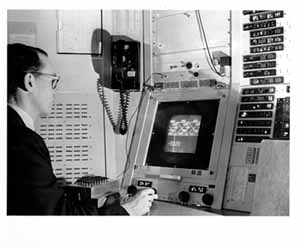 Ivan Sutherland at
the console of the TX-2 - Sketchpad Project, MIT, 1963
Ivan Sutherland at
the console of the TX-2 - Sketchpad Project, MIT, 1963
Upon graduation from Gradute school, Sutherland was enlisted in the Army were he worked at the National Security Agency (NSA) as an Electrical Engineer. The following year, Sutherland was transferred to the Defense Department's Advanced Research Projects Agency (ARPA) were he commisioned research projects in important comnputing concepts such as timesharing and artificial intelligence.
Sutherland continued on into academia were he took a
poistion as Professor at Harvard University. Two years later, he became a
Professor at the Univeristy of Utah, building the school's reputation as the
mecca for computer graphics. In 1976, Sutherland became the head of the
Computer Science department at Caltech. There he helped make integrated
circuited design a subject in academia. Until then, circuit design was
considered too mundane or too difficult to study. By introducing circuit
design, Sutherland helped pave the way for advances in chip design, which in
turn propelled the chip "explosion" in Silicon Valley.
 |
 |
 |
|
| ||
Over the years, Ivan Sutherland has recieved many awards for his contributions toward computer science.
"The Franklin Institute Certificates of Merit - Dr. Ivan E. Sutherland" http://sln.fi.edu/tfi/exhibits/sutherland.html
"Ivan Sutherland" http://www.realtime-info.be/encyc/techno/terms/31/48.html