INDIAN NATIONAL ANTHEM
Jana-Gana-Mana-Adhinayaka,
Jaya He
Bharata-Bhagya-Vidhata
Punjab-Sindhu-Gujarata-Maratha-
Dravida-Utkala-Banga
Vindhya-Himachala-Yamuna-Ganga
Ucchhala-Jaladhi Taranga
Tava Subha Name Jage
Tava Subha Ashisha Mage
Gahe Tava Jaya Gatha.
Jana-Gana-Mangala Dayaka, Jaya He
Bharata-Bhagya-Vidhata,
Jaya He, Jaya He, Jaya He,
Jaya Jaya Jaya, Jaya He
The following is a translation of Rabindranath Tagore's
rendering of the stanza:
Thou art the ruler of the minds of all
people, dispenser of
Victory, victory, victory to thee.
INDIAN NATIONAL EMBLEM

The National
Emblem of India is a replica of the Lion of Sarnath,
near
The four lions (one hidden from view) - symbolising power, courage
and confidence - rest on a circular abacus. The abacus is girded by four
smaller animals - guardians of the four directions: the lion of the north, the
elephant of the east, the horse of the south and the bull of the west. The
abacus rests on a lotus in full bloom, exemplifying the fountainhead of life
and creative inspiration. The motto 'Satyameva Jayate' inscribed below the
emblem in Devanagari script means 'truth alone triumphs'.
INDIAN NATIONAL ANIMAL
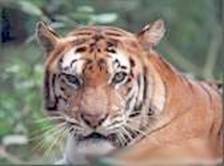
Large Asiatic carnivorous feline quadruped, Panthera Tigris, mane
less, of tawny yellow colour with blackish transverse stripes and white belly,
proverbial for its power and its magnificence.
There are very few tigers left in the world today. A decade ago the
tiger population in
INDIAN NATIONAL FLAG

The Indian flag was designed as a symbol of freedom. The late Prime
Minister Nehru called it a flag not only of freedom for ourselves,
but a symbol of freedom to all people.
The flag is a horizontal tricolour in
equal proportion of deep saffron on the top, white in the middle and dark green
at the bottom. The ratio of the width to the length of the flag is two is to
three. In the centre of the white band, there is a wheel in navy blue to
indicate the Dharma Chakra, the wheel of law in the Sarnath Lion Capital. Its diameter approximates the width
of the white band and it has 24 spokes. The saffron stands for courage,
sacrifice and the spirit of renunciation; the white, for purity and truth; the
green for faith and fertility.
INDIAN NATIONAL BIRD
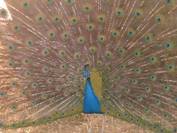
Male bird of species P. cristatus, is a native of
Found wild in
INDIAN NATIONAL FLOWER
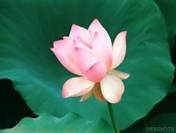
The Lotus or
water lily is an aquatic plant of Nymphaea with broad floating leaves and
bright fragrant flowers that grow only in shallow waters. The leaves and
flowers float and have long stems that contain air spaces. The big attractive
flowers have many petals overlapping in a symmetrical pattern. The root
functions are carried out by rhizomes that fan out horizontally through the mud
below the water. Lotuses, prized for their serene beauty, are delightful to
behold as their blossoms open on the surface of a pond. In
INDIAN NATIONAL TREE
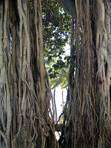
Indian fig tree, Ficus
bengalensis, whose branches root themselves like new trees over a large area. The roots
then give rise to more trunks and branches. Because of this characteristic and
its longevity, this tree is considered immortal and is an integral part of the
myths and legends of
INDIAN NATIONAL FRUIT
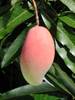
A fleshy fruit, eaten ripe or used green for pickles etc., of the
tree Mangifera indica, the
mango is one of the most important and widely cultivated fruits of the tropical
world. Its juicy fruit is a rich source of Vitamins A, C and D. In