
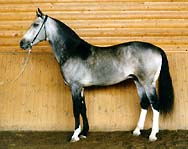
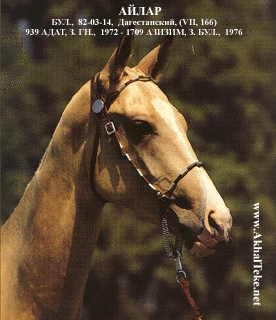
Akhal-Teke
important info:
light horse
hot-blooded
use:hacking
size:14.2-15.2hh
color variations: dun, palomino, bay, chesnut, or gray
place of origin:Turkmenistan
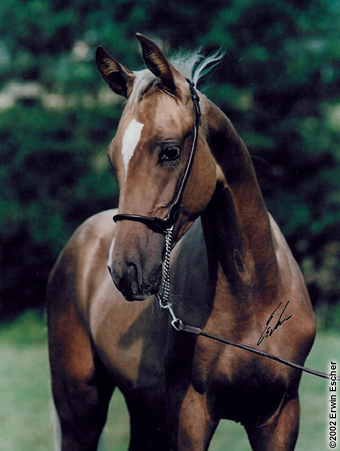
The Akhal-Teke is a very old breed. They were bred primarily as racehorses, and are still used for and excell at this today. The Akhal-Teke is a unique horse, found mainly in the Turkmenistan are of Central Asia. It was devolped by Turkoman tribes to be a horse of great endurance and stamina, and to be able to cope with extreme hot and cold. They are the most enduring horse. They have travelled more than 2,500 miles, including 235 mile of desert in 3 days with no water. They are belived to be related to Arabians, though no one is sure which came first. They are very long and slender, and are like the greyhound of the horse world. They posess much elegance and beauty. They are traditionally racing horse, but are also used for riding, dressage and jumping. They have been cross-bred with Thouroughbreds to improve their racing ability, but when this was done they lost their endurance. So, now they are trying to keep the breed pure.The Akhal-Teke have always been special to the Turkoman people who treat them very well. The Akhal-Teke are small horses, but very lively, alert, courageous, and sometimes rebellious.
Alexander the Great's favorite horse, Bucephalus, was said to be related to the Akhal-Teke.
They are a good riding horse and very brave..
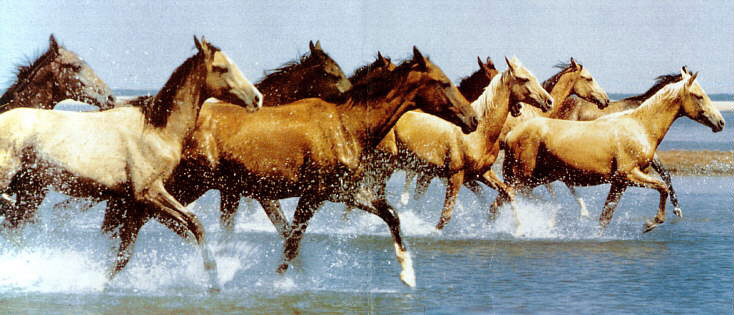
They traditionally roamed the wild in herds.
The head is built very fine and the neck is long and can be held almost veritcal so that the mouth is above the withers.~sent in by Spaz
The ahkal-teke is not a good specimen for a western horse. The reason being that their is head is carried " above the bit" so that limits the control you have and also theirs backs are too long.~sent in by Spaz
IOn 1960 the glod-medal dressage winner in Rome was an ahkal-teke stallion. It was an exception to the rule because he was required to hold his head in the convential manner. (mouth slightly below the rider's hand.)~sent in by Spaz
Since the breed's head is too high to compete in any event they are being developed to meet the new criterea.~sent in by Spaz
The principle breeding center is at Ashkhadad.~sent in by Little bit
The ahkal-teke is bred around the oases of the karakum desert.~sent in by Little bit
The head is joined to the neck at a 45 degree angle.~sent in by little bit.
Their legs are long and slender with joints high off the ground.~sent in by Little Bit
Hooves are small but regular, they have low set heels.~sent in by Little Bit
It's influence is horse type 3.~sent in by Little bit
Roaming wild in a herd,
An old breed they remain,
built for endurance and stamina,
racehorses, jumpers, dressage,
hurray!
coping with extremes,
with miles and miles to go,
bravery in bunches,
must be there,
to endure what these horses do.
roaming wild in the herds,
wild they may still remain,
a picture taken, elusive, they still remain.
Without water they may go,
bravery in the highest,
many colors, all light
warm blooded,
hold you in their heart
Ahkal-Teke
Ahkal-teke homepage