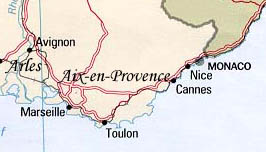
Avignon
Avignon is a wonderful
charming town, over-run by tourists during the summer. Not so small anymore
(pop. 88,000) if offers so much to see. Most of the town is ancient, and
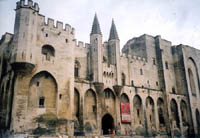
offers the spectacular Palais des Papes (some to the Popes before Rome),
great art stores, old buildings, wonder little restaurants, and of course a
huge variety of C�tes du Rh�ne wines. Compared with wine prices in Hong
Kong (my hometown), the French wines are great bargains. I made sure to
drink 3 bottles a day while traveling through the area. I found Provence
food and wines are totally irresistible!! The historic village of Avignon is
surrounded by a 4.3km wall, built during 1359 and 1370.
Highlight:
Palais des Papes, a huge Gothic palace, built in the 14th century as a
fortified palace for the pontif. Walking through this huge place you can
only imagine what life would have been like hundreds of years ago. Imagine
this: The feast to celebrate Clement VI's coronation in 1342 comprised 4,428
chickens, 50,000 sweet tarts, 39,980 eggs, and 95,000 loaves of bread, among
other numerous delights.
|
|

French breads at 7am
bakery

Avignon street

Palais des Papes

Courtyard outside the
Palais des Papes

Cathedral next to
Palais des Papes

Provence strawberries
The peaches are wonderful!!
|
|

Avignon street with old
water mill at the right

Palais des Papes

Palais des Papes

From inside the
Palais des Papes

Palais des Papes

Avignon street
|
|

Avignon street

Restaurants outside the
Palais des Papes

Palais des Papes

Palais des Papes

St-B�n�zet's bridge
(Pont d'Avignon) partly washed away by floods in 1669

Avignon street
|
Arles
Arles is 36km south west
of Avignon and less than 30 minutes by train. After Julius Caesar conquered
the area in 49 B.C. Arles became the provincial centred and a 20,000 seat
Roman amphitheatre was built to entertain the populous of plebs and their
masters. Les Ar�nes was built to host sporting contests, chariot races, and
the wildly popular bloody spectacles so beloved by the Roman public. Wild
animals were thrown in with other animals or gladiators (usually slaves or
criminals) who fought each other until most were killed. Even surviving
criminals got their throats slashed if they survived the animals or other
gladiators. Other highlights include the Romanesque churches, charming
streets and small provencial restaurants. It also here where Van Gogh
spent his last days painting the sunflowers and streets of Arles (for his
boyfriend's bedroom) before he cut off his own ear, and later committed suicide.
|
|

An artist at work

Village view from
Les Ar�nes Amphitheatre

Arles building

Streets of Arles

Streets of Arles

Arles Restaurants
|
|

Les Ar�nes Amphitheatre

Les Ar�nes Amphitheatre

Village view from
Les Ar�nes Amphitheatre

Streets of Arles

Arles building

The famous cafe painted by Van Gogh near
Place du Forum
|
|

Les Ar�nes Amphitheatre

Streets of Arles

�glise St-Trophine
Romanique Church

Place de le R�publique with townhall in the back

Restaurant next to
Les Ar�nes Amphitheatre

Streets of Arles
|
Aix-en-Provence
Aix (pronounced
"X") is a tourist and student mecca and only a 30 minute train
ride from Marseilles.
The University of Aix-Merseilles has a student population of about 30,000.
Certainly worth a visit to see the streets, caf�s, and the tens
fountains.
|
|

Provencial delights
|
|

Cath�drale St-Sauveur
|
|

Cours Mirabeau with several fountains and tens of caf�s for people watching
|
|
|