ELECTROSTATIC RECORDERS:
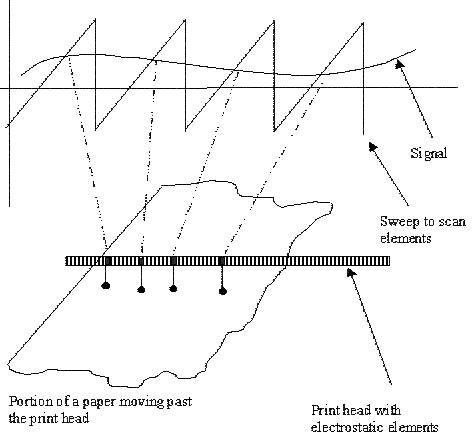
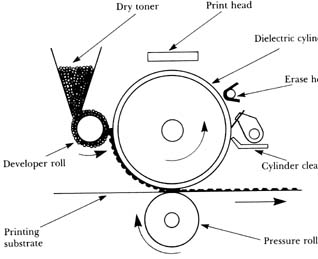
In electrostatic recorders xerographic chart paper is moved past a print head consisting of an array of closely spaced electrostatic elements. Analog input voltage signal activates these elements when a comparator compares a sweep saw tooth wave with the input signal as illustrated. Similar to xerographic copier machine where a charged photo conducting drum is selectively discharged by laser these instruments require toner which can be liquid or solid.
|
Also called electrographic or ionographic in its simplest form.
Electrographic
|
|
|
Ionographic
|
 |
INSTRUMENTATION TAPE RECORDERS:
Instrumentation tape recorder is a magnetic tape recorder used in measurement applications. These tape recorders record data in digital or analog form on a magnetic tape 1/4, 1/2 or 1 inch wide. The tape is moved past a recording/playback head at a constant speed (1.875 in/sec to 120 in/sec). There may be no of heads positioned across the width of the tape depending on the no of tracks of data recordable. A 1 in wide tape permits 14 tracks. Head consists of a toroidal core with a nonmagnetic gap and a winding around. The non magnetic gap (tip) makes contact with the magnetic tape which moves past the head closer to the tip. Tape provides a magnetic path (gap is non magnetic and tape forms a bridge) to the flux which is proportional to the current signal which is to be recorded. As the tape moves away from the head the tiny magnetic particles retain the state of magnetisation to which they were subjected to, resulting in a record of the signal. Tape transport mechanism moves the tape at a constant set speed and associated electronics does the required processing of the signal.
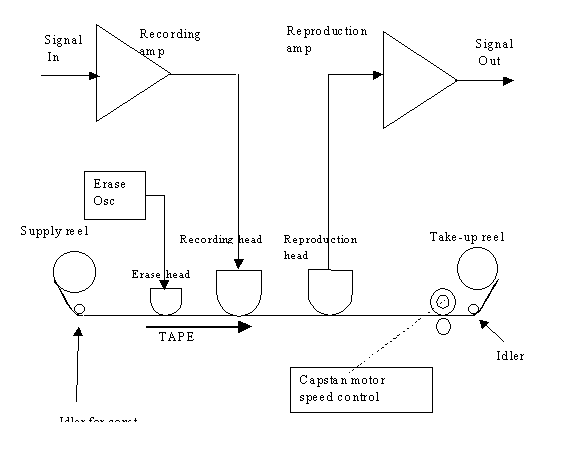
Block diagram of a tape recording unit 'Idler for constant tension' is the text unclear |
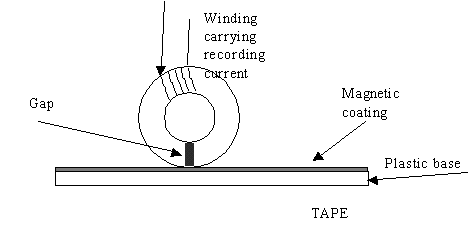
Tape and tape head with a nonmagnetic gap |
Signals stored in tape can be retrieved at a later instant when needed in the same original electrical form and the recorder/playback unit permits recording at one speed and play back at a different speed enabling time expansion or compression. signals recorded over hours can be played back in minutes or seconds and vice versa.
Methods:
Digital magnetic tape recorders:
They use 1/2 inch wide tape with 7 or 9 tracks. Combination of bits stored across the width of the tape in these 7 or 9 tracks comprises the code for each character. 100 to 1600 chs per inch along the axis possible. For a tape speed of 200in/sec this allows 320000 chs/sec. merits: accuracy, insensitivity to speed changes, direct compatibility with computer systems.
Types: