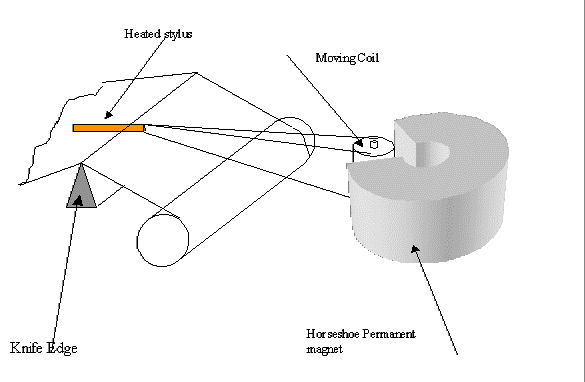
Diagram shows a PMMC movement with a stylus (or pen) attached to the end of pointer. An attempt was made to draw a 3D horse shoe magnet.
RECORDERS
Recorder is a device which records the value of a quantity as it is being measured. These instruments include XY plotters, strip chart recorders, magnetic tape recorders, printers, magnetic and optical computer discs, EPROMS, CRT s and so on..
DIRECT WRITING RECORDERS
Galvanometer recorders using a pen assembly mounted on the end of a pointer of a PMMC movement is known as direct writing recorder. Movement of the pointer is proportional to the quantity being measured and the paper moves at a constant speed due to a separate motor for time axis. It results in curvilinear recording which is made rectilinear by passing the chart paper over knife edge.. The chart paper used with rectilinear grid is heat sensitive and a pen at the end of the pointer is replaced with heated stylus. Stylus removes the white cellulose coating above the chart paper to expose the black portion underneath leaving a record. This recorder is nothing but a moving coil meter with a pen or heated stylus attached to the end of the indicating pointer. These recorders are compact and hence multichannel outputs feasible and can record simultaneously large number of slowly varying quantities like several physiological functions of a hospital patient like BP, temperature etc. They can be used for frequencies upto 100 Hz with accuracies ±1 to ±2 % full scale and maximum sensitivity on the order of 25 mV/in.
|
Diagram shows a PMMC movement with a stylus (or pen) attached to the end of pointer. An attempt was made to draw a 3D horse shoe magnet. |
UV RECORDER
To reduce friction and inertia, ink is replaced in the ultraviolet (UV) recorder by a fine beam of ultraviolet light from a high pressure mercury vapor lamp. The beam is focused by means of a series of lenses such that it reflects off a tiny mirror attached to the shaft of a galvanometer. Side-to-side movement of the galvanometer is under the control of y–axis driven electromagnets.
The reflected beam of UV light falls onto photo-sensitive paper. The image appears on the paper with exposure to bright light for a few seconds. This image is not stable and disappears altogether on continued exposure to bright light, but may be fixed by chemical developing and fixing, or simply by avoiding prolonged exposure to bright light. UV-sensitive paper is expensive compared with the ordinary paper used in pen or inkjet recorders, but the gain is a wide frequency response, typically 0–5kHz ±3dB, but easily extendable up to, say, 20kHz with carefully designed galvanometers. These recorders are known as rapid response recorders.
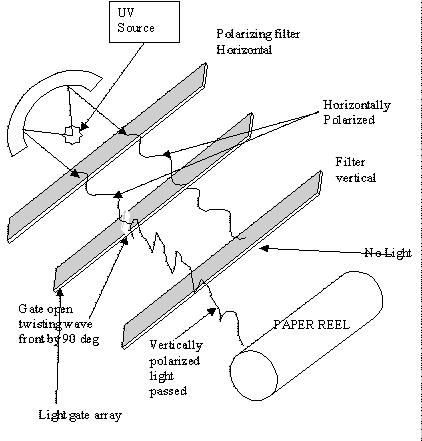
A Light gate array recorder which is another optical recorder uses a UV source. Light from the source is reflected by a concave mirror and the unpolarized light passes through a horizontal polarizing filter. Wide flat beam of polarized light is directed toward an array of gates. Each gate twists the wave front by 90o if open will not alter the wave front if closed. This light is passed through a vertical polarizing filter which allows only twisted light which passes through to reach a light sensitive paper to leave a record. Where the gates were closed the wave was not twisted and the vertical filter blocks and no light comes out. Now by suitably opening or closing the gates with the help of an electronic circuitry it is possible to record the measurand
 |