

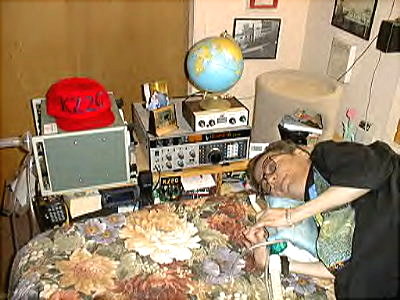
Here I am operating my Omni 6 Plus. Sitting on top of it is my MFJ-941C Versa Tuner II. My cat's bed is on the right and my respirator, similar to Christopher Reeve's, is on the left.
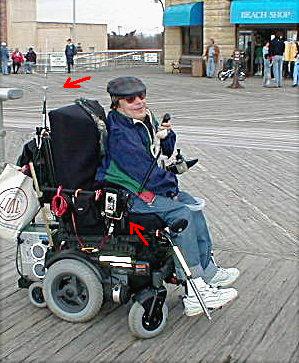
Here I am at Jones Beach in my new Blast 850 motorized wheelchair. You can see the Diamond SG-7000 antenna on the back of chair. I used the Diamond K540KM luggage mount to mount the antenna. My FT-90R VHF/UHF Transceiver is by my right leg. Listen for me on 146.850 Mhz FM, the Long Island Mobile Amateur Radio Club Repeater.
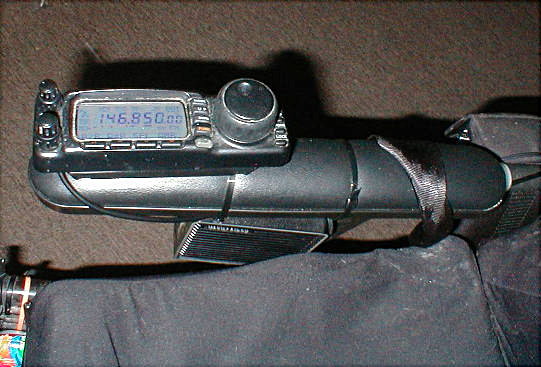
Here's my newest setup. I have my FT-100D mounted remotely on the back of my motorized wheelchair. It's powered by my 22nf gel cell vent battery. You can see the transceiver's head mounted on my chair's right armrest. A Radio Shack speakers is mounted below the armrest. I'm using the Diamond SG-7000 for VHF/UHF and a Miracle Whip for HF, running 17 watts on SSB. On CW I run 10 watts using the Palm Paddles.
My ham plates below.
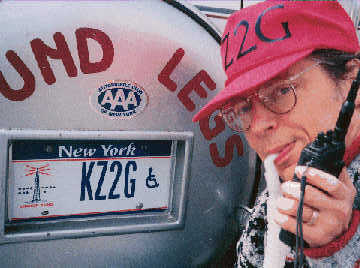
Here's a picture of me by my modified, life-equipped van. I'm holding my Kenwood TH-79A(D) dual-band HT. I have the hose of my respirator in my mouth.
Being a ham with a disability isn't much different than being a ham without one. Disabled or not, we hams love to communicate. The seeds of amateur radio were planted in me back in the Fifties. As a kid, I watched Captain Midnight on TV. I always wanted to make a communicator like he did out of a piece of wire, a spoon and some tape.
In 1960, at age 13, I bought an National NC-60 communication receiver from Lafayette Electronics, in Jamaica, Queens, New York City. I listened to foreign broadcasts coming from countries as far away as Russia. But by 1961 everyone was talking about Citizen Band radio. You could talk to friends in your town and beyond. That year I was 14 and flat on my back for nine months, thanks to childhood polio and two spinal fusions. I was homebound. And I needed friends. I paid my $4 to the FCC and became KBI-1409. I bought a Lafayette HE-15B CB transceiver with a horrible receiver and one crystal to transmit on channel 15. At first I used an indoor whip antenna, but later had a ground-plane and then a Super Magnum antenna up on my roof, in Whitestone, Queens, New York. I also had a number of great CB buddies.
In 1963, and still pretty much homebound, one of my parish priest began to visit me. Father Joe O'Brien from St. Luke's church would bring me Holy Communion and talk to me about the wonders of amateur radio. Father Joe had a 3-element Mosley beam on a 30-foot tower behind our church rectory. He operate Collins equipment and loved CW. Like me, he was left handed. So he let me borrow his left-handed, chrome-plated Vibroplex bug and a tone oscillator. He gave me a few Ameco code records (which I still have) and I began to study CW. I also listened to the American Radio Relay League code practice sessions, broadcast on 20 meters and later got my Code Proficiency Certificate for 20 WPM, from the ARRL. I also studied radio theory, and in 1965 got my novice ticket. WN2UHY, and soon my General, becoming WB2UHY.
My first transmitter, after becoming WB2UHY, was an Ameco 40-meter, 15-watt, crystal-controlled, CW transmitter, which I built in my basement. I had a 40-meter dipole on my roof. It was exciting contacting people as far away as Arizona, but I still enjoyed talking to my local CB friends.
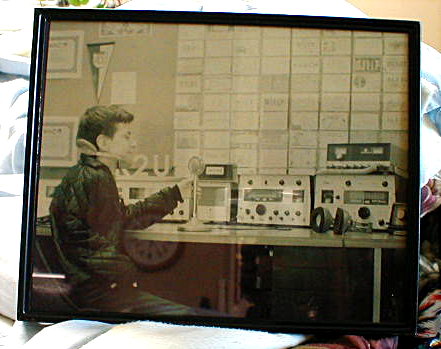
Here I am back in 1964 or '65 at the K2US ham radio station in the Coca Cola pavilion at the 1964-65 New York World's Fair. This is the VHF station.
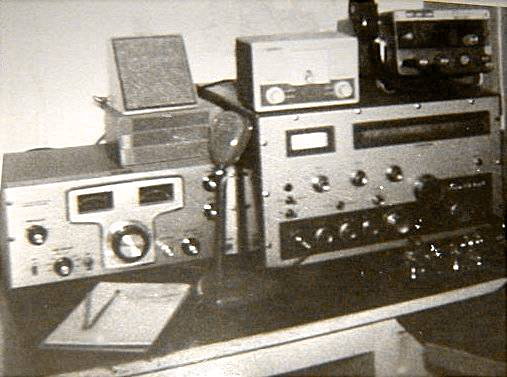
I later built a HeathKit 6-meter transceiver, called a "lunch box" because of its lunch box size and the handle on top. Finally, my New York City Board of Education home instruction teacher, Murray Kerner, told me he had a friend at Lafayette Electronics in Jamaica, Queens. I was able to get a rock-steady ham receiver there at cost. Still, I wasn't making very many local ham friends.
In 1967 my homebound days ended when I entered Hofstra University in Uniondale, Long Island. In 1968, I helped start the Hofstra University disability advocacy group, People United in Support of the Handicapped. At one of our PUSH meetings, in 1973, I met a blind ham, Armand, WB2ZEI. Armand told me about 2-meters. By the mid 1970s, CB radio was so polluted by jammers and jerks, I had sold my final CB rig, a Sonar-G. Thanks to WB2ZEI, I discovered 2-meters.
Armand mentioned The Long Island Mobile Amateur Radio Club and other repeater groups, like 147.03 MHZ, WB2ROL/R. This sounded like CB's better days, when, in the Sixties, there was civility and comradeship on the CB band. In late 1973, I bought my first 2-meter rig, a Geneva crystal- controlled transceiver. In 1983, I got my Extra-class ticket and to this day my ham friends and my 2-meter friends on the LIMARC repeaters have helped me when my van broke down or when my motorized wheelchair ran out of juice. They've even put up antennas for me. And my many ham friends are never far away. All I have to do is reach out and hit the push-to-talk button.
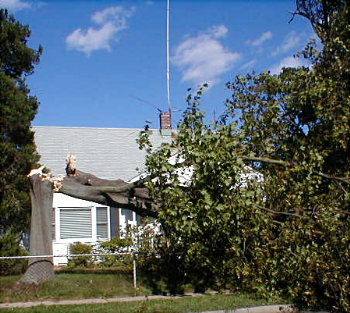
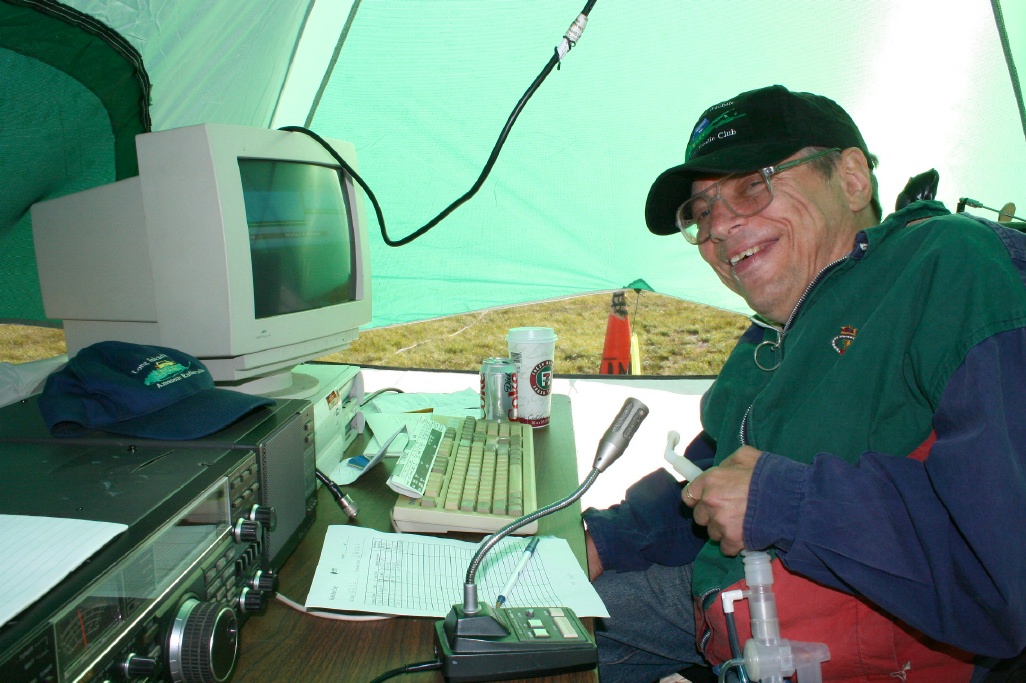
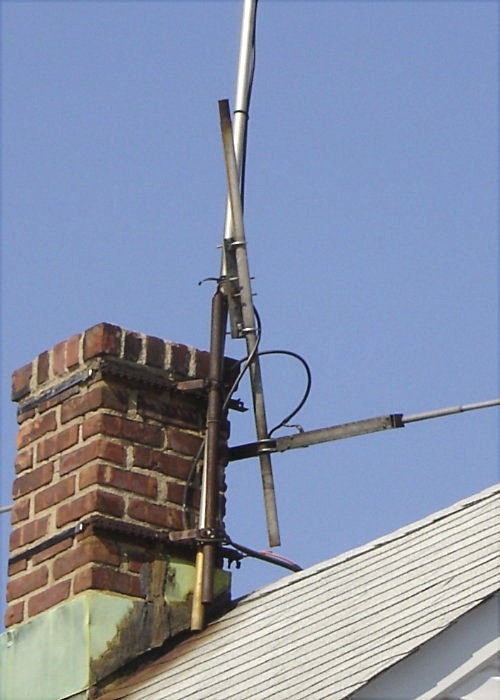
As of March 18, 2005, my HF antenna was hanging by one ty-wrap!
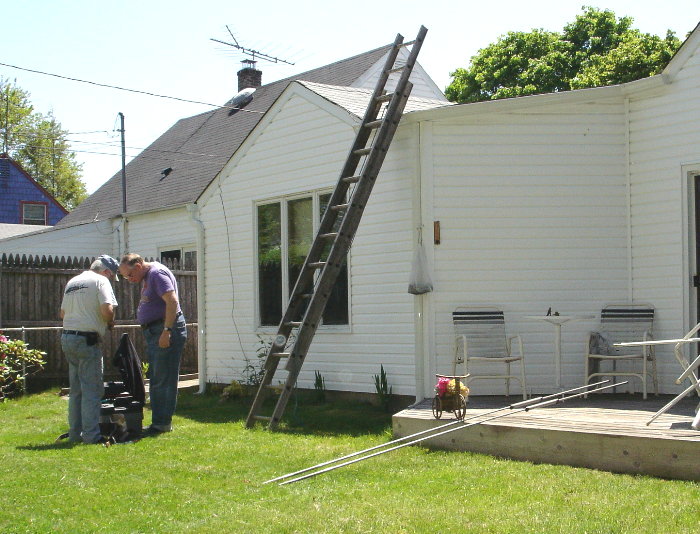
Then, on May 28th, 2005, after putting the antenna back up and using Bob's antenna analyzer to determine the antenna was bad, not the coax, Don, WB2BEZ, and Bob, KC2MWA decided what to do to fix my antenna, which Don and my brother, Frank, took down. You can see it on the right, resting on my deck.
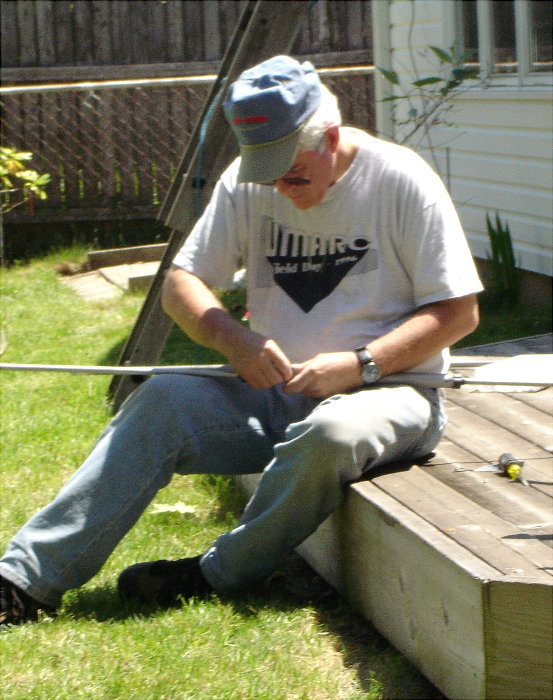
Don is cleaning the traps after sanding all joints and contact points with my brother.
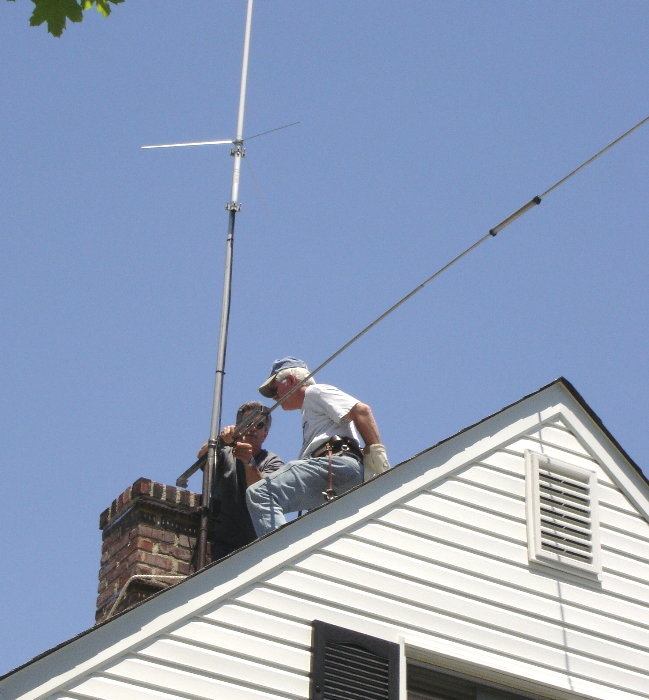
Finally, after three and a half hours of work, my brother and Don, WB2BEZ, put my antenna back up on the roof. Thanks, Frank, Bob and Don! This ham really appreciates your good work! But that's what ham radio is all about: Hams helping their community and each other!
Over the years, I've owned a number of rigs. I've used Wilson, Icom, Yeasu, Alinco, and Kenwood HT's. I have a Yaesu FT-100D transceiver. There's an Icom 2000H by my computer. And on my Levittown house, I have a Diamond X-510MA dual-band (2-meter, 70-centimeter) antenna up about 30 feet. Just below it is what's left of my 3-element High Gain TA-33jr beam. I use the radiator element as my 20-,15-, and 10-meter antenna. There's no rotor, and the "dipole" is positioned to work Europe and the South West. I also am using a Pro-Am 30-meter mobile whip on 30-meters. On the low bands, I've used all sorts of rigs, including Drake Twins and even a Kenwood 540.
In 1983, I decided to study for my Advanced and my Extra-class amateur tickets. I got the Extra around July 1983 and became KZ2G. I got interested in computers, so in 1984 I sold the 540 to buy my first computer, a Tandy 64K Color Computer (the CoCo). I began to miss the low bands soon after, and around 1985, I borrowed a used Ten-Tec Omni-A from Handi Hams, which I bought from them the following year and used for years, until I bought the Scout and the Omni VI Plus. I send code with my chrome Bencher Iambic paddle and my "left-handed" VibroPlex Deluxe Original Bug. If you're disabled and want to become a ham or need manuals or study guides or tapes, adaptive equipment or gear, contact Handi Hams on the World Wide Web or write to Courage Handi Hams, COURAGE CENTER, 3915 Golden Valley Rd., Golden Valley, Minnesota 55422. Have you guessed that my favorite band is 2-meters? But I love CW a lot.
I also have a Kenwood TH-79A(D) dual-band HT on my motorized wheelchair. If you're in the Levittown, NY area, give me a call on 146.85 MHZ. I often listen on the Long Island Mobile Amateur Radio Club repeater. If you're a Ham radio operator and would like to set up a schedule, E-mail me. Perhaps we can meet on 20-meter SSB. Pick a frequency and time.
MY HAM ARTICLES AND HUMOR
WHY I LOVE CW
By Bob Mauro, KZ2G
There's a music and a mystery to CW. In ways, Morse Code reminds me of poetry. Perhaps not Shakespearean iambic pentameter -- but pretty done close! There's definiitely a rhythm and a rhyme to all those dits and dahs. And on the low bands that's what you'll usually find me doing, sending and receiving CW.
I started listening to CW when I was about 13 years old, back in 1960. I bought a National NC-60 communications receiver with the money my parents and relatives gave me for my elementary school graduation. I enjoyed short wave listening, especially listening to Radio Moscow and the BBC. I was also excited by all the staticky voice of faraway hams, then on AM. I also wondered what all those dits and dahs meant.
I was pretty much home bound for the next five years, following two spinal fusions in 1960-1961 to correct a curvature caused by childhood polio. It was during those years that Father Joe O'Brien started visiting me. He brought me Holy Communion. And ham radio!
Father Joe was a long-time amateur radio operator by then. He was also my parish priest. He had managed to talk the monsignor of our church into letting him erect a radio tower and a 3-element tri-bander beam behind St. Luke's rectory, in Whitestone, Queens.
When he visited me, Father Joe saw my Lafayette HE-15B CB transceiver and my National NC-60 SWL receiver. He immediately started talking to me about ham radio. He fired up my interest and lent me his Vibroplex Deluxe Original bug and some code records. I quickly fell in love with CW. Part of the intrigue, I guess, was the mystery of Morse Code. As kids my friends and I were always coming up with ways to write and send coded secret messages to each other. And CW was one code that was not only mysterious but historic. In school, we had all learned about Samuel Finley Breese Morse and his first Morse Code message, sent on May 24, 1844, "What hath God wrought!"
Father Joe became my Elmer, and in 1965 I became a ham. My first ham transmitter was a little 15-watt Ameco CW kit, which I built. I bought a Lafayette 160-10-meter ham receiver -- and my own Vibroplex Deluxe Original bug. Okay, Mom and Dad helped with the financing!
To this day I love CW. I enjoy talking on 2-meters to the guys on the LIMARC machine. But on HF I'm usually on 20, 10 or 15 CW. I must say, after over 40 years, I still enjoy the mystery and the music of all those dits and dahs!
TOP 10 THINGS TO DO BEFORE AND DURING A CONTEST
By Bob Mauro, KZ2G
10. Drink 10 cups of coffee.
9. Order 10 pepperoni pizzas.
8. Sharpen 10 pencils.
7. Boot up and try 10 contest logging programs.
6. Send the OM or XYL to his/her mother's or Hawaii -- which ever is farther.
5. Send the kids to camp, Disney World, or any foreign friend or relative who doesn't have a serious criminal record.
4. Drink 10 more cups of coffee.
3. Order 10 more pizza, but this time PLEASE hold the pepperoni!
2. Find the Pepto Bismol fast!
And the number one thing to do before and during a contest...
1. Run as fast as you can to any restroom!!!
TOP 10 THINGS A HAM NEEDS IN HIS/HER SHACK
By Bob Mauro, KZ2G
10. 589 copies of QST, each carefully catalogued by dates, product reviews, and articles in your Pentium III computer.
9. A Pentium II computer.
8. Numerous unwashed coffee mugs with your novice, tech, general, advanced, extra and first, second and HOPEFULLY last vanity call sign on them.
7. A very big box of assorted resistors, capacitors, ICs, LCDs, transistors, insulators, and 256 unread copies of QST, still uncatalogued in that Pentium II computer!
6. Various copies of US call books with your novice, tech, general, advanced, extra, and first, second and HOPEFULLY last vanity call sign in.
5. Several extremely green slices of what vaguely resembles pizza from last year's three-day DX contest. They're beside the unwashed coffee mugs. See number 8 above.
4. 2,876 QSL cards you still haven't mailed.
3. 5,865 DX QSL cards you still haven't catalogued in that Pentium II computer.
2. A picture of you with your arm lovingly wrapped around your loved one, i.e., that brand new ICOM IC-756 PRO transceiver!
And the number 1 thing a ham needs in his/her shack...
1. A lot of free time!
QUIZ: ARE YOU A REPEATER COP?
	By Bob Mauro, KZ2G
	www.geocities.com/ram9872002/kz2g.htm

	Following in a quiz to determine if you're a Repeater Cop.  If you are, don't panic!  There's a cure.
	For each of the following questions, circle A or B.

1. Someone on the repeater has a noisy signal.  Do you:
		A. Yell: "Sheesh!  Get a better antenna or a more powerful rig before using this repeater again!"
	B. Say, "Try again, my friend.  You're a bit noisy."

	2. You hear alternator whine on someone's signal.  Do you:
		A. Command: "Stay off the repeater until that terrible alternator whine is gone!"
		B. Suggest how to fix the alternator-whine.

	3. Someone new on the repeater doesn't wait for "the beep."  Do you:
		A. Scream: "Wait for the darn beep, dummy!"
	B. Politely explain the purpose of "the beep."

	4. Someone from Fiji is visiting the area and gets on the repeater.  You then:
		A. Tell the person to join the repeater club by paying his or her dues before using the machine and wasting the repeater club's electricity!
		B. You welcome the visiting ham and invite him or her to enjoy the repeater while in the area.

5. A ten-year-old, new ham gets on with an H-T, and you:
	A. Refuse to talk to children on the repeater.
		B. Welcome the youngster and congratulate the new ham on his or her ticket.

Ok!  It's time to determine if you're a Repeater Cop.  For every A you've circled, give yourself 2 point.  For every B you've circled, give yourself -2 points.  Add up your score and rate yourself:

	10 to 8.  You're too nasty to be a ham and you're a chronic Repeater Cop.
	6 to 4. You're not as friendly as most Correctional Officers in Sing Sing and are a veritable Repeater Cop.
	2. You're bordering on sociable, and are an occasional Repeater Cop.
	-2 to -4 . You might know a Repeater Cop but are not one yourself.
	-6 to -10.  You're the kind of ham who makes ham radio a really fun hobby.  And you'll never be a Repeater Cop.

Finally, what if you ARE a Repeater Cop?  There's a simple cure.  LIGHTEN UP ALREADY!  IT'S ONLY A HOBBY!
Check out a great book on Ham Radio called HAM RADIO FOR DUMMIES by clicking here