
The Venus of Willendorf, above, was discovered in 1908 at Willendorf, Austria. It was found on the north bank of the Danube. This tiny figurine of a grossly obese woman dates from the Aurignacian period, (the Old Stone Age) between 30,000 and 25,000 BC. To the people of thirty-two millenniums ago, obesity was a sign of fecundity and of promise. It gave its possessor the power to propagate the race.
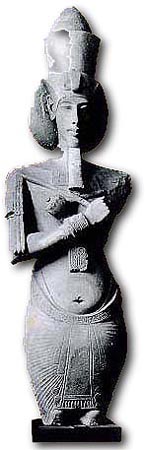
Just after the dawn of history, in ancient Egypt, Akhenaton, also called Amenhotep IV, king of Egypt (1350-1334 BC), was the husband of the beautiful Nefertiti. Akhenaton is notable as the first historical person to establish monotheism. His cult of Aton, or Aten, the sun god, saw God as a universal, omnipresent spirit and the sole creator of the universe. Scholars theorize that the Hebrew prophets' concept of a universal God, seven hundred fifty years later in a land that Akhenaton once ruled, was derived partially from his belief system. Akhenaton is depicted in many of the Egyptian tomb and temple paintings as very visibly disabled. His body is curved and distorted. He has a misshaped stomach and an elongated head. Yet he was considered a god by some of his people. For Akhenaton's monotheism, a heretical believe to some Egyptians, the Pharaoh, to the orthodox, was thought of as cursed and a curse on Egypt. His successor, Tutankhamen, attempted to destroy every one of Akhenaton's images. Religion can create symbols, images and stereotypes -- both negative and positive. Many of the world's religions have done just that. In the Bible, there are one hundred eighty incidences of disability, according to Charles Kokaska's "Disabled People in the Bible" (Rehabilitation Literature 45 [1-2]:20-21). The Bible portrays those with disabilities often as castaways, and as people shunned by society. This can be seen in Samuel-2 5:8, "Wherefore they said, The blind and the lame shall not come into the house." Furthermore, if persons with disabilities weren't cast away at birth, they were eventually relegated to the streets, begging with "hand in cap," i.e., they were handicapped. But then we have Moses, a man with a disability. Biblical scholars believe Moses had a cleft palate. When God asked Moses to lead His people out of Egypt, Moses replied, "I am not eloquent... I am slow of speech, and of a slow tongue." (Exodus 4:10) Yet he was chosen to become the liberator of his people. Moses was an advocate and a leader with a disability. Certainly a positive image. In Leviticus 19:14, we read, "Thou shalt not curse the deaf, nor put a stumblingblock before the blind." Sounds like here the Bible is advocating for respect and the removal of architectural barriers! The Bible often uses words like "deaf" and "blind" as symbols for ignorance. In Matthew 15:14, we read, "Let them alone: they be blind leaders of the blind. And if the blind lead the blind, both shall fall into the ditch." This is echoed in Luke 6:39. But interestingly enough, the Bible does not use the word "crippled" or "cripples." And it only uses the word "cripple" once, in Acts 14:8, "And there sat a certain man at Lystra, impotent in his feet, being a cripple from his mother's womb, who never had walked...." Like the Bible the Koran, compiled in 632 AD, used disability imagery as symbols for ignorance. In Sura II, The Cow, 160, we read, "Deaf, dumb, blind: therefore they have no understanding." Also, we can read this in Sura VIII, The Spoils, 20, "For the vilest beast in God's sight, are the deaf, the dumb, who understand not." But the Koran also talks of inclusion when it comes to persons with disabilities. This is most apparent in Sura XXIV, Light, 60: "No crime shall it be in the blind, or in the lame, or in the sick to eat at your tables." A very similar passage can be found in the Bible in Luke 14:13, "But when thou makest a feast, call the poor, the maimed, the lame, the blind...." During the Dark Ages men, women and children with disabilities were often treated with contempt. Superstition reigned in those unenlightened days. Disabilities were viewed as curses from the devil or as a punishment from God for a sin or sins you had committed. The mentally disabled were seen as possessed by demons and often burned at the stake. Many mentally disabled persons were burned at the stake during the Dark Ages. The image of the disabled then was one of evil. The disabled, according to the superstitious, had committed sins or were possessed by evil spirits. Eventually the Renaissance arrived. But this age of enlightenment wasn't much better than the Dark Ages for persons with disabilities. During the Renaissance physical beauty was celebrated. Poets wrote verses on courtly love and sensual beauty. Artists painted and sculpted the nude body. It was always perfectly proportions. Hieronymus Bosch, on the other hand, painted images of hell and Armageddon.
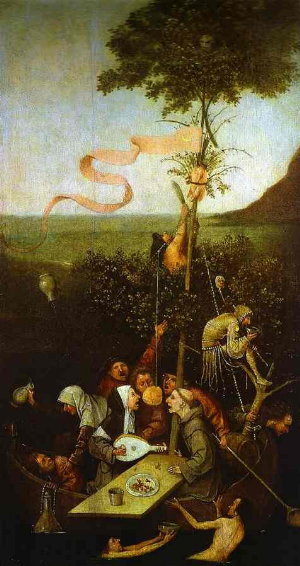
As shown above in his "Ship of Fools," Bosch also painted evil and personified it as someone with a twisted, misshapen body, i.e., as a person with a disability. Again disability becomes a symbols of evil, of damnation. Bosch used horror to scare the people into repentance. Repent or become a distorted demon -- a disabled person. One infamous disabled demon was Shakespeare's Richard the Third. During the Elizabethan Age, Richard, in Will's words, characterizes himself as "rudely stamped," "deformed, unfinished." In Act I, sc. I, of Richard III, Richard says, "I cannot prove a lover. ... I'm determined to prove a villain." Here we have the stereotypical image of the angry, vindictive cripple, raging against "the slings and arrows of outrageous fortune," to quote a line from Hamlet. Dante in his Inferno wrote about the damned, sin and sinners. In Canto XXVIII, Circle 8, Bolgia 9, of the Inferno the poet talks about a one-eyed traitor, and tongueless and armless men. These disabled human beings are, once more, used as symbols and examples of evil doers. To the mind of the faithful, Hell is often seen as a place filled will punishment. And that punishment is frequently depicted by using physical and mental disability imagery as symbols of spiritual disability. Is it any wonder that the parents of a disabled child would often leave that child in the sand, the snow or the forest to die? It was best to be rid of "a curse" before anyone discovered a family's "misfortune."
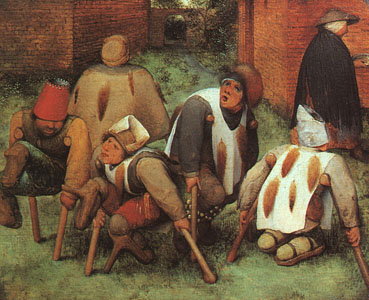
Bruegel, The Elder, in 1568 painted "The Beggars," also called "The Cripples," illustrated above. The painting shows four legless "fools" with mouths agape. Each seriously disabled person is begging.
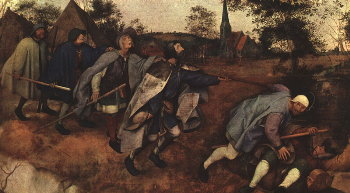
That year Bruegel also painted "The Blind Leading the Blind," shown above. Here he uses persons with disabilities as symbols of ignorance, in this case as a satire on the unquestioning following of religious dogma.
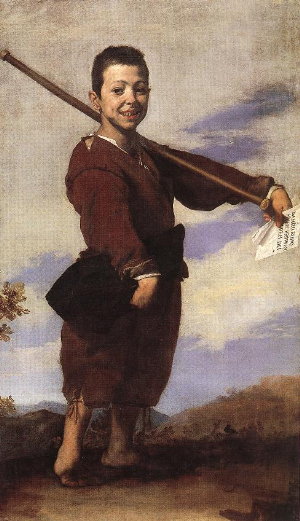
Like Bruegel, Ribera in 1642 painted "The Club-Footed Boy." The child is a "happy, dumb" beggar holding a sign which translated reads GIVE ME ALMS FOR THE LOVE OF GOD. All of these disability images show stereotypical depictions of persons with physical disabilities. The images are designed to evoke pity. The Bruegel's paintings evoke ridicule, portraying these seriously physically disabled persons as simpletons. Are they candidates for institutionalization? Or just objects of contempt? It was at the end of the Renaissance that institutionalization began in Europe. Michel Foucault, a social philosopher, wrote in his book Madness and Civilization in 1961, that 1656 was the year of the "great confinement." It was by royal order that "hospitals" were established in Paris to institutionalize the poor "of both sexes, of all ages... of whatever breeding and birth...able-bodied or invalid, sick or convalescent, curable or incurable...." People were tired of seeing these "eye-sores" on their streets and in their families. It was more "humane" to shut them away from society. As the 18th Century arrived, the world became more "enlightened" towards disability. The educated no longer thought disability was a sign of the devil, a curse, or a punishment. Well...most of the "enlightened" thought that anyway. So instead of burning the disabled person at the stake or abandoning him or her to the wastelands of desert or arctic snows, men, women and children with disabilities were often interned in asylums. Places like Bedlam were early examples of future Willobrooks. The developmentally disabled, the paralyzed, the hearing and visually impaired were, as in the past, shut away from society. Many of these institutionalized men, women, and children with disabilities didn't live beyond middle age. Diseases and lack of nutrition took their toll on the physically and mentally frail locked in these filthy, disease-ridden state hell holes. The lucky ones tried to remain free to beg on the streets. During the 19th Century in the United States "a cult of asylums swept the country," says David Rothman in his book The Discovery of the Asylum. He calls this "the age of asylums." During the Jacksonian era, mental illness was thought to be caused by societal pressures, dissipation and masturbation. The mentally ill were often portrayed as grotesque. Before 1820 many psychiatric patients were abandoned to jails or hidden in back rooms by families. A few enlightened men and women, like Doreathe Dix and Florence Nightingale tried to improve the conditions in asylums and hospitals. They didn't want to free the disabled from the institutions. Just clean the places up a bit. Dix herself founded "more humane institutions" for the mentally disabled in 20 states and in Canada. She was fighting against the numerous filthy asylums where patients slept on straw and lived in straight jackets and shackles. Nightingale was appalled at the horrible conditions disabled persons had to endure in hospitals. Nellie Bly, while she was writing for the New York World, in 1887, pretended she was mentally disabled. She was committed to an asylum on Blackwell's Island, in New York City. Her subsequent article of conditions there brought improvements in patient care. But the situation and image of persons with disabilities didn't improve much during the 19th Century. In some areas it grew worse. In 1831 in The Hunchback of Notre Dame, Victor Hugo created the deformed bell ringer Quasimodo. He was too "ugly" to be a part of "civilized" society. In 1841, P.T. Barnum gave birth to the sideshow, often called the "freak show" by the public and the media. The freak show still exists today on Coney Island, in New York City. (See my article "Freak Show Redux" in the July-August 1997 Ragged Edge) Disabled men, women and even children unable to be accepted into the mainstream of life or find employment, had no where to go but the circus sideshow. In her 1997 book Extraordinary Bodies: Figuring Disability in American Culture and Literature, Rosemarie Garland Thomson, on page 17, quotes from David Hevey's 1992 book The Creatures Time Forgot: Photography and Disability Imagery. Hevey says nondisabled undergo "enfreakment" when they attend freak shows. In other words, a "normal" person sees these "human oddities" and gets to feel normal, no matter what he or she looks like. This is a live, visual example of that old saying, "Don't complain; there's always someone worse off than you." Novelists Charles Dickens in 1843 wrote A Christmas Carol. In it he created the pathetic Tiny Tim. Tim was the stereotypical image of the "helpless cripple," and an object of pity. Tim could not survive, according to Dickens, unless others cared for him. Only the charity of Scrooge could provide that much needed care. In Moby Dick, Melville's Captain Ahab is portrayed as the angry, vengeful cripple. The white whale is a symbol of nature, which has short-changed Ahab, robbed him of his humanity. And for that the captain will not rest until Moby Dick is destroyed -- even if Ahab must destroy everyone else in the process. Giacomo Puccini 1896 opera, La Boh�me, is about a pitiful pretty young woman dying of consumption. Today that opera has been rewritten and reborn as Broadway's smash hit Rent. And consumption has been changed to AIDES. But the image is still one of pity, as it was in 1850-52 when Harriet Beecher Stowe created Little Eve in Uncle Tom's Cabin. Little Eva is the angelic, chronically ill child. She is pure. Perfect. Innocent. Not unlike the poster child image of a hundred years later. In fact, Little Eva is once again an image of the helpless cripple. Only others can help her. In this case, the stereotypical African American, Uncle Tom. In 1861 Rebecca Harding Davis wrote Life in the Iron Mills. The humpback Deb, in that book, is a mill worker and a symbol, this time, according to Rosemarie Garland Thomson in Extraordinary Bodies: Figuring Disability in American Culture and Literature, of the wretched lower working classes. Deb, writes Davis, is "a limp, dirty rag...," "a weak, flaccid wretch." Disabled people are ugly, filthy, and socially useless, according to Davis. In an industrial age, society needs big, strong men. Not humpback crippled women. The United States began to recognize the problems faced by physically disabled persons as the 19th Century ended. In 1899 the Cleveland Rehabilitation Center in Ohio was founded. But once the motion picture was invented, at the close of the century, negative images of persons with disabilities began to show up. Hunchbacks, mentally ill grotesques, and misshapen monsters began to flash in the face of society. Is it any wonder people were ashamed of their disabled brothers, sisters, sons and daughters? In 1904, Sir James Matthew Barrie created Peter Pan and the infamous Captain Hook. He was mean and evil, a monstrous villain. And, guess what, he was disabled. Hook was very much like Captain Ahab. In Peter Pan, however, the white whale is replaced by a crocodile, which took off Hook's arm. Society over the ages has often been ashamed of its disabled members. Wars of mass destruction began to change that shame to veneration. Wounded war veterans who survived the infections, the amputations, the paralyzing wounds, began to weight on the conscience of the world. Veterans were supposed to be viewed as heros, not as pathetic, forgotten human beings. A few meager jobs were created for vets. As the 20th Century dawned, there was still a long way to go before persons with disabilities were seen as valued citizens. In fact, in his book The Body Silent, Robert Murphy (who is disabled) says, "We are subverters of the American Ideal." People cannot deal with difference, the other. This lead to the Immigration Restriction Act of 1924 and a desire for mandatory sterilization of mentally disabled and physically disabled persons. And forced sterilization of the mentally and physically disabled in Nazi Germany some years later. In the early 20th Century rehabilitation began to replace institutionalization. The establishment in 1917 of the Red Cross Institute for the Crippled and Disabled came about. Nevertheless, most families still hid their disabled family members behind closed doors. There was little or no education or employment for persons with disabilities. It was better they remained hidden and didn't prosper or, God forbid, propagate. After World War I, wounded vets and vets suffering from shell-shock could not be ignored. Soldiers didn't need pity. They needed respect and jobs. Soldiers deafened by explosions were taught lip reading, but for the most part rehabilitation was slow in coming for the mentally and physically disabled vet. The Smith-Sears Soldier Rehabilitation Act was enacted in June 1918. It was the first of many measures limited to persons disabled in military service. For the rehabilitation of nonvets, the Vocational Rehabilitation Act of 1920, amended in 1943 by the Barden-La Follette Act, established the Office of Vocational Rehabilitation, now the Office of Special Education and Rehabilitative Services, a unit of the Department of Education since 1980. More recently the National Institute of Disability and Rehabilitation Research has focused on more severely disabled individuals. Many of these programs were built on the abilities of people like Helen Keller, Franklin D. Roosevelt and Harold Russell, each of whom showed what persons with physical disabilities could do. FDR demonstrate what a person with a polio was capable of, given the opportunities many less financially well off disabled persons were denied. Also, he started Warm Springs Rehabilitation Center in Georgia. Yet to Roosevelt, and to the public of the 1930s, disability still meant inability. So FDR hid his disability as best he could. This is vividly reported in Hugh Gregory Gallagher's excellent book FDR: The Splendid Deception. Roosevelt feared his disability, if shown by the media, would create a negative image: one of weakness and inability. And the 32nd President of the United States, during the depression, felt the public needed to see strength not weakness. Ironically the very year FDR became President, the 1932 MGM film "Freaks" was released. Men and women with disabilities starred in this motion picture. It showed the life of these "human oddities" in not totally positive ways. Rehabilitation was not as prevalent for the mentally disabled. State mental asylums were still places where the depressed and the developmentally disabled lingered in horrible conditions. In the early 1940s, in Nazi Germany, persons with physical and mental disabilities were seen as "race polluters," "race defilers," and as "useless eaters." First came forced sterilization for persons with disabilities, next came total extermination. Nearly 240,000 disabled men, women and children were gassed under Hitler's T-4 extermination program. But first an image of disability had to be created to allow the German people to accept the killing of the innocent. That job was left to Hitler's chief image maker: Goebbels. Goebbels was himself disabled. He was a self-hating crip. So to get the German people to see disabled persons negatively, Hitler and Goebbles used negative images. Films were produced, showing the public "deformed, sub-human animals" i.e., the mentally and physically disabled. These disabled men, women and children were shown on the screen as shabby and bizarre. Some were seen acting in "abnormal" ways. The Discovery Cable Channel presented a documentary called "The Nazi Killing Films." In it the Nazis were shown using propaganda, including motion pictures, to justify the killing of those who had "life without existence," namely the physically and mentally disabled. Films like "Life Without Existence" and "I Accuse," made by the Nazi propaganda machine during the 30s and 40s oddly ring of the very same arguments used today by the right-to-die lobby and people like Dr. Jack Kevorkian. These arguments are used by the advocates of assisted suicide and by the media to justify "euthanasia" and "mercy killing," especially for those with disabilities. In the Nazi propaganda films of the 30s and 40s the characters portray disability as "hopeless" and disabled people as an "economic burden on society." In "I Accuse," which won a prize in a Venice film competition, the screenwriter shows how a woman with Multiple Sclerosis begs her doctor to kill her so she will not be a burden on her husband. The Nazis used these films as part of their T-4 program, which eventually resulted in the gassing of hundreds of thousands of mentally and physically disabled men, women, and children. These disabled persons were in German asylums and private homes. Without seeing or examining any of them, loyal Nazi psychiatrists and doctors deemed these patients "incurable" and candidates for "release by a comfortable death." These disabled men, women and children were bused to six death asylums in Germany, undressed on arrival, and put into "showers" where they were gassed with carbon monoxide. Families were told that their child or relative died of the flu. Towns people living around these death asylums became suspicious when they notice that every time a large group of disabled people arrived, smoke began to appear from the building's chimney. After the disabled were gassed, they were cremated by the State quickly to hide the truth of their murders. Thanks to the outcry of the Church and the local Germans, some of whom ended up in concentration camps for their "treason," Hitler stopped his systematic killing of the disabled. However, he used what he had learned to kill other men, women and children in his Final Solution. These were mostly Jews. Goebbels produced another film called "The Eternal Jew." The image he used in that film to justify the "removal" of the Jews was that of vermin. Goebbels depicted Jewish people as rats. The T-4 program was euphemistically called "racial hygiene" by the Nazis. It was a rehearsal for the Holocaust. It was a way to "cleanse" the Third Reich of "lives not worthy of living." And because of an outcry from parents of the disabled and the churches, the T-4 program, unlike the Holocaust, was stopped. Hugh Gregory Gallagher, a polio survivor, in By Trust Betrayed: Patients, Physicians and the License to Kill in the Third Reich tells how in Nazi Germany from 1939-1941 these "mercy" killing of persons with disabilities was State policy. During World War II, in Vichy France, 40,000 psychiatric patients were starved or frozen to death by the pro-Nazi collaborationist government. After World War II soldiers suffering from battle fatigue began to give society a reason to rehabilitate the mentally ill. And the many thousands of wounded vets, who needed physical rehabilitation could not be ignored. In New York City, Dr. Howard A. Rusk started the Rusk Institute to rehabilitate first wounded vets and then all disabled persons. Harold Russell, who lost both his arms during the war, pushed to "hire the handicapped." He created an image of ability. Russell also starred in the 1946 film "The Best Years of Our Lives". The film won seven Oscars, including best picture. Russell won a special Oscar for portraying a vet with no arms, just hooks, and for giving the vet "hope and courage." Was Russell the first Supercrip? Or simply a powerful, positive image? He didn't run races or climb mountains in "The Best Years of Our Lives," he simply showed what it was to be a man, a lover, and someone who just happened to have a disability. The year before "The Best Years of Our Lives," there was a totally different, stereotypical, image of disability. In 1945, Tennessee Williams created a "cripple" named Laura Wingfield, in his play The Glass Menagerie. Poor Laura had a bad leg. "I'm -- crippled!" Laura says to her mother to explain why she is not yet married. She is asexual and as fragile as her glass animals. After all, she's a cripple. Laura can't find a man to love her because of her gimpy leg, which critics say is symbolic for William's own impotence. And so poor Laura stays at home and plays with her glass menagerie, until one day a gentleman caller comes. Things don't improve for the crippled Laura. In a scene filled with the symbolism of sex and disability, Laura and her gentleman caller dance, only to bump into a table and break the horn -- a sexual/phallic symbol -- off the glass unicorn. In other words, cripples are asexual. Broken. Not whole. Disability and sexuality just don't mix. During the 1950s, there was an atmosphere of "helping the handicapped," as if we were helpless. More accurately we were shut out and shut in. Telethons like Jerry Lewis' came about, showing us as cute -- but helpless -- poster children. Lewis himself often used disability as a comic affectation. In his 1955 film, "Artists and Models," he said, or rather his character said, "I'm a little retarded." Lewis didn't turn us into monsters, but clowns. Writers like Tennessee Williams and Flannery O'Connor used disability imagery as symbols of spiritual emptiness. But during the late 1950s, persons with disabilities were getting mad as hell. We wouldn't take it any longer. We became militant. Advocates. By the 1960's the disability movement had truly taken off. Disabled students fought to open colleges and universities to persons with disabilities. Our image changed from passive and helpless to active and evocative. Yet in Stanley Kubrick's 1963 film, "Dr. Strangelove," we see a sinister man in a wheelchair. Strangelove cannot control himself and is out to destroy the world, which he despises. Of course, Strangelove wants to save himself and many beautiful woman to breed with and continue the race. Here the image of disability is that of a sex-obsessed Nazi. The 1993 Nobel Prize winner for literature, Toni Morrison, in 1973 wrote Sula. Morrison creates in her books what she calls "the pariah figure." This is a character despised by society. The pariah figure is often an outcast. In Sula the pariah figure is Eva Peach. Eva is called "a black Eva" and "a goddess" by Rosemarie Garland Thomson in Extraordinary Bodies: Figuring Disability in American Culture and Literature. Eva needs to save her starving son, Plum, and does so by cutting off her leg. Only then will society/government pity/notice her. And give her the handout/funding she needs to help her family survive. Despite the pariah figures and the negative images that surrounded us in books, movies, TV, and on telethons, persons with disabilities fought for inclusion and equality. We helped pass, in 1972, the Education Act, guaranteeing equal education to all disabled children. In 1973 Section 504 of the Rehabilitation Act was passed, opening access and outlawing discrimination to person with disabilities in all Federal facilities, by all Federal contractors, and by anyone receiving Federal funds. The Fair Housing Amendments Act of 1988 outlawed discrimination in housing to persons with disabilities. Finally in 1990 the Americans with Disability Act was signed into law. Hundreds of disabled advocates, lead by men like Justin Dart and women like Becky Ogle, marched to make public places, buses, housing, and personal care accessible. With their advocacy, our image became one of fighters, not forlorn castaways. Advocacy and the ADA guaranteed us equal access to public facilities, including transportation, communications, housing, jobs, education, and Affirmative Action. As a result of our advocacy and the federal legislation we helped pass, more and more disabled persons are becoming more and more visible. And images on TV and in the movies of persons with disabilities began to show more disabled persons in more positive ways. Movies like "Coming Home" in 1978 and "Born on the Forth of July" in 1989 were made. Of course Disney did remake "The Hunchback of Notre Dame" in 1996. So we still have a long way to go before we are seen as equal, capable, and as productive citizens of the world, citizens worthy of life as opposed to being classified as "useless eaters." Today, in the Netherlands, where euthanasia is legal, CNN has reported on studies which have shown that over 20,000 persons were involuntarily euthanized. When asked why the doctors put to death these persons without their consent, the doctors said because the patients were too old, too ill, and had a poor quality of life. In others words, to some, we are still seen as useless and hopeless. Not a positive image. In the United States there is growing support for men like Dr. Jack Kevorkian and for final solutions like physician-assisted suicide. The majority of people support assisted suicide. Why? Is it because disabled persons are still not seen as valued human being worthy of life or even living? Are we still seen by some as "useless eaters" better off dead? We are now in the 21st Century, yet in countries like Russia, disabled persons are still housed in filthy asylums reminiscent of those in 19th Century American and Europe. In Asia disabled persons are still viewed as cursed, and their families continue to hide them away. Some Third World disabled children are let die or strangled by their parents. The Third World lags far behind in seeing persons with disabilities in positive ways. Begging, asylums, neglect, superstition, and infanticide are still common. But today we, people with disabilities, have a voice. And today we are changing our world. And perhaps in the 21st Century the views of persons with disability will be all positive. I kind of doubt it. But we can all hope and work towards getting the media to portray us that way. Certainly with advances in mobility devices and all the new technologies that will be developed, we, the disabled, will be more visible. With the ADA -- unless the Republicans destroy it -- we will have greater access to all aaspects of our brave new world. Just maybe, conditions, rights, rehabilitation, and more positive images will move us all into a better, more positive society. When I picture disabled persons in my mind, I see men like Justin Dart and Fred Fay; women like Becky Ogle and Diane Coleman. I also see you. And each of these images is very, very positive. After 130,000 years of disability images, it's about time the rest of the world saw us in a positive way!