Helpful Horse Information


Basic things you might need

when starting to ride


jodphurs are very inportant but if you dont have them straight away you could use tight jeans ( not baggy). they cost about £15 at the most depends were you get them from.

a grooming kit consists of a hoof pick 50p dandy brush 50p swet scrapper £1.00 curry comb about £1.00 thats the basic grominhg box.

a riding hat is very important you have to make sure its fits around your head properly if you are not shore what kind of hat you need then ask a member of staff im sure they would love to help. if you ever fall of your horse and hit the hat on the floor the air bubbles move further away inside the hat the best thing to do is get a new hat that is very important.

tack saddles you have to choose the right sort of saddle for your horse and what you are hoping to do with the horse like show jumping dressage and just hacking out and make sure you have you have the right fitting. but if you get a horse on loan/lease then saddles bridles and rugs should come with it.

A snaffle is the most suitable type of bridle for horse training, flatwork, jumping, and riding out. It is made up of two parts:

1. Basic bridle, the bit and reins
2. The noseband

A Basic Bridle consists of a headpiece, cheek pieces, throatlatch, and brow band. The size of a bridle can be adjusted at the buckle attached to one or both of the cheek pieces.

The Snaffle bit acts on the horses tongue and the bars of the mouth. As a general rule, the thinner the bit, the more severe its action. A thick mouthpiece, provided it is not too thick to fit comfortably in the mouth, is readily accepted by most horses. The bit lies on the bars, the space in the lower jaw where there are no teeth.


Horse buying tips

When considering a horse, don't make the mistake of buying a young one unless you are an experienced trainer or plan to make use of one. A horse over 5 years old is probably manageable and will forgive your mistakes, showing you the right way to do things.

An experienced horse person can help you evaluate a horse's conformation - how the horse is "put together". If you intend to compete, you'll want conformation that lends itself to the kinds of competition that you have planned. A horse with conformation problems is not necesssarily a bad horse, but you may find its abilities limited.

Other buying tips

Determine your purpose before you start looking. Do you want a horse suitable for trail riding or showing, or both? Are you capable of starting a young animal, or do you need an older animal established in its gait? Will you want to raise foals later or is a gelding better suited for your purposes?

If a gaited horse, make sure of the gait. Whatever use you have in mind for your horse, remember to look for the chief distinguishing characteristics of the breed. How well the gaits are performed often depends on the horse's age and training.

Are you buying potential or proven ability? Many buyers who are looking for a potential show contender will purchase their horse as a two year old. Top two year olds frequently demand top dollar even though they are unproven in the show arena.

There are advantages to buying an aged horse. By five years, a horse will have reached maturity in terms of temperament, gait, and size. It may have proven its worth in one or more areas of expertise such as pleasure riding, field trials, versatility events, ranch work, or in the show arena.

As with any purchase, if you are unfamiliar with the product, you should know the seller. And, if you don't know the breed or the seller, you would be wise to seek the assistance of a knowledgeable professional to help you evaluate the horse and its sale price as they relate to your intended usage.

Many buyers consider a pre-purchase exam by an equine veterinarian to be well worth the cost. Overall soundness is important and, if you will be using your horse to produce foals, suitability for breeding should also be evaluated.

Familiarize yourself with the breed's registry rules and regulations. Make sure the last recorded owner on the horse's registration certificate matches the seller on the transfer form.


Chaps are made of leather or suede, and may have fringe.

English riders will wear riding breeches that fir very snugly. There are different kinds of breeches, some with suede patches inside the knees, and others with the suede running from the knees all the way up and around the backside. These are the best.

Some riders like to color coordinate their shirt with the horse's coloring, and the styles will change from time to time.

Footwear
Boots are essential when riding. While Western riders will generally wear cowboy-style boots, many like lace-up boots and even ankle-high paddock boots.

English riders, in competition, wear knee-high leather boots.

Leather (not rubber) heels are best. Never wear sneakers (tennis shoes) when riding as they can be slippery in the stirrups.

When working around the barn, wear sturdy and waterproof boots.

Hats / Helmets
Western riders wear a traditional cowboy hat, many can be very fancy.

English riders can wear a derby hat or a cap with a button on top, but generally today usually wear helmets. This helmet must be ASTM-certified.

Helmets come in various styles but with few color choices. The helmet with the button at the top is the common choice.

Be sure your helmet fits snugly, has ample ventilation, and look into decorative helmet covers.

Many riders chose not to wear a helmet because they complain that they're too hot or they flatten the hair. But think about it, the helmet's job is to provide a stopping distance between your head and the ground.

A fall on the head causes the brain to ricochet inside the skull, which causes bruising and swelling. With this in mind, designers have built into the helmet a "bubble wrap" system. The padding of your helmet has been injected with millions of gas bubbles set in many layers.

When you fall, the bubbles burst, taking much of the impact. The idea is that the bursting will slow the impact and help keep bruising down to a minimum. The outside shell of the helmet offers protection against outside factors such as hooves, rocks and branches.

Wear a helmet!

Safety Vests
Safety vests are lightweight and comfortable, though expensive. If you do a lot of jumping or are starting young horses under saddle, definitely consider one.


Equipment you will need for a show

PAPERWORK CHECKLIST
Original or photocopy of registration papers
Coggins test certification
Health exam certification
Proof of ownership
Amateur or Non-Pro card
Association membership card
Proof of age - youth
Show bill
Rule book
Paper and pencils

HORSE CARE ITEMS
Grain and feed tub
Grain
Hay net
Hay
Water pail
Water, if necessary
Wintergreen, cider vinegar, Jell-O, or Kool-Aid, if needed to flavor water
Electrolyte paste or powder
Manure fork and bucket or basket
Barn broom
Rake
Bedding - shavings or straw
Barn lime
Horse blanket and hood
Sheet or fly net
Fly repellent

TRAVELING
Traveling blanket
Shipping leg wraps
Tail wrap
Halter and lead rope

TACK
Saddle
Bridle
Martingale
Pad or blanket
Girth or cinch
Lead rope
Protective boots
Tack trunk
Extra halter and lead rope

TACK CARE
Sponges
Cloths
Saddle soap
Polish
Small bucket

GROOMING KIT
Hoof pick
Rubber curry
Dandy brush
Body brush
Rubber mitts
Rub rags
Sponge
Sweat scraper
Bucket
Shampoo
Hose
Corn starch
Baby oil
Hoof sealer
Hoof black
Electric and battery operated clippers
Comb
Hair brush
Yarn and needle for hunter
Rubber Bands or tape
Scissors
Extra tail wrap

MISCELLANEOUS
Plastic bags
Extra cloths

FIRST AID
Iodine-based antiseptic solution
Triple antibiotic ointment
Non-stick gauze pads
Self-conforming gauze rolls
Stretch bandaging tape
Elastic adhesive tape
Scissors
Cotton or disposable diaper
Chemical ice pack
Liniment
Sunscreen

FOR THE RIDER
Coat or vest
Pants
Chaps
Shirt
Tie or pin
Boots
Spurs
Gloves
Hat, show type
Hat, for sun protection
Hair net
Pins
Comb
Brush
Safety pins
Mirror
Rain gear
Rubber shoes/boots
Nutritious snacks
Water
Folding chairs


Did You Know!

The world's horse population is estimated at 75,000,000.

China not only has the most people in the world, but also has the most Horses with 10,000,000

There are over 350 different breeds of horses and ponies.

The Horse belongs to the Equus Family. Equus comes from the ancient Greek word meaning "QUICKNESS"

One of the first horses was called a Hyracotherium. It lived about 50 million years ago and was as tall as a fox. It had toes! This horse changed over millions of years to become a modern horse.

The Pliohippus was the first ancestor of the horse to have hoofs?

The average lifespan for a horse is around 20 - 25 years, though they can live up to 30 years.

The "OLDEST" horse recorded to date is - "Old Billy", an English Barge horse born in 1760 who lived to the age of 62 years old.

The"OLDEST" pony in history was 54 years old when he died in France.

The "OLDEST" horse ever to give birth was a 42 year old Australian brood mare.

The "SMALLEST" breed is the Falebella of Argentina. The tallest of the breed stands about 74 cm (30 inches) at the shoulder.

The "SMALLEST" pony in history was a stallion named "Little Pumpkin." He stood 14 inches and weighed only 20 lbs..!

The World's Largest Horse ever recorded was a Shire gelding named Samson, bred by Thomas Cleaver of Toddington Mills, England. Foaled in 1846, this horse measured 21.2 1/2 hand high ( 7 ft. 2 inches) in 1850, and weighed 3,360 pounds.Samson is also recorded as the "HEAVIEST" horse weighing 1524 kg (3360 lbs.)

The world speed record for a horse is 43.2 mph, it was set by a four year old race horse named Big Racket.

World Record "LOG PULLING" was set in 1893. two Clydesdale Stallions hauled a sledge stacked with timber weighing 128 tonnes.

The longest tail measured was 22 ft. long was grown by an American Palomino named Chinook.

The longest horse mane was 18 ft. long and grown by a Californian mare named Maude.

In the wild horse world, the mare decides when and where the herd will go while the stallion follows.

The fastest Pony Express ride was 7 days, 17 hours and was carrying Lincoln's inaugural address.

One horsepower (cars)= 746 watts; one metric horsepower= 736 watts.

HIPPO PHOBIA - Is the fear of horses.

EQUINOPHOBIA - Is the fear of horses.

If a statue in the park of a person on a horse has both front legs in the air, the person died in battle; if the horse has one front leg in the air, the person died as a result of wounds received in battle; if the horse has all four legs on the ground, the person died of natural causes.

The AQHA was founded in 1940.

The American Saddle Horse Breeders Association was formed in 1891.

Shetland ponies were first imported into the U.S. in 1885.


Basic Horse Facts:
Horses are measured in hands.A hand is four inches.
A horse is generally over 14.2 hh (hands high).
Anything under 14.2 hands high is a pony.
A horse is considered adult at age four.
A female horse over 4 years old is called a mare.
A male horse over 4 years old is called a stallion.
Horses can drink up to ten gallons of water a day.
The average horse's HEAD WEIGHS 11.84 pounds
A horse's "HEART WEIGHS" about 10 pounds.
The scientific name for the horse is equus caballus.
The Clydesdales became the Anheuser-Busch symbol on April 7, 1933.
Adult male horses generally have 40 teeth while the females only have 36.
Horses cannot breathe through their mouths.
Horses can see color.
Horses have two blind spots. One is directly behind them,the other is directly in front of them.
Horses expend more energy lying down than they do when they are standing up.
Horses can communicate how they are feeling by their facial expressions. They use their ears, nostrils, and eyes to show their moods. Beware of a horse that has flared nostrils and their ears back. That means it might attack.
You can tell how old a horse is by how many teeth it has. A horse gets all of its teeth by the time it is five years old. After that, they just grow longer.
With his long limbs and large heart and lungs, the horse is designed for galloping. Jumping is not a natural activity for horses and left to their own devices most will go around obstructions.
When spoken to, horses distinguish tones rather than particular words.

Horse Superstitions:
Gray horses are supposed to be lucky.
Horseshoes are supposed to be lucky, and must be hung right side up. Horseshoes hung upside down, are said to have the luck running out.
The luckiest horse shoe of all is one off the hind leg of a large gray mare.

Strange Facts:
The horse is New Jersey's state animal.
Human hair and fingernails are made from the same protein as horse hooves.
Horses like classical music.
Horses are required to wear hats in hot weather in Rasario, Argentina.
A British law states that an Englishman must not sell a horse to a Scotsman.
Hippocrates means horse master.
The only mode of transportation on the Greek island of Hydra are horses and ponies.
Approximately 90% of all Thoroughbreds can be traced back to Eclipse, a stallion brought to England in the early 1700s. The horse got its name because it was foaled during a solar eclipse. He died in 1789. Eclipse, a liver chestnut with a blaze and one hind stocking.
In New York City, it is illegal to open or close an umbrella in the presence of a horse.
Colorado bans fishing from horseback, as do Washington D.C. and Utah.
Tennessee prohibits riders from lassoing fish.


QUESTIONS

Which of these is the smallest breed of horse? (Hint <edu4.html>)

Shetland
Arabian
Fallabella
Hackney

What is a baby horse called when it's at weaning age?

Green Colt
Weanling
Weaner
Foal

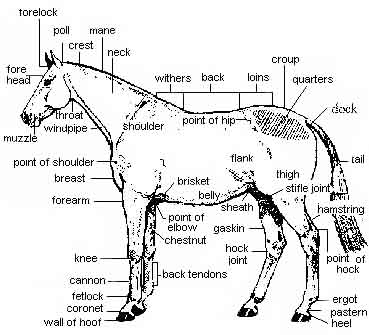
Where is the Stifle Joint located? (Hint <edu2.html>)

Below the knee on the front leg
Where the tail meets the hindquarters
Rear leg, above the hock
Where the skull meets the vertebrae

What is another name for a horse shoer?

Metal bender
Farrier
Vet
Hoof saver

Which of these IS a part of the English saddle?

Jockey
Horn
Flap
Fenders

A mule is a cross between a?

Donkey & horse
Arab & Appy
Zebra & donkey
Pony & horse

Which of these is NOT a rodeo event?

cutting
bull riding
bareback bronco riding
barrel racing

How old do horses generally live to be? (Hint <edu4.html>)

10-15 years
20-25 years
30-40 years
40-60 years

How many gallons of water do horses drink a day? (Hint <edu4.html>)

10-15 gallons
2-4 gallons
6-9 gallons
15-25 gallons

What and where is the Gaskin? (Hint <edu2.html>)

A muscle on the rear leg
A bone in the tail
A nerve under the tongue
A muscle on the belly

What is the horse's scientific name? (Hint <edu2.html>)

Equis
Equine
Horseum Nickerum
Equus Caballus

Which of these is NOT a type of snaffle bit?

Eggbutt
Curb
D-ring
O-ring

Which of these IS a part of the Western saddle?

Jockey
Corn
Over-n-under
Stirrup Iron

ANSWERS

Which of these is the smallest breed of horse? Fallabella

What is a baby horse called when it's at weaning age? Weanling

Where is the Stifle Joint located? Rear leg, above the hock

What is another name for a horse shoer? Farrier

Which of these IS a part of the English saddle? Flap

A mule is a cross between a? Donkey & horse

Which of these is NOT a rodeo event? Cutting

How old do horses generally live to be? 20-25 years

How many gallons of water do horses drink a day? 6-9 gallons

What and where is the Gaskin? The Gaskin is a muscle on the rear leg
above the hock and below the stifle.

What is the horse's scientific name? Equus Caballus

Which of these is NOT a type of snaffle bit? Curb

Which of these IS a part of the Western saddle? Jockey


Back

Hosted by www.Geocities.ws

1