A student is using a balance to measure 50 grams of powdered starch for an experiment. The student accidentally pours too much starch from the bottle onto the balance. What should the student do with the extra starch?
Pour the extra starch back into the bottle
Leave it on the balance in case other students need it
Put it in a chemical disposal container
Use the extra amount of starch in the experiment
Students must do the following four things after finishing an experiment. The steps are shown out of order. 1. Wash beaker 2. Put away unused chemicals 3. Wash hands 4. Wipe off lab bench Which of the steps should the students do last?
Wash beaker
Put away unused chemicals
Wash hands
Wipe off lab bench
These are the distances from the planets to the sun: Mercury: 58,000,000 km, Venus: 110,000,000 km, Earth: 150,000,000 km, Mars: 230,000,000 km, Jupiter: 780,000,000 km, Saturn: 1,400,000,000 km, Uranus: 2,900,000,000 km, Neptune: 4,500,000,000 km, Pluto: 5,900,000,000 km. Some students are preparing a report on our solar system. Which of the following would be the MOST effective way to present the data above?
Flow chart
Line graph
Map
Table
A student mixed two clear liquids in a beaker, then covered the beaker and let it sit. White crystals formed at the bottom of the beaker. The student concluded that the crystals are a new substance formed by the two liquids. Which of the following observations, if made by the student, MOST strengthen the student's conclusion?
The liquid in the beaker has remained clear.
The beaker has become cooler to the touch.
The mass of the liquid in the beaker has remained the same.
The beaker has not vibrated or moved from its original spot.
Michael Faraday thought that because an electric current could create a magnetic field, a magnetic field should be able to create an electric current. Faraday's research proved his idea correct and laid the groundwork for the invention of the —
generator
electric stove
light bulb
propane heater
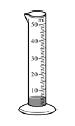
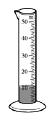
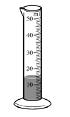
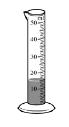
Students experimenting with chemical changes need to measure 15 mL of vinegar. Which graduated cylinder below contains 15 mL of vinegar?
Some students are investigating the similarities and differences between plant and animal cells. Which of the following sets of equipment would be MOST useful for this investigation?
Microscope and slides
Hand lens and razor blades
Microscope and graduated cylinder
Triple beam balance and microscope
Some students riding bicycles coasted down a large hill. Later in their trip, they coasted down a small hill. Their speed at the bottom of the large hill was greater than their speed at the bottom of the small hill. Which of the following statements MOST likely explains why their final speed on the large hill was greater?
The large hill had greater mass than the small hill.
There was more friction coasting down the large hill.
The large hill was taller than the small hill.
The small hill had a bumpier surface than the large hill.
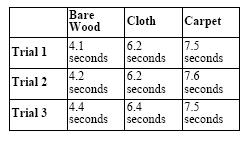
Some students were studying the effects of friction on the motion of objects. They slid a block down a 1-meter long wooden ramp three times and recorded the time it took to travel the length of the ramp. The students repeated the procedure with the ramp covered with cloth, and then again with the ramp covered with carpet. Their data are in the chart below. Which conclusion MOST completely describes the results of this experiment?
Carpet produces the greatest frictional force.
Bare wood does not produce frictional force.
Carpet produced more frictional force than cloth or wood.
Carpet, cloth, and wood each have a different frictional force.
Scientists often study examples in nature when designing future technology. A scientist studies bacteria that live near fuel tanks and feed on materials that are toxic to ocean birds. This research will MOST likely lead to —
the extinction of seagulls
the creation of new oil fields
discovery of new gas deposits
a new way to clean up pollution
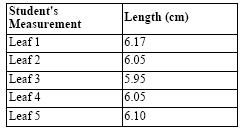
A student measured the length of five leaves with a centimeter ruler. The lengths that the student measured are shown in the table. Which is the average length of the leaves that the student measured?
5.95 cm
6.00 cm
6.06 cm
6.17 cm
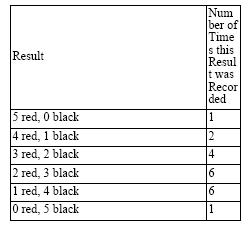
A student wanted to study ant populations. The student set up a small bottle containing a piece of food. The student recorded the color of the first five ants to walk into the bottle. The student repeated the experiment 20 times. The results are shown in the table. In which percent of the trials did EXACTLY two black ants walk into the bottle?
80%
40%
25%
20%
A student slides two slabs of clay on a table to model Earth's tectonic plates. Which of the following would be hardest to show using this model?
How sliding tectonic plates can move in different directions
How colliding tectonic plates form mountain ranges
How a volcano forms in the middle of a tectonic plate
How a new sea could form in the space left when plates move apart
Which of these is the best way to show the shapes of the organs of the digestive system?
Making a chart that has a picture of each of the organs
Creating a data table that lists each organ along with its function
Using the length and width of each organ to make a scatter plot
Drawing a map of the body that has an X in the position of each organ
A scientist studied 700 children with colds. One half of the students were given a new cold medicine. The other half of the children had no medicine. It took all of the children about 10 days to get over their colds. About 7% of the children taking the medicine got a mild rash. About 3% of the children not taking the medicine got a mild rash. The information above best supports the conclusion that the new medicine probably —
reduces the number of colds children have
causes a rash in some children
shortens the length of time children have colds
prevents the spread of colds to children
Long ago people believed Earth was flat. Which of these would have been the best observation to use to show the people that this hypothesis was wrong?
Water flows down hill.
The sun rises from the east every day.
A shadow cast on the moon during a lunar eclipse is circular.
On the ocean the horizon looks the same in every direction.
A chemical change is
reversible
permanent
a phase change
rare
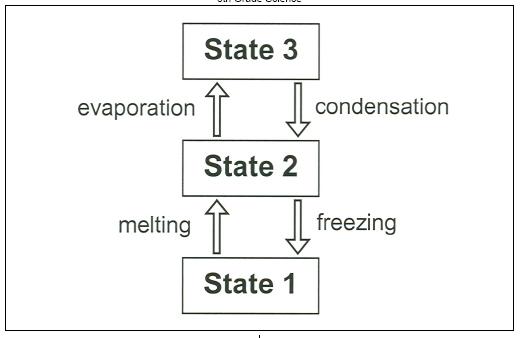
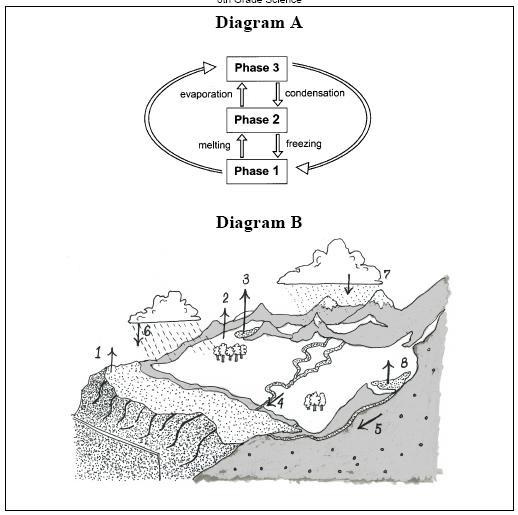
By studying the terms and directions of arrows in the diagram, you can determine that
State 1 is a gas, state 2 is a solid, state 3 is a liquid.
State 3 is a solid, state 2 is a liquid, state 1 is a gas.
State 1 is a solid, state 2 is a liquid, state 3 is a gas.
State 1 is a liquid, state 2 is a solid, state 3 is a gas.
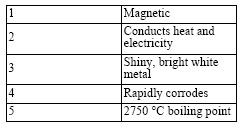
Properties of Iron Using the table above, which of the following represent the chemical property(ies) of iron?
1, 2, 3, 5
4
5
1, 2
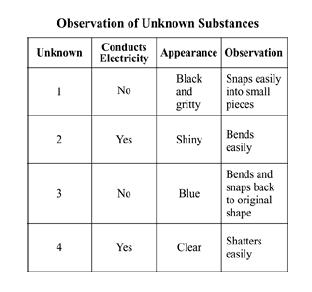
Students were given four unknown substances and asked to observe their characteristics. Their observations are shown in the table below. Which of the unknown substances is MOST likely a metal?
1
2
3
4
A teacher had two clear liquids, Liquid A and Liquid B. The teacher filled one beaker with Liquid A, and then added Liquid B drop by drop until solid crystals suddenly formed on the bottom of the beaker. Which of these is the MOST LIKELY explanation for what happened?
Liquid A changed phases from a liquid to a solid state.
Liquid B evaporated, leaving behind solids that had been dissolved in it.
Liquid A and Liquid B combined to form a new solid substance.
Liquid A and Liquid B did not mix because they had different properties.
Vanessa had a beaker with a small amount of baking soda. She added a few drops of vinegar to the baking soda and observed fizzing and bubbling. Based on her observation, which of these can Vanessa determine about the new substance formed by mixing the baking soda and vinegar?
It was hot.
It was a gas.
It was magnetic.
It was a conductor.
Howard poured a liter of blue colored water in a 2-liter glass jar and added a couple of rocks to the bottom. He inverted an empty 2-liter glass jar on top of the first, tightly taped the two jars together, and placed them in a sunny, warm window. After 24 hours, he observed changes in the jar. Howard made a second model, substituting salt water for blue colored water. After having both setups in the window for two days, he noticed that the condensed drops on both jars were colorless. He concluded that
Pure water evaporates faster than mixtures.
The condensed droplets in jar 1 were actually blue but were too small for any color to be detected.
It wasn’t warm enough to evaporate the solid particles along with the liquid.
The colored particles do not evaporate just as salt and pollutants are left behind when water evaporates from oceans.
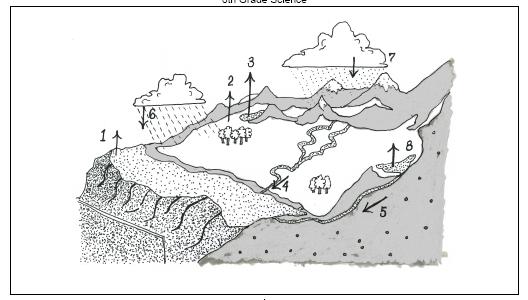
In which stages does water change from a liquid to a gas?
4, 5
1, 2, 3, 8
6, 7
all the stages
Interpret both diagrams to choose the correct statement below.
Diagram A: phase 3 = Diagram B: 1, 2, 3, 8
Diagram A: X = Diagram B: 3, 5
Diagram A: Z = Diagram B: 4, 5
Diagram A: phase 1 = Diagram B: 6, 7
The ability to do work can also be defined as
force
energy
matter
pressure
Which of these pathways can energy from the Sun take through an ecosystem?