Majapahit was an Indianized kingdom
based in eastern Java from 1293 to around 1500. Its greatest ruler was Hayam
Wuruk, whose reign from 1350 to 1389 marked the empire's peak when
it dominated other kingdoms in the southern Malay Archipelago, Borneo, Sumatra, Bali, and the Philippines.
The Majapahit empire was the last of the major Hindu empires of the Malay archipelago and
is considered one of the greatest states in Indonesian history.[2]
Its influence extended to states on Sumatra, the Malay Peninsula, Borneo and eastern
Indonesia, though the extent of its influence is the subject of debate.[3]
Historiography
Little physical evidence of Majapahit remains,[4] and its
detailed history is not very clear.[5]
The main sources that are used by historians are: the Pararaton ('Book of
Kings') written in Kawi language and Nagarakertagama in
Old Javanese.[6]
Pararaton is mostly about Ken Arok (the founder of Singhasari)
but includes a number of shorter narrative fragments about the formation of
Majapahit. Nagarakertagama, on the other hand, is an old Javanese epic poem
written during the Majapahit golden age under the reign of Hayam
Wuruk after which events are not so clear.[5]
In addition, there are some inscriptions in Old Javanese and Chinese
records.
The accuracy of all of the Javanese sources is in dispute. There is no doubt
that they incorporate some non-historical, mythological elements, and some
scholars such as C. C. Berg consider the entire corpus to be not a record of the
past, but a supernatural means by which the future can be determined.[7] However,
most scholars do not accept this view, as the basic outline corresponds with
Chinese records that could not share this intention. The list of rulers and the
nature of the state, in particular, seem rather certain.[5]
History
Formation
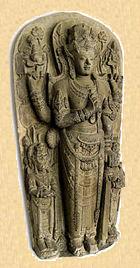 | | The statue of Harihara, the god combination
of Shiva and Vishnu. It was the mortuary deified portrayal of Kertarajasa. Originally
located at Candi Simping, Blitar and the statue is now preserved at National Museum of Indonesia. |
|
| |
After defeating Srivijaya in Sumatra in 1290,
Singhasari became the most powerful kingdom in the area. Kublai Khan, the ruler of
the Chinese Yuan Dynasty, challenged
Singhasari by sending emissaries demanding tribute. Kertanegara, the last ruler
of Singhasari, refused to pay the tribute. In 1293, Kublai Khan sent a massive
expedition of 1,000 ships to Java.
By that time, Jayakatwang,
the Adipati (Duke) of Kediri, a
vassal state of Singhasari, had usurped and killed Kertanagara. After being
pardoned by Jayakatwang with the aid of Madura's regent, Arya Wiraraja; Raden
Wijaya, Kertanegara's son-in-law, was given the land of Tarik timberland. He
then opened that vast timberland and built a new village there. The village was
named Majapahit, which was taken from a fruit name that had bitter taste
in that timberland (maja is the fruit name and
pahit means bitter). When Mongolian Yuan army sent by Kublai Khan
arrived, Wijaya allied himself with the army to fight against Jayakatwang. Once
Jayakatwang was destroyed, Raden Wijaya forced his allies to withdraw from Java
by launching a surprise attack.[8] Yuan's
army had their last chance to catch the monsoon winds home; otherwise,
they would have had to wait for another six months on a hostile island.
In AD 1293, Raden Wijaya founded a
stronghold with the capital Majapahit. The exact date used as the birth of the
Majapahit kingdom is the day of his coronation, the 15th of Kartika month in the year 1215
using the Javanese �aka calendar, which equates to November 10, 1293. During his
coronation he was given formal name Kertarajasa Jayawardhana.
The new kingdom faced challenges. Some of Kertarajasa's most trusted men,
including Ranggalawe, Sora,
and Nambi rebelled against him, though unsuccessfully. It was suspected that the
mahapati (equal with prime minister) Halayudha
set the conspiracy to overthrow all of the king's opponents, to gain the highest
position in the government. However, after following the death of the last rebel Kuti,
Halayudha was captured and jailed for his tricks, and then sentenced to
death.[9] Wijaya himself died in AD 1309.
Wijaya's son and successor, Jayanegara
was notorious for immorality. One of his sinful acts was taking his own
stepsisters as wives. He was entitled Kala Gemet, or "weak villain". In
AD 1328, Jayanegara was murdered by his doctor, Tantja. His stepmother, Gayatri
Rajapatni, was supposed to replace him, but Rajapatni retired from court to
become a bhiksuni (a female Buddhist monk) in a monastery.
Rajapatni appointed her daughter, Tribhuwana Wijayatunggadewi, or known in her formal name as Tribhuwannottungadewi
Jayawishnuwardhani, as the queen of Majapahit under Rajapatni's auspices. During
Tribhuwana�s rule, the Majapahit kingdom grew much larger and became famous in
the area. Tribhuwana ruled Majapahit until the death of her mother in AD 1350.
She was succeeded by her son, Hayam Wuruk.
Golden age
 | | 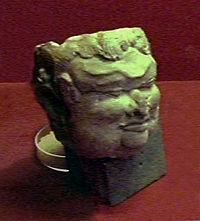
The terracotta portrait of Gajah Mada. Collection of Trowulan
Museum. |
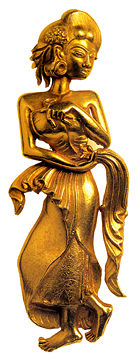
| The graceful Bidadari Majapahit, golden celestial apsara in Majapahit
style perfectly describes Majapahit as "the golden age" of archipelago. |
| |
Hayam Wuruk, also known as Rajasanagara, ruled Majapahit in AD 1350�1389.
During his period, Majapahit attained its peak with the help of his prime
minister, Gajah Mada. Under Gajah
Mada's command (AD 1313�1364), Majapahit conquered more territories. In 1377, a
few years after Gajah Mada's death, Majapahit sent a punitive naval attack
against Palembang,[2]
contributing to the end of the Srivijayan kingdom. Gajah
Mada's other renowned general was Adityawarman, known for his
conquest in Minangkabau.
According to the book of Nagarakertagama pupuh
(canto) XIII and XIV mentioned several states in Sumatra, Malay Peninsula, Borneo, Sulawesi, Nusa Tenggara islands, Maluku,
New Guinea, and some parts of Philippines islands as under
Majapahit realm of power. This source mentioned of Majapahit expansions has
marked the greatest extent of Majapahit empire.
The Nagarakertagama, written
in 1365 depict a sophisticated court with refined taste in art and literature,
and a complex system of religious rituals. The poet describes Majapahit as the
centre of a huge mandala extending from New Guinea
and Maluku to Sumatra and Malay Peninsula. Local
traditions in many parts of Indonesia retain accounts in more or less legendary from 14th century
Majapahit's power. Majapahit's direct administration did not extend beyond east Java
and Bali, but challenges to Majapahit's claim to overlordship in outer islands drew forceful
responses. [10]
The nature of the Majapahit empire and its extent is subject to debate. It
may have had limited or entirely notional influence over some of the tributary states in
included Sumatra, the Malay Peninsula, Kalimantan
and eastern Indonesia over which of authority was claimed in the
Nagarakertagama.[11]
Geographical and economic constraints suggest that rather than a regular
centralised authority, the outer states were most likely to have been connected
mainly by trade connections, which was probably a royal monopoly.[2]
It also claimed relationships with Champa, Cambodia, Siam, southern Burma, and Vietnam, and even sent missions
to China.[2]
Although the Majapahit rulers extended their power over other islands and
destroyed neighboring kingdoms, their focus seems to have been on controlling
and gaining a larger share of the commercial trade that passed through the
archipelago. About the time Majapahit was founded, Muslim traders and proselytizers began entering
the area.
Decline
Following Hayam Wuruk's death AD 1389, Majapahit power entered a period of
princess Kusumawardhani, who married a relative, Prince Wikramawardhana. Hayam
Wuruk also had a son from his previous marriage, crown prince Wirabhumi,
who also claimed the throne. A civil war, called Paregreg,
is thought to have occurred from 1405 to 1406,[5]
of which Wikramawardhana was victorious and Wirabhumi was caught and
decapitated. Wikramawardhana ruled to 1426 AD and was succeeded by his daughter
Suhita, who ruled from 1426 to 1447 AD. She was the second child of Wikramawarddhana by a
concubine who was the daughter of Wirabhumi.
In 1447, Suhita died and was succeeded by Kertawijaya,
her brother. He ruled until 1451 AD. After Kertawijaya died, Bhre
Pamotan became a king with formal name Rajasawardhana and ruled at
Kahuripan. He died in 1453 AD. A three year kingless period was possibly the
result of a succession crisis. Girisawardhana,
son of Kertawijaya, came to power 1456. He died in 1466 AD and was succeeded by
Singhawikramawardhana. In 1468 AD Prince Kertabhumi rebelled against
Singhawikramawardhana promoting himself king of Majapahit.
Singhawikramawardhana moved the Kingdom�s capital to Daha and continued his
rule until he was succeeded by his son Ranawijaya
in 1474 AD. In 1478 AD he defeated Kertabhumi and reunited Majapahit as one
Kingdom. Ranawijaya ruled from 1474 AD to 1519 AD with the formal name
Girindrawardhana. Nevertheless, Majapahit's power had declined through these
family conflicts and the growing power of the north-coastal kingdoms in Java.
Majapahit found itself unable to control the rising power of the Sultanate of
Malacca. Dates for the end of the Majapahit Empire range from 1478 (that is,
1400 Saka, the ends of centuries
being considered a time when changes of dynasty or courts normally ended[12]) to
1527. The year is marked among Javanese today with candra sengkala
"sirna ilang kertaning bumi" (the wealth of earth disappeared and
diminished) (sirna = 0, ilang = 0, kerta = 4, bumi =
1). After series of battles with the Sultanate of Demak,
the last remaining courtsmen of Majapahit were forced to withdraw eastward to Kediri; it is unclear
whether they were still under the rule of the Majapahit dynasty. This small
state was finally extinguished at the hands of the Demak in 1527.[13]
A large number of courtiers, artisans, priests, and members of the royalty moved
east to the island of Bali; however, the crown and the
seat of government moved to Demak under the leadership of Pengeran, later Sultan
Fatah. The Muslim emerging forces defeated the local
Majapahit kingdom in the early 16th century.
Culture
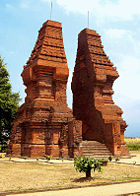
Wringin Lawang, the 15.5 meter tall red brick
split gate. Located at Jatipasar, Trowulan, Mojokerto, East Java.
Believed to be the entrance of an important compound in Majapahit
capital.
|
"Of all the buildings, none lack pillars, bearing fine carvings and
coloured" [Within the wall compounds] "there were elegant pavilions roofed
with aren fibre, like the scene in a painting... The petals of the
katangga were sprinkled over the roofs for they had fallen in the wind.
The roofs were like maidens with flowers arranged in their hair, delighting
those who saw them".
� Description of the Majapahit capital from the
Old Javanese epic poem Nagarakertagama. |
|
| |
The main event of the administrative calendar took place on the first day of
the month of Caitra (March-April) when
representatives from all territories paying tax or tribute to Majapahit came to the
capital to pay court. Majapahit's territories were roughly divided into three
types: the palace and its vicinity; the areas of east Java and Bali which were
directly administrated by officials appointed by the king; and the outer dependencies which enjoyed
substantial internal autonomy. [14]
The capital (Trowulan) was grand and known
for its great annual festivities. Buddhism, Shaivism, and Vaishnavism were all
practiced, and the king was regarded as the incarnation of the three. The
Nagarakertagama does not mention Islam, but there were certainly
Muslim courtiers by this time.[2]
Although brick had been used in the candi of
Indonesia's classical age, it was Majapahit architects of the 14th and 15th
centuries who mastered it.[15]
Making use of a vine sap and palm sugar mortar, their
temples had a strong geometric quality.
Economy
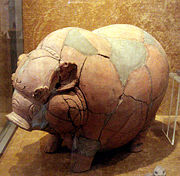 | | Majapahit Terracotta Piggy Bank, 14-15 century AD Trowulan, East Java.
(Collection of National Museum of Indonesia, Jakarta) |
|
| |
Taxes and fines were paid in
monetisided since the late 8th century, using gold and silver coins. In about
the year 1300, in the reign of Majapahit's first king, an important change took
place: the indigenous coinage was completely replaced by imported Chinese copper
cash. The reason for this is not given in any source, but most scholars assume
it was due to the increasing complexity of Javanese economy and a desire for a
currency system that used much smaller denominations suitable for use in everyday market
transactions. This was a role for which gold and silver are not well suited.
[16]
Some idea of scale of the internal economy can be gathered from scattered
data in inscriptions. The Canggu inscriptions dated 1358 mentions 78 ferry
crossings in the country (mandala Java). [17]
Majapahit inscriptions mention a large number of occupational specialities,
ranging from gold and silver smiths to drink vendors and butchers. Although many
of these occupations had existed in earlier times, the proportion of the
population earning an income from non-agrarian pursuits seems to have become
even greater during the Majapahit era.
The great prosperity of Majapahit was probably due to two factors. Firstly,
the northeast lowlands of Java were suitable for rice cultivation, and during
Majapahit's prime numerous irrigation projects were undertaken, some with
government assistance. Secondly, Majapahit's ports on the north coast were
probably significant stations along the route to obtain the spices of Maluku, and as the spices passed
through Java they would have provided an important source of income for
Majapahit.[18]
The Nagarakertagama states that the fame ruler of Wilwatikta (a synonym for
Majapahit) attracted foreign merchants from far and wide, including Indians, Khmers, Chinese among others. A
special tax was levied against some foreigners, possibly those who had taken up
semi-permanent residence in Java and conducted some type of enterprise other than foreign trade
Legacy
 | 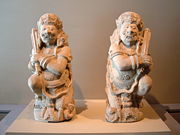
Pair of door guardians from a temple, Eastern Java, 14th
century (Museum of Asian Art, San Francisco) |
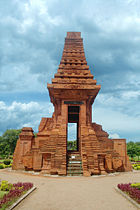
| The elegant 16.5 metres tall Bajang Ratu gate, at Trowulan, echoed
the grandeur of Majapahit. |
| |
In sum, Majapahit was the largest empire ever to form in Southeast Asia.
Although its political power beyond the core area in east Java was diffuse,
constituting mainly ceremonial recognition of suzerainity, Majapahit society
developed a high degree of sophistication in both commercial and artistic
activities. Its capital was inhabited by a cosmopolitan population among whom
literature and art flourished. [19]
For Indonesians in later centuries, Majapahit became a symbol of past
greatness. The Islamic sultanates of Demak, Pajang, and Mataram sought to
establish their legitimacy in relation to the Majapahit.[20] The
Demak claimed a line of succession through Kertabumi, as its founder, Raden
Patah, in court chronicles was said to be the son of Kertabumi with Putri
Cina, a Chinese princess, who had been sent away before her son was born.[13]
Sultan Agung's conquest of Wirasaba
in 1615, led by the sultan himself, may have had such importance as it was the
location of the Majapahit capital.[21]
Central Javanese palaces have traditions and genealogy that attempt to
prove links back to the Majapahit royal lines - usually in the form of a grave
as a vital link in Java - where legitimacy is enhanced by such a
connection. Bali in partic
Majapahit and they consider themselves to be the true heirs of the kingdom.[15]
Modern Indonesian nationalists, including those of the early 20th century Indonesian
National Revival, have invoked the Majapahit Empire. The memory of its
greatness remains in Indonesia, and is sometimes seen as a precedent for the
current political boundaries of the Republic.[2]
Many of modern Indonesian national symbols derived from Majapahit Hindu-Buddhist
elements. Indonesian national flag "Sang Merah Putih"
("Red and White") or sometimes called "Dwiwarna" ("The bicolor" ), derived from
Majapahit royal color. Indonesian Navy flag of red and white stripes also has
Majapahit origin. The Indonesian national motto, "Bhinneka Tunggal
Ika", is a quotation from an Old Javanese poem
"Kakawin Sutasoma", written by Majapahit poet, Mpu Tantular.
The Indonesian coat of arms, Garuda
Pancasila, also derive from Javanese Hindu elements. The statue and relief of Garuda has been found in many
temples in Java such as Prambanan from ancient Mataram era, and Panataran
also Sukuh
temple dated from Majapahit era. The notable statue of Garuda is the statue of
king Airlangga that depicted as Vishnu riding Garuda.
In its propaganda from the 1920s, the Communist Party
of Indonesia presented its vision of a classless society as a reincarnation
of a romanticized Majapahit.[22]It was
invoked by Sukarno for nation building and by the New Order as
an expression of state expansion and consolidation.[23] Like
Majapahit, the modern state of Indonesia covers vast territory and is
politically centred on Java.
Majapahit had a momentous and lasting influence on Indonesian
architecture. The descriptions of the architecture of the capital's
pavilions (pendopo) in the
Nagarakertagama (see the quotation above) invokes the Javanese Kraton and also the
Balinese temples and compounds of today.
Palapa, the series of communication satellites owned by Telkom, an Indonesian
telecommunication company, named after Sumpah Palapa, the famous oath
taken by Gajah Mada. Gajah Mada swore
that he would not taste any spice as long as he had not succeeded to unify
Nusantara (Indonesian archipelago). This ancient oath of unification, signify
Palapa satellite as the modern means to unify Indonesian archipelago by way of
telecomunication. The name was chosen by president Suharto, and the program was
started in February 1975.
List of rulers
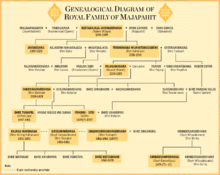
| | Genealogy of the Majapahit Royal Family. Rulers are highlighted.[24] |
|
| |
- Raden Wijaya, styled Kertarajasa Jayawardhana (1294 - 1309)
- Kalagamet, styled Jayanagara (1309 - 1328)
- Sri Gitarja, styled Tribhuwana Wijayatunggadewi (1328 - 1350)
- Hayam Wuruk, styled Sri Rajasanagara (1350 - 1389)
- Wikramawardhana (1389 - 1429)
- Suhita (1429 - 1447)
- Kertawijaya, styled Brawijaya I (1447 - 1451)
- Rajasawardhana, born Bhre Pamotan, styled Brawijaya II (1451 - 1453)
- Bhre Wengker, Purwawisesa or Girishawardhana,
styled Brawijaya III (1456 - 1466)
- Singhawikramawardhana, Pandanalas, or Suraprabhawa,
styled Brawijaya IV (1466 - 1468 or 1478[5])
- Kertabumi, styled Brawijaya V (1468 - 1478)
- Girindrawardhana, styled Brawijaya VI (1478 - 1498)
Majapahit in popular culture
Celebrated as 'the golden era of the archipelago', Majapahit empire has and
still continue to inspired many writers and artists to create their works based
on, described, or mentioned this era. The impact of Majapahit theme in popular
culture are:
- Sandyakalaning Majapahit (1933), or Twilight/Sunset in Majapahit is
historical romance written by Sanusi Pane, took place during the fall of
Majapahit empire.
- Panji Koming (since 1979), a weekly comic strip by Dwi
Koendoro published in Sunday edition of Kompas, telling the everyday
life of Panji Koming, a common Majapahit citizen. Although took place in
Majapahit era, the comic strip serve as witty satire and critics of
modern Indonesian society. From politic, social, culture and many aspect of
today Indonesia describe as the 'reincarnation' of
Majapahit empire. Present serving Indonesian president often portray as
Majapahit monarch or prime minister.
- Saur Sepuh (1987-1991), radio drama and film by Niki Kosasih. Begin
as the popular radio drama program in late 80s, Saur Sepuh is based on 15th
century Java, centered around the story about fictional hero; Brama Kumbara,
the king of Madangkara, a fictional kingdom neighbour of Pajajaran. On several
story describe the Paregreg war, the civil war of Majapahit between
Wikramawardhana against Bhre Wirabhumi. This part the become the single film
titled the same 'Saur Sepuh'.
- Tutur Tinular, radio drama and film by S Tidjab. Tutur Tinular is a
martial art historical
epic fictional story with Majapahit era as the background of the story. The
story also involved romance between hero named Arya Kamandanu, an
lover Mei Shin.
- Wali Songo, the film tell story about nine muslim saints ('wali') that
spreading Islam
to Java. The story took place near the end of Majapahit era and the formation
of Demak. Describing the
decaying Majapahit empire where royalties are fighting each others for power,
while commoners are suffering.
- Senopati Pamungkas (1986, reprinted in 2003), a novel by Arswendo
Atmowiloto. Also a martial art-historical epic fiction. Took place in late
Singhasari period and formation of Majapahit. This novel describe the saga,
royal intrigue, and romance of the formation of Majapahit kingdom, also the
adventure of main character, a commoner named Upasara Wulung and his forbidden
love with princess Gayatri Rajapatni, later she become the consort of Raden
Wijaya, the first king of Majapahit.
- Imperium Majapahit, comic book series by Jan Mintaraga, Published
by Elexmedia Komputindo. This series telling the history of Majapahit from the
formation until the decline.
- Puteri Gunung Ledang (2004), a Malaysian epic film based on
traditional Malay Legend. This film telling the lovestory between Gusti Putri
Retno Dumilah, a Majapahit Princess, and Hang Tuah, a Malaccan admiral.
- Gajah
Mada, a pentalogy written by Langit Kresna Hariadi, about fictionalized detail of Gajah Mada's life from
Kuti rebellion until Bubat War.
- Dyah Pitaloka, a novel written by Hermawan Aksan, about fictionalized
detail lifestory of Sunda Princess Dyah Pitaloka, focussed around the Bubat
War. The novel pretty much took the same context and inspired by Kidung Sundayana.
References
General
- M.C. Ricklefs, A History of Modern Indonesia Since c. 1300, 2nd ed.
Stanford: Stanford University Press, 1991
Notes
- ^ D.G.E. Hall (1956). "Problems of Indonesian
Historiography". Pacific Affairs 38 (3/4): 353�359. doi:10.2307/2754037.
- ^ a
b
c
d
e
f
Ricklefs (1991), page 19
- ^ Prapantja,
Rakawi, trans. by Theodore Gauthier Pigeaud, Java in the 14th Century, A
Study in Cultural History: The Negara-Kertagama by Pakawi Parakanca of
Majapahit, 1365 AD (The Hague, Martinus Nijhoff, 1962), vol. 4, p. 29. 34;
G.J. Resink, Indonesia�s History Between the Myths: Essays in Legal History
and Historical Theory (The Hague: W. van Hoeve, 1968), p. 21.
- ^ Taylor, Jean Gelman (2003).
Indonesia: Peoples and Histories. New Haven and London: Yale University
Press, pp.29. ISBN 0-300-10518-5.
- ^ a
b
c
d
e
Ricklefs (1991), page 18
- ^
Johns, A.H. (1964). "The Role of Structural Organisation and Myth in Javanese
Historiography". The Journal of Asian Studies 24 (1): 91�99.
doi: 10.2307/2050416.
- ^ C. C. Berg.
Het rijk van de vijfvoudige Buddha (Verhandelingen der Koninklijke
Nederlandse Akademie van Wetenschappen, Afd. Letterkunde, vol. 69, no. 1)
Ansterdam: N.V. Noord-Hollandsche Uitgevers Maatschappij, 1962; cited in M.C.
Ricklefs, A History of Modern Indonesia Since c. 1300, 2nd ed.
Stanford: Stanford University Press, 1993, pages 18 and 311
- ^ Slamet
Muljana. Menuju Puncak Kemegahan (LKIS, 2005)
- ^ Slamet
Muljana. Menuju Puncak Kemegahan (LKIS, 2005)
- ^ Millet, Didier (Hardcover edition - Aug
2003). Indonesian Heritage Series: Ancient History. Singapore 169641:
Archipelago Press, page 106. ISBN
981-3018-26-7.
- ^
Cribb, Robert, Historical Atlas of Indonesia, University of Hawai'i
Press, 2000
- ^ Ricklefs, 37 and 100
- ^ a
b Ricklefs, 36-37
- ^ Millet, Didier (Hardcover edition - Aug
2003). Indonesian Heritage Series: Ancient History. Singapore 169641:
Archipelago Press, page 107. ISBN
981-3018-26-7.
- ^ a
b
Schoppert, P., Damais, S. (1997).
in Didier Millet: Java Style. Paris: Periplus Editions, 33�34. ISBN
962-593-232-1.
- ^ Millet, Didier (Hardcover edition - Aug
2003). Indonesian Heritage Series: Ancient History. Singapore 169641:
Archipelago Press, page 107. ISBN
981-3018-26-7.
- ^ Millet, Didier (Hardcover edition - Aug
2003). Indonesian Heritage Series: Ancient History. Singapore 169641:
Archipelago Press, page 107. ISBN
981-3018-26-7.
- ^ Millet, Didier (Hardcover edition - Aug
2003). Indonesian Heritage Series: Ancient History. Singapore 169641:
Archipelago Press, page 107. ISBN
981-3018-26-7.
- ^ Millet, Didier (Hardcover edition - Aug
2003). Indonesian Heritage Series: Ancient History. Singapore 169641:
Archipelago Press, page 107. ISBN
981-3018-26-7.
- ^ Ricklefs, page 40
- ^ Ricklefs, page 43
- ^ Ricklefs, page 174
- ^ Friend, Theodore. Indonesian
Destinies. Cambridge, Massachusetts and London: Belknap Press, Harvard
University Press, p.19. ISBN
0-674-01137-6.
- ^ Bullough, Nigel (Indonesian 50th
independence day commemorative edition - 1995). Historic East Java: Remains
in Stone. Jakarta: ADLine Communications, page 116-117.
�������

