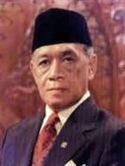
Sri Sultan Hamengku Buwono IX or Sri Sultan HB IX (April 12, 1912 - October 1, 1988) was the first Governor of the Yogyakarta Special Region, the ninth Sultan of Ngayogyakarta Hadiningrat Sultanate (the Sultanate of Yogyakarta) and the second vice president of Indonesia during the Suharto's reign.
Early life
Hamengkubuwono IX was born Raden Mas Dorodjatun in Sompilan,
Ngasem, Yogyakarta on 12 April 1912 to Gusti Pangeran
Haryo (Prince) Puruboyo and Raden Ajeng Kustillah. When Hamengkubuwono IX was
three, he was named Crown Prince to the Yogyakarta Sultanate after his father
ascended to the throne and became Sultan Hamengkubuwono VIII.
Hamengkubuwono IX had a distinctly Western education. When he was four, he
was sent away to live with a Dutch family. After completing his primary and
secondary education in 1931, Hamengkubuwono IX left Indonesia to attend the Leiden University in
the Netherlands. There
Hamengkubuwono IX took Indonesian studies and economics. He returned to
Indonesia in 1939.
Sultan of Yogyakarta
 With the death of Hamengkubuwono VIII in October 1939, Hamengkubuwono
ascended to the throne with a coronation ceremony on March 18, 1940. His full title is "Sampeyan
Dalem Ingkang Sinuwun Kanjeng Sultan Hamengkubuwono Senopati Ing Alogo
Ngabdurrakhman Sayidin Panotogomo Kholifatullah Ingkang Kaping Songo." During
his coronation speech, Hamengkubuwono recognized his Javanese origins and said "Even
though I have tasted Western Education, I am still and will always be a
Javanese."[1]
With the death of Hamengkubuwono VIII in October 1939, Hamengkubuwono
ascended to the throne with a coronation ceremony on March 18, 1940. His full title is "Sampeyan
Dalem Ingkang Sinuwun Kanjeng Sultan Hamengkubuwono Senopati Ing Alogo
Ngabdurrakhman Sayidin Panotogomo Kholifatullah Ingkang Kaping Songo." During
his coronation speech, Hamengkubuwono recognized his Javanese origins and said "Even
though I have tasted Western Education, I am still and will always be a
Javanese."[1]
Sri Sultan Hamengkubuwono IX also became a noted reformer. In his reign, the
office of the Sultan adopted a more democratic and decentralized approach. An
example of this was the granting of more power to local village chiefs and
general modernization of the way in which the court was managed. Hamengkubuwono
IX also changed the ways in which the Sultanate held its traditional ceremonies;
doing away with ceremonies which he considered to have become obsolete.
In 1942, the Dutch Colonial Government in Indonesia was defeated by the
Japanese Imperial Army. As the Japanese Imperial Army consolidated their hold on
Indonesia, many suggested that Hamengkubuwono IX evacuate himself and seek
asylum in Australia or the Netherlands. Hamengkubuwono IX refused this offer,
insisting that Sultan has to stay close to its people in times of crisis. In
fact, he saved his people from being sent to Burma to become romusha forced-labors, by asking
the Japanese to grant him to build a water canal, called Kali Mataram.
The Indonesian War of Independence
Directly after the declaration of Indonesian independence at 17 August 1945, Hamengkubuwono IX
together with Paku Alam VIII, the
Prince of Pakualaman decided to support
the newly formed Republic. Hamengkubuwono IX's support was immediately
recognized by the Central Government with an appointment to the
Life-Governorship of Yogyakarta with Paku Alam VIII as Vice Governor.
Yogyakarta's status was also upgraded to that of Special Region. In addition,
Hamengkubuwono IX served as Yogyakarta's Military Governor and was also Minister
of the State from 1945-1949.
It was not long however, before the Dutch returned to lay claim to their
former colony. Hamengkubuwono IX played a vital role in the resistance. In early
1946, the capital of Indonesia was quietly
relocated to Yogyakarta, in that time the
Sultan gave the new government some funds. When Indonesia first sought a
diplomatic solution with the Dutch Government, Hamengkubuwono IX was part of the
Indonesian delegation.
Things took a turn for the worse on 21 December 1948. That day, the Dutch
successfully occupied Yogyakarta and arrested Sukarno and Hatta, Indonesia's first
President and Vice President. The Dutch didn't dare to
overthrow the Sultan however. Hamengkubuwono IX did not leave Yogyakarta and
continued to serve as Governor. The Dutch viewed him with suspicion and at one
stage began to entertain the idea that Hamengkubuwono IX was either planning to
make Yogyakarta a completely autonomous region or setting his eyes on the
leadership of the Republic.[2]
The 1 March General Offensive
In early 1949, Hamengkubuwono IX conceived the idea of a major offensive to
be launched against Yogyakarta and the Dutch troops occupying it. The purpose of
this offensive was to show to the world that Indonesia still existed and that it
was not ready to surrender. Hamengkubuwono IX also thought that this would also
give the idea of Indonesian independence some legitimacy in the eyes of the
international community.
The idea was suggested to General Sudirman, the Commander of the
Indonesian Army and received his approval. In February 1949, Hamengkubuwono IX
had a meeting with then Lieutenant Colonel Suharto, the man chosen by
Sudirman to be the field commander for the offensive. After this discussion,
preparations were made for the offensive. This involved intensified guerilla
attacks in villages and towns around Yogyakarta so as to make the Dutch station
more troops outside of Yogyakarta and thin the numbers in the city itself.
On 1 March at 6 AM, Suharto and his troops launched the 1 March General Offensive. The
Offensive caught the Dutch by surprise. For his part, Hamengkubuwono IX allowed
his palace to be used as a hide out for the troops. For 6 hours, the Indonesian
troops had control of Yogyakarta before finally retreating. The Offensive was a
great success, inspiring demoralized troops all around Indonesia and most
importantly, caused the United Nations to
pressure the Netherlands to recognize Indonesia's Independence.
Minister in the Indonesian Government
After Indonesia's Independence was recognized by the Dutch Government,
Hamengkubuwono IX continued to serve the Republic. In addition to continuing his
duties as Governor of Yogyakarta, Hamengkubuwono IX continued to serve in the
Indonesian Go
Hamengkubuwono IX served as Minister of Defense and Homeland Security
Coordinator (1949-1951 and 1953), Vice Premier (1951), Chairman of the State
Apparatus Supervision (1959), Chairman of the State Audit Board (1960-1966), and
Coordinating Minister for Development while concurrently holding the position of
Minister of Tourism (1966).
In addition to these positions, Hamengkubuwono IX have also served as
Chairman of the Indonesian National Sports Committee (KONI) and Chairman of the
Tourism Patrons Council.
Transition from Old Order to Orde Baru
During the G30S Movement, in the
course of which six Generals were kidnapped from their homes and killed,
Hamengkubuwono IX was present in Jakarta. That morning, with President Sukarno's
location still uncertain, Hamengkubuwono was contacted by Suharto, who was now a
Major General and the Commander of Kostrad for advice. Suharto
suggested that because Sukarno's whereabouts are still unknown, Hamengkubuwono
IX should form a provisional Government to help counter the movement.[3]
Hamengkubuwono IX rejected the offer and contacted one of Sukarno's many wives
who confirmed Sukarno's whereabouts.
After Suharto had received Supersemar in March 1966,
Hamengkubuwono IX and Adam Malik joined him in a triumvirate to reverse
Sukarno's policies. Hamengkubuwono IX was appointed Minister of Economics,
Finance, and Industry and charged with rectifying Indonesia's Economic problems.
He would hold this position until 1973.
Vice Presidency
Ever since Mohammad Hatta resigned from the Vice Presidency in December 1956,
the position had remained vacant for the rest of Sukarno's time as President.
When Suharto was formally elected to the Presidency in 1968 by the People's
Consultative Assembly, it continued to remain vacant. Finally in March 1973,
Hamengkubuwono IX was elected as Vice President alongside Suharto who had also
been re-elected to a 2nd term as President.
Hamengkubuwono IX's election was not a surprise as he was a popular figure in
Indonesia. He was also a civilian and his election to the Vice Presidency was
hoped to complement Suharto's military background. Despite being officially
elected in 1973, it can be said that Hamengkubuwono IX had been the de facto Vice
President beforehand as he regularly assumed the leadership of the country
whenever Suharto was out of the country.[4]
As Vice President, Hamengkubuwono IX
also given the duty of supervising economic development.[5]
It was expected that the Suharto and Hamengkubuwono IX duet would be retained
for another term. However, Hamengkubuwono IX had become disillusioned with
Suharto's increasing authoritarianism and the increasing corruption.[6]
These two elements were also recognized by protesters who had demanded that
Suharto not stand for another term as President. These protests reached its peak
in February 1978, when students of Bandung Technological Institute (ITB)
published a book giving reasons as to why Suharto should not be elected
President. In response, Suharto sent troops to take over the campus and issued a
ban on the book.
As a man who believed in democracy, Hamengkubuwono could not accept what
Suharto had done. In March 1978, Hamengkubuwono rejected his nomination as Vice
President by the MPR. Suharto asked Hamengkubuwono to change his mind, but
Hamengkubuwono continued to reject the offer and cited health as his reason for
not accepting the nomination.[7]
Suharto took Hamengkubuwono IX's rejection personally and in his 1989 autobiography would claim
credit for conceiving the 1 March General Offensive.
Scout movement
Hamengkubuwono IX had been active with Scouts from the days of the Dutch
colonial government and continued to look after the movement once Indonesia
became independent. In 1968, Hamengkubuwono IX was elected Head of the national Scout movement.
Hamengkubuwono IX was also awarded the Bronze Wolf, the only
distinction of the World Organization of the Scout Movement, awarded by the World Scout Committee for
exceptional services to world Scouting, in 1973.
Death
Hamengkubuwono IX died at the George
Washington University Medical Center in the United States on October
1, 1988 and was buried at Imogiri. There is a special
museum dedicated to him in the sultan's palace (kraton) in Yogyakarta. He
was also given the title National Hero of
Indonesia, a distinction for Indonesian patriots. He was replaced by his
son, Raden Mas Herdjuno Darpito, who took the name Hamengkubuwono X.
Miscellaneous
Hamengkubuwono IX never had a Queen Consort during his reign; preferring
instead to take four concubines from which he had 21 children.
Hamengkubuwono IX was a fan of wuxia movies and novels.[8]
. He also enjoyed cooking and headed an unofficial cooking club which included
Cabinet Ministers as its members.
Quotes
- "Walaupun saya telah mengenyam pendidikan Barat yang sebenarnya, namun
pertama-tama saya adalah dan tetap adalah orang Jawa." (Even though I have
tasted Western Education, I am still and will always be a Javanese)
- "Izinkanlah saya mengakhiri pidato saya ini dengan berjanji, semoga saya
dapat bekerja untuk memuhi kepentingan nusa dan bangsa, sebatas pengetahuan
dan kemampuan yang ada pada saya." (Allow me to end my speech with a promise.
I hope that I will be able to work for in the interest of my Nation and
Country with all the knowledge and skill that I possess)
Notes
- ^
"Sri Sultan Hamengkubuwono IX, Bangsawan Yang Demokratis (Sri
Sultan Hamengkubuwono IX, the Democratic Aristocrat)". Tokoh Indonesia.
Retrieved on 28 October, 2006.
- ^ Elson, Robert [2001]. Suharto:
A Political Biography. UK: The Press Syndicate of the University of
Cambridge, p. 33. ISBN 0-521-77326-1.
- ^ Hughes,
John [1967] (2002). The End of Sukarno: A Coup That Misfired: A Purge That
Ran Wild, 3rd (in English), Singapore: Archipelago Press, p. 68. ISBN
981-4068-65-9.
- ^
Elson, Robert [2001]. Suharto:
A Political Biography. UK: The Press Syndicate of the University of
Cambridge, p. 167. ISBN
0-521-77326-1.
- ^
"Wakil Presiden, antara Ada dan Tiada" (The Vice Presidency,
between Existence and Non-Existence". Kompas (8 May 2004). Retrieved on 30 October,
2006.
- ^ Elson, Robert [2001]. Suharto:
A Political Biography. UK: The Press Syndicate of the University of
Cambridge, p. 225. ISBN
0-521-77326-1.
- ^
"Sultan Hamengkubuwono IX". Setwapres. Retrieved on 30 October, 2006.
- ^
"Komunitas Pendekar Penggebuk Anjing". Kompas. Retrieved on 28 October, 2006.
Further reading
- Soemardjan, S. 1989 In Memoriam: Hamengkubuwono IX, Sultan of Yogyakarta, 1912-1988 Indonesia. 47:115-117
�������

