The Sultanate of Demak was Muslim state located on Java's north coast in Indonesia, at
the site of the present day city of Demak. A port fief
thought to have been founded in the last quarter of the fifteenth century, it
was influenced by Islam brought by Arab and Gujarat traders. The sultanate
played an important role in the establishment
of Islam in Indonesia; the new religion's influence manifest by the
Great Demak Mosque Wali Songo (the 'Nine Saints').
Origins
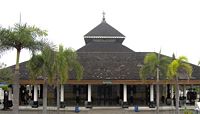
Demak Grand Mosque.
Demak�s origins are uncertain although it was apparently founded in the last
quarter of the fifteenth century by a foreign Muslim, probably a Chinese who was
perhaps named Cek Ko-po.[1]
It is thought that perhaps it was his son to whom the Portuguese gave the name
'Rodim', which most likely meaning 'Badruddin' or 'Kamaruddin', and he is
thought to have died c. 1504.[1]
Rodim�s son, or possibly his brother, was the founder of the Demak�s brief
domination in Java. Known as Trenggana, later Javanese traditions say he gave
himself the title Sultan. It appears Trenggana had two reigns�c 1505�1518
and c 1521�1546�between which his brother in law, King Yunnus of Jepara filled
in.[1]
One of Wali Songo, Sunan Kalijaga was the
teacher of Raden Patah and had great influence on the philosophy of the Kingdom.
Babad Tanah Jawa(or the Javanese Chronicle) recorded him as Jimbun.
Conquests
Trenggana spread Demak�s influence east and west and c 1527, during
his second regin, he conquered the last Javanese Hindu-Buddhist
state, Majapahit of East Java.
Majapahit had been in decline since the later fifteenth century and was in an
advanced state of collapse at the time of the Demak�s conquest.[1]
Majapahit's heirlooms were brought to Demak and adopted as Demak's royal
icons. Demak was able to subdue other major ports and its
reach extended into some inland areas of East Java that are not thought
to have been Islamised at the time. Although evidence is limited, it is known
that Demak's conquests covered much of Java: Tuban, an old Majapahit port
mentioned in Chinese sources from the eleventh century, was conquered c.
1527;
Raden Patah was succeeded by Pati Unus (1518 - 1521), known best for his two attempts in 1511 and 1521 to
seize the port of Malacca from the control of Portuguese. This
campaign attempt ended with a loss of the King's life.
The King's brother-in-law, Trenggana
(1522 - 1548), crowned by Sunan Gunung Jati (one of Wali Songo), became the
Third and the greatest King of Demak. He conquered the Hindu based ressistance
in Central Java, Banten, Sunda Kelapa (which will become Jakarta) in the future, and
ended his campaign as he was killed in Panarukan, [East Java] in 1548.
Javanese legends of Demak
Later Javanese chronicles
provide varying accounts of the conquest, but they all describe Demak as the
legitimate direct successor of Majapahit although, they do not mention the
possibility that by the time of its final conquest, Majapahit no longer ruled.
The first 'Sultan' of Demak, Raden Patah, is portrayed as the son of Majapahit's
last king by a Chinese princess who was exiled from the court before Patah's
birth. The chronicles conventionally date the fall of Majapahit at the end of
the fourteenth Javanese calendar, a
time when changes of dynasties or courst was though to occur. Although these
legends explain little about the actual events, they do illustrate that the
dynastic continuity survived Islamisation of Java.
Decline
The death of the strong King sparked the civil war of succession between the
King's younger brother, Sekar
Seda Lepen; and the King's son, Prince
Prawoto; all two were killed in this civil war; and finally Sekar's son, Arya
Penangsang won the throne.
Arya Penangsang soon faced heavy opposition from his own vassals due to his
unlikeable character, and soon was dethroned by a coalition of vassals led by Jaka
Tingkir, Lord of Boyolali, who had kinship with
the King Trenggana. Jaka Tingkir assumed the role as the King but he moved all
the Demak heirlooms and sacred artifacts to Pajang, then he ended the Demak
Kingdom history when he founded his new kingdom: the Kingdom of Pajang.
References
- ^ a
b
c
d
Ricklefs, M.C. 1991. A History of Modern Indonesia since c.1300. 2nd
Edition, Stanford: Stanford University Press. page 36, ISBN
0-333-57690-X
�������

