The Sultanate of Mataram was the last major independent Javanese empire on Java before the island was colonized by the Dutch.
It was the dominant political force in interior Central Java from the
late sixteenth century until the beginning of the eighteenth century.
The name "Mataram" does not refer to a particular polity, but to two
different kingdoms which have existed in the areas around present-day
Yogyakarta. Rulers of the earlier Mataram kingdom, which flourished in
Central Java between 712 and 938, practiced both Hinduism and Mahayana Buddhism. The kingdom vanished after two centuries, leaving behind archaeological evidence of great artistic and cultural achievement.
The second Mataram kingdom emerged from Demak, the most powerful
early Muslim kingdom on Java. Extensive military conquests during the
long reign of Sultan Agung Hanyokrokusumo, from 1613 to 1646, were
responsible for the great expansion and lasting historical legacy of
Mataram. In 1677, King Amangkurat II sought the assistance of the Dutch East India Company
(VOC) in reclaiming the throne which had been usurped by his rebellious
brother. In return, he made substantial concessions of land to the
Dutch East India Company, beginning seventy-five years of political and
military machinations among various Javanese princes and rulers,
Chinese rebels, and the Dutch, who sought to establish a stable trading
empire in Java. The kingdom of Mataram ended under an agreement signed
in 1755, dividing nominal control over central Java between the
Yogyakarta Sultanate, under Mangkubumi, and Surakarta, under Pakubuwana.
Early Mataram
The name Mataram itself was never the official name of any
specific polity. The name refers to the areas around present-day
Yogyakarta. Two kingdoms that have existed in this region are both
called "Mataram," but the second kingdom is called Mataram Islam to distinguish it from the Hindu ninth century Kingdom of Mataram.
The earlier Mataram kingdom flourished in Central Java between 712 and 938 C.E.[1]
The nature of ancient Javanese kingship is still unclear. Most of the
rulers were male, but women also held high positions and were able to
endow temples. The rulers practiced both Hinduism and Mahayan Buddhism.
The kings had many religious duties and were considered a “titisan
dewa,” a "droplet distilled from the essence of God," a semi-divine
union of heavenly and human aspects (binathara, the passive form of
"bathara," god). The responsibility of the king was to maintain the
relationship between the kingdom and the universe. The Javanese kingdom
was conceived of as a mandala or center of the world, focused on the
person of the king (variously called Sri Bupati, Sri Narendra, Sang
Aji, Prabu). The king was thought to be directly connected with Mount
Meru, the axis of the world, and was the master of the world. As the
royal icon, the king was considered the base of the kingdom's existence.
As Islam spread through Java, the concept of the king as a
semi-divine, priestly being was gradually replaced with the concept of
the ruler as a messenger of God (Kalifatullah).[2]
but the king continued to occupy a central role. Archaeological remains
testify to almost two centuries of artistic and cultural achievement
before the earlier Mataram suddenly vanished.
Dates of Mataram
The dates for events in Java and Mataram before the Siege of Batavia
in the reign of Sultan Agung, third king of Mataram, are difficult to
determine. The contemporary historian H.J. de Graaf used Javanese
annals, such as Babad Sangkala and Babad Momana, which
contain list of events and dates in Javanese calendar (A.J., Anno
Javanicus), but apart from the difficulty of translating Javanese years
to the modern calendar, the Javanese sources themselves are not in
agreement. In Javanese literature, only events such as the rise and
fall of kratons, the deaths of important princes, and great wars are
deemed important enough to be dated, by using a poetic formula called candrasengkala,
which can be expressed verbally and pictorially. All other events are
simply described in narrative succession without dates. These candrasengkalas do not always match the annals.
Therefore, the dates from historians de Graaf and Ricklefs for the
period before the Siege of Batavia are generally accepted as a best
guess. For the period after the Siege of Batavia (1628-29) until the
first War of Succession (1704), the dates of events in which foreigners
participated are recorded in their histories and reports, but are not
always consistent with Javanese versions of the stories. Events which
occurred between 1704-1755 can be dated with greater certainty, since
during that period the Dutch interfered deeply in Mataram affairs.
The rise of Mataram
Information in Javanese sources about the early years of the kingdom
is limited, and historical records are blended with myths. There are
indications that later rulers, especially Agung, made efforts to
establish a long line of legitimate descent by inventing predecessors.
By the time more reliable records begin in the mid-seventeenth century,
the kingdom was so large and powerful that most historians concur it
had already been established for several generations.
According to Javanese records, the kings of Mataram were descended
from one Ki Ageng Sela (Sela is a village near the present-day Demak).
Demak was the most powerful early Muslim kingdom on Java from 1518 to
1550, after which two kingdoms emerged, Banten on the northwest coast
and Mataram in central Java.[3]
In the 1570s, one of Ki Ageng Sela's descendants, Kyai Gedhe Pamanahan
became the ruler of the Mataram area with the support of the kingdom of
Pajang to the north, near the current site of Surakarta (Solo).
Pamanahan was often referred to as Kyai Gedhe Mataram.
Pamanahan's son, Sutawijaya or Panembahan Senapati Ingalaga,
replaced his father around 1584. Under Panembahan Senapati the kingdom
grew substantially through regular military campaigns against Mataram's
overlord Pajang, and Pajang's former overlord, Demak. After the defeat
of Pajang, Senapati assumed royal status by assuming the title
"Panembahan" (literally "one who is worshiped/sembah"). He began a
fateful campaign to the East along the course of the Solo River
(Bengawan Solo) that was to bring endless conflicts and the eventual
demise of his kingdom. He conquered Madiun in 1590-1, and turned east
from Madiun to conquer Kediri in 1591, and perhaps during the same time
also conquered Jipang (present day Bojonegoro), Jagaraga (north of
present day Magetan), and Ponorogo. His effort to conquer Banten in
West Java in 1597, witnessed by Dutch sailors, failed, perhaps due to
lack of water transport. He reached east as far as Pasuruan, whose
people may have used his advances as a threat to reduce pressure from
the then-powerful Surabaya.
The reign of Panembahan Seda ing Krapyak (c. 1601-1613), the son of
Senapati, was dominated by further warfare, especially against powerful
Surabaya, already a major center in East Java. He faced rebellion from
his relatives who were installed in the newly conquered area of Demak
(1602), Ponorogo (1607-8), and Kediri (1608). The first contact between
Mataram and the Dutch East India Company
(VOC) occurred under Krapyak. Dutch activities at the time were limited
to trading from limited coastal settlements, so their interactions with
the inland Mataram kingdom were minimal, although they did form an
alliance against Surabaya in 1613. Krapyak died that year.
Mataram under Sultan Agung
Krapyak was succeeded by his son, Raden Mas Rangsang, who assumed
the title Panembahan ing Alaga. Feeling threatened by the popularity of
the Isamic religious leaders (wali), he later took the title of Sultan
Agung Hanyokrokusumo ("Great Sultan") after obtaining permission from
Mecca to use the title of "Sultan." The extensive military conquests of
Agung's long reign, from 1613 to 1646, were responsible for the great
expansion and lasting historical legacy of Mataram. He attacked
Surabaya in 1614, and also Malang, south of Surabaya, and the eastern
end of Java. In 1615, he conquered Wirasaba (present day Mojoagung,
near Mojokerto). In 1616, Surabaya tried to attack Mataram, but this
army was crushed by Sultan Agung's forces in Siwalan, Pajang (near
Solo). The coastal city of Lasem, near Rembang, was conquered in 1616,
and Pasuruan, south-east of Surabaya, was taken in 1617. Tuban, one of
the oldest and biggest cities on the coast of Java, was taken in 1619.
Surabaya was Mataram's most difficult enemy. Senapati had not felt
strong enough to attack this powerful city and Krapyak had attacked it
unsuccessfully. Sultan Agung weakened Surabaya by capturing Sukadana,
Surabaya's ally in southwest Kalimantan, in 1622. The island of Madura,
another ally of Surabaya, was taken in 1624 after a fierce battle.
After five years of war Agung finally conquered Surabaya in 1625. The
city was taken, not through outright military invasion, but because
Agung surrounded it on land and sea, starving it into submission. With
Surabaya brought into the empire, the Mataram kingdom encompassed all
of central and eastern Java, and Madura, except for the west and east
end of the island and parts of its mountainous south. In the west,
Banten and the Dutch settlement in Batavia remained outside Agung's control. He tried unsuccessfully in 1628-29 to drive the Dutch from Batavia (Jakarta).
By 1625, Mataram was undisputed ruler of Java. Such a mighty feat of
arms, however, did not deter Mataram's former overlords from rebellion.
Pajang rebelled in 1617, and Pati rebelled in 1627. After the capture
of Surabaya in 1625, expansion stopped while the empire was preoccupied
with internal rebellions. In 1630, Mataram crushed a rebellion in
Tembayat (south east of Klaten) and in 1631-36, Mataram had to suppress
rebellion of Sumedang and Ukur in West Java.
In 1645, Sultan Agung began building Imogiri, his burial place,
about fifteen kilometers south of Yogyakarta. Imogiri remains the
resting place of most of the royalty of Yogyakarta and Surakarta to
this day. Agung died in the spring of 1646, leaving behind an empire
that covered most of Java and stretched to its neighboring islands.
Power struggles
Upon taking the throne, Agung's son Susuhunan Amangkurat I tried to
bring long-term stability to Mataram's realm. He executed local leaders
who were insufficiently deferential to him, and closed ports and
destroyed ships in the coastal cities to prevent them from becoming too
powerful through trade. To further his glory, the new king abandoned
the wooden palace in Karta, Sultan Agung's capital, and moved to a
grander red-brick palace in Plered.
By the mid-1670s, dissatisfaction with the king was turning into
open revolt, beginning from the recalcitrant Eastern Java and creeping
inward. The Crown Prince (future Amangkurat II) took his father's
concubine with the help of his maternal grandfather, Pangeran Pekik of
Surabaya, making Amangkurat I suspicious that Surabayan factions were
conspiring to use the Crown Prince to grab power in the capital. He had
Pangeran Pekik executed. The Crown Prince, fearing that his own life
was in danger, conspired with Panembahan Rama from Kajoran, west of
Magelang, to finance a rebellion in East Java led by Raden Trunajaya,
Rama's son-in-law. Trunajaya, a prince from Madura, led a revolt
fortified by mercenaries from faraway Makassar that captured the king's
court at Mataram in mid-1677. The king escaped to the north coast with
his eldest son, the Crown Prince and future king Amangkurat II, leaving
his younger son Pangeran Puger in Mataram. Apparently more interested
in profit and revenge than in running a struggling empire, the rebel
Trunajaya looted the court and withdrew to his stronghold in Kediri,
East Java, leaving Puger in control of a weak court. Seizing this
opportunity, Puger assumed the throne in the ruins of Plered with the
title Susuhanan ing Alaga.
Beginning of foreign involvement
Amangkurat I died in Tegal just after his expulsion, making
Amangkurat II king in 1677. He was nearly helpless, having fled without
an army nor a treasury to build one. In an attempt to regain his
kingdom, he made substantial concessions of land to the Dutch East India Company
(VOC), who then went to war to reinstate him. For the Dutch, a stable
Mataram empire that was deeply indebted to them would help ensure
continued trade on favorable terms. The multinational Dutch forces,
consisting of light-armed troops from Makasar and Ambon, in addition to
heavily-equipped European soldiers, first defeated Trunajaya in Kediri
in November, 1678. Trunajaya himself was captured in 1679, near
Ngantang west of Malang. In 1681, the alliance of VOC and Amangkurat II
forced Susuhunan ing Alaga (Puger) to relinquish the throne in favor of
his elder brother Amangkurat II. Since the fallen capital Plered was
considered inauspicious, Amangkurat II moved the capital to Kartasura
in the land of Pajang (the northern part of the stretch of land between
Mount Merapi and Mount Lawu).
By providing help in regaining his throne, the Dutch brought
Amangkurat II under their immediate control. Amangkurat II was
apparently unhappy with the situation, especially the increasing Dutch
control of the coast, but he was helpless in the face of a crippling
financial debt and the threat of Dutch military power. The king engaged
in a series of intrigues to try to weaken the Dutch position without
directly confronting them, such as seeking alliances with other
kingdoms like Cirebon and Johor; and sheltering fugitives such as
Untung Surapati, who were wanted by the Dutch for attacking colonial
offices or disrupting shipping, In 1685, Batavia sent Captain Tack, the
officer who had captured Trunojoyo, to capture Surapati and negotiate
further details of the agreement between VOC and Amangkurat II. The
king arranged a ruse in which he pretended to help Tack, who was then
killed when pursuing Surapati in Kartasura, then capital of Mataram.
The Dutch in Batavia decided not to retaliate, since the situation in
Batavia itself was far from stable, unbalanced by the insurrection of
Captain Jonker, native commander of the Ambonese settlement in Batavia,
in 1689. By the end of his reign, Amangkurat II was deeply distrusted
by the Dutch, but they were uninterested in provoking another costly
war on Java.
Wars of succession
Amangkurat II died in 1703, and was briefly succeeded by his son,
Amangkurat III. However, the Dutch sought to strengthen their control
by supporting his uncle Pangeran Puger, formerly Susuhunan ing Alaga,
who had previously been defeated by VOC and Amangkurat II. Pangeran
Puger went to the Dutch and accused Amangkurat III of planning an
uprising in East Java. Unlike Pangeran Puger, Amangkurat III had
inherited a blood connection with the Surabayan ruler, Jangrana II,
through his father Amangkurat II. This lent credibility to the
allegation that he was cooperating with the now powerful Untung
Surapati in Pasuruan. Though he harbored personal hatred towards
Pangeran Puger, Panembahan Cakraningrat II of Madura, VOC’s most
trusted ally, persuaded the Dutch to support him. Though Jangrana II
was his grandson, Cakraningrat II wished to prevent an alliance between
Amangkurat III, his Surabaya relatives and Surapati in Bangil.
Pangeran Puger took the title of Pakubuwana I upon his accession in
June 1704. The conflict between Amangkurat III and Pakubuwana I, who
was supported by the Dutch, known as the First Javanese War of
Succession, dragged on for five years before the Dutch managed to
install Pakubuwana. In August 1705, Pakubuwono I's retainers and VOC
forces captured Kartasura without resistance from Amangkurat III, whose
forces turned back in fear when the enemy reached Ungaran. Surapati's
forces in Bangil, near Pasuruan, were crushed by the alliance of VOC,
Kartasura and Madura in 1706. Jangrana II, who tended to side with
Amangkurat III and did not venture any assistance in the capture of
Bangil, was called to present himself before Pakubuwana I, where he was
murdered at the request of the VOC in the same year. Amangkurat III
fled to Malang with Surapati's descendants and his remnant forces, but
found himself without glory in an isolated no-man's-land. Though allied
operations to the eastern interior of Java in 1706-08, were not
particularly successful, the fallen king surrendered, in 1708, after
being promised a household (lungguh) and land. He was banished to
Ceylon along with his wives and children, putting an end to the
Surabayan faction in Mataram.
With the installation of Pakubuwana, the Dutch substantially
increased their control over the interior of Central Java. Pakubuwana I
was more than willing to agree to anything the VOC asked of him. In
1705, he agreed to cede the regions of Cirebon and eastern part of
Madura (under Cakraningrat II), over which Mataram had no real control,
to the VOC. The VOC was given Semarang as a new headquarters, the right
to build fortresses anywhere in Java, a garrison in the kraton in
Kartasura, monopoly over opium and textiles, and the right to buy as
much rice as they wanted. Mataram would pay an annual tribute of 1300
metric tons of rice. Any debt incurred before 1705 was canceled. In
1709, Pakubuwana I made another agreement with the VOC in which Mataram
would pay annual tribute of wood, indigo, and coffee (planted since
1696 at the instigation of the VOC) in addition to rice. These tributes
made Pakubuwana I the first genuine puppet of the Dutch. On paper,
these terms seemed very advantageous to the Dutch, since the VOC itself
was in financial difficulties during the period of 1683-1710. But the
ability of the king to fulfill the terms of agreement depended largely
on the stability of Java, which VOC had guaranteed. Later, the VOC's
military might proved incapable of such a huge task.
The last years of Pakubuwana's reign, from 1717 to 1719, were
overshadowed by rebellion in East Java against the kingdom and its
foreign patrons. The murder of Jangrana II in 1706 had incited his
three brothers, regents of Surabaya, Jangrana III, Jayapuspita and
Surengrana, to raise a rebellion with the help of Balinese mercenaries
in 1717. Pakubuwana I's tributes to the VOC secured him political and
military power over his subjects in Central Java, but for the first
time since 1646, Mataram was ruled by a king who had no eastern
connection. Surabaya no longer had any reason to submit to Mataram, and
the brother regents openly contested Mataram's power in Eastern Java.
Cakraningkrat III, who ruled Madura after ousting the VOC's loyal ally
Cakraningrat II, sided with his cousins in Surabaya. The VOC managed to
capture Surabaya after a bloody war in 1718, and Madura was pacified
when Cakraningrat III was killed in a fight on board a VOC ship in
Surabaya the same year. In 1718, Balinese mercenaries plundered eastern
Madura and were repulsed by VOC. However, the interior regencies in
East Java (Ponorogo, Madiun, Magetan, and Jogorogo) joined the
rebellion en masse. Pakubuwana I sent his son, Pangeran Dipanagara (not
to be confused with another prince with the same title who fought the
Dutch in 1825-1830) to suppress the rebellion in the eastern interior,
but instead Dipanagara joined the rebels and assumed the messianic
title of Panembahan Herucakra.
In 1719, Pakubuwana I died and his son Amangkurat IV took the
throne, but his brothers, Pangeran Blitar and Purbaya, contested the
succession and attacked the kraton in June 1719. When they were
repulsed by the cannons in VOC's fort, they retreated south to the land
of Mataram. Another royal brother, Pangeran Arya Mataram, hurried to
Japara and proclaimed himself king, beginning the Second War of
Succession. Before the year ended, Arya Mataram surrendered and was
strangled in Japara by king's order, and in November, Blitar and
Purbaya were dislodged from their stronghold in Mataram. The two
Surabayan princes fled to the still rebellious interior of East Java,
where Jangrana III and Jayapuspita died in 1718-20, and Pangeran Blitar
died in 1721. In May and June of 1723, the remnants of the rebels and
their leaders surrendered, including Surengrana of Surabaya, Pangeran
Purbaya and Dipanagara. All were banished to Ceylon except Purbaya, who
was taken to Batavia to serve as a "backup" replacement for Amangkurat
IV in case of any disruption in the relationship between the king and
VOC. It is obvious from these two Wars of Succession that even though
VOC forces were virtually invincible in the field, mere military
prowess was not sufficient to pacify Java.
Court intrigues in 1723-1741
After 1723, the situation seemed to stabilize, much to the delight
of the Dutch. Javanese nobility had learned that an alliance with the
VOC's military power made any Javanese faction nearly invincible. It
appeared that the VOC's plan to reap the profit from a stable Java
under a kingdom which was deeply indebted to them would soon be
realized. In 1726, Amangkurat IV died of an illness that resembled
poisoning. His son assumed the throne as Pakubuwana II, this time
without any serious resistance from anybody. The history for the period
of 1723 until 1741 was dominated by a series of intrigues which further
demonstrated the fragile nature of Javanese politics, held together by
the efforts of the Dutch. In this relatively peaceful situation, the
king could not gather the support of his "subjects" and instead was
swayed by short-term considerations, siding with one faction for a
moment and then with another. The king never seemed to lack challenges
to his "legitimacy." The descendants of Amangkurat III, who were
allowed to return from Ceylon, and the royal brothers, especially
Pangeran Ngabehi Loring Pasar and the banished Pangeran Arya
Mangkunegara, tried to gain the support of the Dutch by spreading
rumors of rebellion against the king and the patih (vizier), Danureja.
At the same time, the patih tried to strengthen his position by
installing his relatives and clients in the regencies, sometimes
without the king's consent, at the expense of other nobles' interests,
including the powerful Queen-Dowagers, Ratu Amangkurat (Amangkurat IV's
wife) and Ratu Pakubuwana (Pakubuwana I's wife), much to the confusion
of the Dutch. The king tried to suppress the dominance of Danureja by
asking the help of the Dutch to banish him, but Danureja's successor,
Natakusuma, was influenced heavily by the Queen's brother, Arya
Purbaya, son of the rebel Pangeran Purbaya, who was also Natakusuma's
brother-in-law. Arya Purbaya's erratic behavior in court, his alleged
homosexuality, which was abhorred by the pious king, and rumors of his
planning a rebellion against the "heathen" (the Dutch) provoked unrest
in Kartasura and hatred from the nobles. After his sister, the Queen,
died of a miscarriage in 1738, the king asked the Dutch to banish him,
and the Dutch gladly complied. Despite these factional struggles, the
situation did not show any signs of developing into full-scale war.
Eastern Java was quiet, though Cakraningrat IV gave various excuses for
refusing to pay homage to the court. Madura was held under firm control
by the VOC and Surabaya did not stir.
But dark clouds were forming. This time, the explosion came from the west: Batavia itself.
Chinese War 1741-1743
In the meantime, the Dutch were contending with other problems. The
excessive use of land for sugar cane plantation in the interior of West
Java reduced the flow of water in Ciliwung River (which flows through
the city of Batavia) and made the city canals an ideal breeding ground
for mosquitoes, resulting in a series of malaria outbreaks from 1733 to
1795. The fall of sugar price in European market, brought about the
bankruptcy of the sugar factories in the areas around Batavia (the
Ommelanden), which were mostly operated and manned by Chinese labor.
The resulting unrest prompted VOC authorities to reduce the number of
unlicensed Chinese settlers, who had been smuggled into Batavia by
Chinese sugar factory owners. These laborers were loaded into ships to
be transported out of Batavia, but rumors that these people were being
thrown into the sea as soon as the ship was beyond the horizon caused
panic among the Chinese. On October 7, 1740, several Chinese mobs
attacked Europeans outside the city and incited the Dutch to order a
massacre two days later. The Chinese settlement in Batavia was looted
for several days. The Chinese ran away and captured Bekasi, but were
dislodged by the VOC in June of 1741.
In 1741, Chinese rebels infested Central Java, particularly around
Tanjung (Welahan), Pati, Grobogan, and Kaliwungu. In May 1741, Juwana
was captured by the Chinese. The Javanese at first sided with the Dutch
and reinforced Demak on June 10, 1741. Two days later, a detachment of
Javanese forces went together with VOC forces of European, Balinese and
Buginese soldiers in Semarang to defend Tugu, west of Semarang. The
Chinese rebels lured them into an ambush by their main force on a
narrow road on Mount Bergota. The allied forces were dispersed and
retreated as fast as they could to Semarang. The Chinese pursued them
but were repulsed by the Dutch cannons in the fortress at Semarang.
Semarang was seized by panic. By July 1741, the Chinese had occupied
Kaligawe, south of Semarang, Rembang, and besieged Jepara.
This was a most difficult time for the VOC. Their military
superiority would enable them to hold Semarang without any support from
Mataram forces, but this would be meaningless because a turbulent
interior would disrupt trade and therefore profit, which was their
primary objective. One VOC official, Abraham Roos, suggested that the
VOC assume royal function in Java by denying Pakubuwana II's
“legitimacy” and asking the regents to take an oath of loyalty to VOC's
sovereignty. This idea was turned down by the Council of Indies (Raad
van Indie) in Batavia, because even if the VOC forces managed to
conquer the coast, they would not be strong enough to conquer the
mountainous interior of Java, where the rugged terrain was unsuitable
for Western methods of warfare. The Dutch East India Company was forced
to support its superior but inadequate military by picking the right
allies. One such ally, Cakraningkrat IV of Madura, could be relied on
to hold the eastern coast against the Chinese, but the interior of
Eastern and Central Java was beyond his reach. The VOC had no choice
but to side with Pakubuwana II.
VOC's dire situation after the Battle of Tugu in July of 1741 had
not escaped the king's attention, but he had avoided any open breach
with VOC, since he needed Dutch support against opposing factions
within his own kraton. Instead, he used Patih Natakusuma to perform
actions against the Dutch, such as ordering Tumenggung Mataun, the
Arch-Regent (Adipati) of Jipang (Bojonegoro), to join the Chinese. In
September 1741, the king ordered Patih Natakusuma and several regents
to help the Chinese besiege Semarang, and let Natakusuma attack the VOC
garrison in Kartasura, which had been starved into submission in
August. Reinforcements from the VOC's posts in the Outer Islands had
been arriving since August, and they were all concentrated on repelling
the Chinese around Semarang. In the beginning of November, the Dutch
attacked Kaligawe, Torbaya, near Semarang, and repulsed the alliance of
Javanese and Chinese forces, who were stationed in four separate
fortresses and did not coordinate with each other. At the end of
November, Cakraningrat IV had control of the stretch of east coast from
Tuban to Sedayu and the Dutch had relieved Tegal of Chinese rebels.
This caused Pakubuwana II to change sides and open negotiations with
the Dutch.
In February of 1742, the alliance of Javanese and Chinese left
Semarang and captured Kudus and Pati. In March, Pakubuwana II sent a
messenger to negotiate with the Dutch in Semarang and offered them
absolute control over all northern coasts of Java and the privilege to
appoint a patih. The VOC promptly sent van Hohendorff with a small
force to observe the situation in Kartasura. Things began to get worse
for Pakubuwana II when, in April, the rebels set up Raden Mas Garendi,
a descendant of Amangkurat III, as king with the title of Sunan Kuning.
In May, the Dutch agreed to support Pakubuwana II after considering
that, after all, the regencies in eastern interior were still loyal to
him, though the Javano-Chinese rebel alliance had occupied the only
road from Semarang to Kartasura and captured Salatiga. The princes in
Mataram tried to attack the Javano-Chinese alliance but they were
repulsed. On June 30, 1742, the rebels captured Kartasura and van
Hohendorff had to flee through a in the wall of the kraton wall, with
the helpless Pakubuwana II on his back. The Dutch, however, ignored
Kartasura’s fate in rebel hands and concentrated its forces under
Captain Gerrit Mom and Nathaniel Steinmets to repulse the rebels around
Demak, Welahan, Jepara, Kudus and Rembang. By October 1742, the
northern coast of Central Java was clear of the rebels, who seemed to
disperse into the traditional rebel hideout in Malang to the east, and
in November, the Dutch forces returned to Semarang. Cakraningrat IV,
who wished to free the eastern coast of Java from Mataram influence,
could not deter the Dutch from supporting Pakubuwana II, but he managed
to capture and plunder Kartasura in November 1742. In December 1742,
the VOC negotiated with Cakraningrat and persuaded him to relieve
Kartasura of Madurese and Balinese troops under his pay. The treasures
of Kartasura, however, remained in Cakraningrat's hand.
The reinstatement of Pakubuwana II in Kartasura on December 4, 1742,
marked the end of the Chinese war and showed who was in control of the
situation. Sunan Kuning surrendered in October 1743, followed by other
rebel leaders. Cakraningrat IV was not pleased with this outcome and
began to make an alliance with Surabaya, the descendants of Untung
Surapati, and hire more Balinese mercenaries. He stopped paying tribute
to VOC in 1744, and after a failed attempt to negotiate, the Dutch
attacked Madura, in 1745, and ousted Cakraningrat, who was banished to
the Cape in 1746.
Division of Mataram
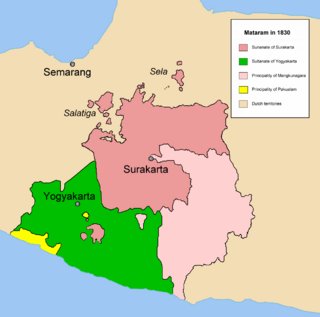
The divided Mataram in 1830, after the Java War.
The fall of Kartasura made the palace there inauspicious for the
king, and Pakubuwana II built a new kraton in Surakarta, or Solo, and
moved there in 1746. However, Pakubuwana II was far from secure on his
throne. Raden Mas Said, or Pangeran Sambernyawa (meaning "Soul
Reaper"), son of the banished Arya Mangkunegara, who later established
the princely house of Mangkunagara in Solo, and several other princes
of the royal blood still maintained a rebellion. Pakubuwana II declared
that anyone who could suppress the rebellion in Sukawati, the area
around present day Sragen, would be rewarded with 3000 households.
Pangeran Mangkubumi, Pakuwana II's brother, who later established the
royal house of Yogyakarta took the challenge and defeated Mas Said in
1746. But when he claimed his prize, his old enemy, patih Pringgalaya,
advised the king against it.
In the middle of this problem, the VOC's Governor General, van
Imhoff, paid a visit to the kraton, (he was the first Governor General
to do so during the whole history of the relationship between Mataram
and VOC), in order to confirm the de facto Dutch possession of the
coastal region and several interior regions. Pakubuwana II hesitantly
accepted the cession in lieu of payment of 20,000 real per year.
Mangkubumi was dissatisfied with his brother's capitulation to van
Imhoff, which was done without consulting the other members of royal
family and nobility. Van Imhoff had neither the experience nor tact to
understand the delicate situation in Mataram and publicly rebuked
Mangkubumi as “too ambitious” before the whole court when Mangkubumi
claimed his prize of 3000 households. This shameful treatment from a
foreigner, who had wrested the most prosperous lands of Mataram from
his weak brother, provoked him to incite his followers to rebellion in
May 1746, this time with the help of Mas Said.
In the midst of Mangkubumi's rebellion in 1749, Pakubuwana II fell
ill and called van Hohendorff, his trusted friend who had saved his
life during the fall of Kartasura in 1742. He asked Hohendorff to
assume control over the kingdom. Hohendorff was naturally surprised and
refused, thinking that he would be made king of Mataram, but when the
king insisted on it, he asked his sick friend to confirm it in writing.
On December 11, 1749, Pakubuwana II signed an agreement in which the
"sovereignty" of Mataram was given to the VOC.
On December 15, 1749, Hohendorff announced the accession of
Pakubuwana II's son as the new king of Mataram, with the title
Pakubuwana III. However, three days earlier, Mangkubumi in his
stronghold in Yogyakarta had also announced his accession with the
title Mangkubumi, with Mas Said as his patih. This rebellion
strengthened day by day, and in 1753, the Crown Prince of Surakarta
joined the rebels. The VOC decided that it did have not the military
capability to suppress this rebellion, though in 1752, Mas Said had
broken away from Hamengkubuwana. By 1754, all parties were tired of war
and ready to negotiate.
The kingdom of Mataram was divided in 1755, under an agreement
signed in Giyanti between the Dutch under the Governor General Nicolaas
Hartingh, and rebellious prince Mangkubumi. The treaty divided nominal
control over central Java between the Yogyakarta Sultanate, under
Mangkubumi, and Surakarta, under Pakubuwana. Mas Said, however, proved
to be stronger than the combined forces of Solo, Yogya and VOC. In
1756, he almost captured Yogyakarta, but realized that he could not
defeat the three powers alone. In February, 1757, he surrendered to
Pakubuwana III and was given 4000 households, all taken from Pakubuwana
III’s own lungguh, a parcel of land near Solo, the present day
Mangkunegaran Palace, and the title of "Pangeran Arya Adipati
Mangkunegara." The political struggle was again confined to palace or
inter-palace intrigues and peace was maintained until 1812.
After 1755, the kingdom was no longer referred to as "Mataram," but
was usually called the “Royal Lands” (Vorstenlanden, Praja Kejawen) to
distinguish it from the region directly administered by the Dutch.[4]
See also
Notes
- ↑ Keat Gin Ooi, Southeast Asia a Historical Encyclopedia, from Angkor Wat to East Timor (Santa Barbara, Calif: ABC-CLIO, 2004), p. 863.
- ↑ Ibid. p. 864
- ↑ Ibid.
- ↑ Ibid. p. 866.
References
- Anderson, Benedict R. O'G. 1990. Language and Power Exploring Political Cultures in Indonesia. Ithaca, N.Y.: Cornell University Press. ISBN 9780801423543.
- Carey, Peter. 1997. Civilization on loan: The making of an upstart polity: Mataram and its successors, 1600-1830. Modern Asian Studies 31(3) :711-734.
- Miksic, John (ed.). 2006. Karaton Surakarta. A look into the Court of Surakarta Hadiningrat, Central Java. Marshall Cavendish Editions. ISBN 981-261-226-2.
- Ricklefs, M.C. 2002. Yogyakarta di Bawah Sultan Mangkubumi 1749-1792: Sejarah Pembagian Jawa. Yogyakarta: Penerbit Matabangsa. ISBN 9789799471093
- Ricklefs, M.C. 2001. A History of Modern Indonesia Since c. 1200. Stanford: Stanford University Press. ISBN 0-8047-4480-7.
- Ricklefs, M.C., and Dharmono Hardjowidjono. 1991. Sejarah Indonesia Modern. Yogyakarta: Gadjah Mada University Press. ISBN 9789794201879.
External links
- Anthony Reid. Cosmopolis and Nation in Central Southeast Asia, April 2004. Asia Research Institute, working paper series 22. Retrieved November 23, 2007.
�������

