|
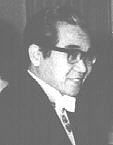 Grand
dad was a trouble maker of sorts in his younger days. He upset the Dutch
and Japanese before the 1940s by setting up clandestine short wave radio
transmitters in Jogja (Yogjakarta, central Java) and elsewhere, transmitting
to the whole world the independence aspirations of the not yet independent
Indonesian nation in perfect English. (He was a linguist--spoke 12 of them,
and his hobby was languages.) (Right
foto at the Vatican, Rome, as a diplomat more than 10 years later in 1950
as Deputy Chief of Mission). Grand
dad was a trouble maker of sorts in his younger days. He upset the Dutch
and Japanese before the 1940s by setting up clandestine short wave radio
transmitters in Jogja (Yogjakarta, central Java) and elsewhere, transmitting
to the whole world the independence aspirations of the not yet independent
Indonesian nation in perfect English. (He was a linguist--spoke 12 of them,
and his hobby was languages.) (Right
foto at the Vatican, Rome, as a diplomat more than 10 years later in 1950
as Deputy Chief of Mission).
 The
world heard. They (and the newly setup U.N.) sympathized and put pressure
on the Allies (mostly the Dutch and British) to leave Indonesia . Clandestine
transmissions never put the "enemy" in a good light. No wonder the Japanese, The
world heard. They (and the newly setup U.N.) sympathized and put pressure
on the Allies (mostly the Dutch and British) to leave Indonesia . Clandestine
transmissions never put the "enemy" in a good light. No wonder the Japanese, 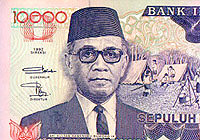 who
threw out the Dutch by force of arms which Indonesia could not, despised
these transmissions.
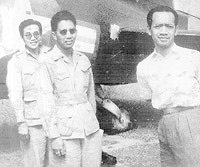
(Left
foto, Raden Mas Suyoto Suryo-di-Puro, one of 5 founders of the Foreign
Office and a founder of the RRI state radio corporation, Sudjarwo
Tjondro Negoro, a future diplomat, and Sri Sultan Hamengku Buwono the IXth.,
the king of Yogjakarta, central Java--later the nation's vice president
in the late '70s, buddies, participants & heroes during the independence
revolution early 1940. The Sultan allegedly refused a second VP term under
President Soeharto. Notice their appearances as men in the mid 30s and
later on as senior citizens. The Sultan's image in a Rp 10,000 rupiah Bank
Indonesia note [about US$ 4.45 early 1997], right foto ). who
threw out the Dutch by force of arms which Indonesia could not, despised
these transmissions.
(Left
foto, Raden Mas Suyoto Suryo-di-Puro, one of 5 founders of the Foreign
Office and a founder of the RRI state radio corporation, Sudjarwo
Tjondro Negoro, a future diplomat, and Sri Sultan Hamengku Buwono the IXth.,
the king of Yogjakarta, central Java--later the nation's vice president
in the late '70s, buddies, participants & heroes during the independence
revolution early 1940. The Sultan allegedly refused a second VP term under
President Soeharto. Notice their appearances as men in the mid 30s and
later on as senior citizens. The Sultan's image in a Rp 10,000 rupiah Bank
Indonesia note [about US$ 4.45 early 1997], right foto ).
These clandestine operations were bombed
(by the Dutch) and had to be moved from place to place dodging bombs as
the family ran from one shelter to another in Jogja, Gunung Kidul and finally
Jakarta.
The Japanese threw him in jail twice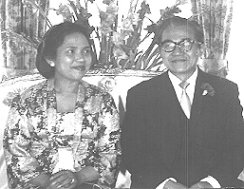 in the early '40s for refusing to cooperate with them, and threatened him
with execution as a "spy". The Japanese tried to make their IInd. world
war "the west against the east" theme ("the Dutch only take advantage of
you, while we as Asians want to see you defeat them," the Japanese would
say), while Grand Dad thought neither the east or west were welcome as
occupying powers. The date of execution was set, and all Grand Dad had
to do was wait. As the guards escorted him out of his cell, the commandant
met him in the courtyard and said, "You're too valuable to die."
So, he lived for another day.
in the early '40s for refusing to cooperate with them, and threatened him
with execution as a "spy". The Japanese tried to make their IInd. world
war "the west against the east" theme ("the Dutch only take advantage of
you, while we as Asians want to see you defeat them," the Japanese would
say), while Grand Dad thought neither the east or west were welcome as
occupying powers. The date of execution was set, and all Grand Dad had
to do was wait. As the guards escorted him out of his cell, the commandant
met him in the courtyard and said, "You're too valuable to die."
So, he lived for another day. (With
Grandmom, Raden Ayu Sri Ambariah Arismunandar**,
& Granddad* at Adji & Minou's Javanese
wedding on July 4th., their 2nd. in London, 1964 after their British civil
ceremony May 4th. 1964, sitting at the bride & groom's chair at the
Ambassadorial residence at The Bishop's Grove, Bishop's Avenue in Hampstead
Heath, London, where they lived for 3 years).
Adji and Minou were married 4 times--yep
4, twice in England, once in Tehran where the dumb priest said to Minou,
"Why do you have to marry this 'foreigner'? Don't we have enough Iranian
men here?", not knowing then that Laila and Arto were already in existence.
Priests should stick to their priesting business, because each time Adji
remembers those irritating comments, his hackles stand up. That's another
story. And one more time in Jakarta witnessed by their 3 teen aged children
because the two parents lost all their wedding papers.
Grand Dad and a bunch of his friends continued
to set up a network of clandestine radio transmitters throughout the country
that later became the State Radio Corporation, Radio Republik Indonesia
(RRI). Years later in the late '70s the Kompas
Daily, Indonesia's largest circulating daily paper, honored his efforts
and those of his friends by publishing the history of the founding of RRI
during the War for Independence that ended when the country declared its
Independence on the 17th. of August, 1945. Before passing away in October
1991, Kompas interviewed him again
on his sick bed on the founding and history of the Foreign Office and RRI's
history. The R.R.I. state radio corporation is the forerunner of
the state television monopoly, TVRI, and anchor of the other private Indonesian
TV stations.

Like his Grandson, Arto, Grand Dad
never let on to his family that he did things that ended up in the papers.
A British daily, for example, carried the story of the Indonesian diplomat
who spoke welsh on TV which is supposed to be a very difficult language
to master, a real tongue twister. One day, his son, Adji, sees his Dad's
picture in this paper under his foot as he was about to step on an escalator
in one of the London underground escalators. "Well, what do you know, Dad
is in the papers again. This time speaking Welsh on Welsh TV," he thought
to himself. The Welsh must have been quiet impressed that they carried
his TV story. Likewise were his other achievements, in newspaper stories
no less. His kids never knew it, if not for the papers.
Likewise with his ancestors, that he came
from an illustrious, and downright dangerous ancestorif
one were to tangle with him. One day in the early '80s, Adji had a visitor
from a well-known paranormal, a Pak (mister) Wiranatakusumah, from a west
Java (Sunda) royal family who came to Adji's office with one of his nephews,
Max Wiranatakusumah, who was one of Adji's assistants and manager.
After sitting at this conference table for
about 20 minutes, this gentleman suddenly went into a fit, convulsing and
shaking this 12 seat table he was holding on to. Adji, all worried, said
to his manager, "Max, do something! Your uncle is ill and I don't want
to end up with your dead uncle at my table."
"Oh, don't worry," he said, "he'll be okay
in a little while." Sure enough after about 5 minutes which seemed like
a long 5 minutes, his uncle was no longer tranced up.
After wiping the sweat from his face, the
uncle suddenly points a finger at Adji, and said, "Waah! (wow) You are
the descendant of Samber Nyowo." In an aside, Adji whispered to a
colleague sitting next to him, "Who is Samber Nyowo?"
Instead of replying, this colleague who is from North Sulawesi some 1,500
miles away, berates Adji for being an ignorant Javanese, unknowledgeable,
"you should be ashamed of yourself", and so forth and so on. "Well, I can't
help it," Adji said defensively, "I was brought up abroad since I was 7.
What do I know about Javanese history anyway."
So, 3 days later he goes to his Dad's home,
and asks him, "Dad, who was Samber Nyowo?" The
name itself in day-to-day Indonesian already labeled him as that dangerous
"life taker". And then Dad went on a long discourse of the legend, the
paranormal things he did, nobody could defeat him in battle against the
Dutch's modern weapons (at that time guns and cannons versus the natives'
bamboo spears), and so on for half an hour. At the end of this he said,
"I am a descendant of Samber Nyowo. Why?" he asks. "Just curious," Adji
said not wanting to go into details at Pak Wiranatakusumah's meeting.
On another discourse on Samber Nyowo, Grand
Dad also said that 6 people who "stabbed him in the back" (figuratively
speaking) died suddenly within a matter of days, 4 of them instantly, and
2 suffered a year long lingering illness. "You didn't do a thing on them,
did you Dad?" Adji asked. "Of-course not!" Grand Dad replied. "One of the
legends says that Samber Nyowo's descendants who have been done an injustice
will suffer the consequences," he said matter of factly. Adji thought:
"Hmmm ... one never knows when it may come in handy."
One lesson Adji learned from Grand Dad while
he was chief of mission at the Embassy in Tunis (on one of those vacations
in the 1960s when he visited his parents), was everybody is equal. And
he practiced it.
He would invite the local royalty, ambassadors
and so on, and at the same time he would invite the farmers in the Tunisian
countryside who once invited him to lunch at their farms, and on occasion
a beggar or two he met on the streets where he learned to pick up the colloquial
expressions. Remember his hobby was languages and that meant also going
to the local people in the streets.
The Tunisian farmers are a friendly lot.
They would wave down Grand Dad's car (which had special CMD - chef de
mission - ambassadorial plates so they knew he was a foreign guest)
from a distance because he liked to visit the country side. Without much
ado about anything and through sign languages (Grand Dad didn't speak Arabic
then), the farmers would pull his and Grand Mom's arms (Adji was there
once for a visit to Tunisia) and steer them into their house, pull them
to the ground and on the ground was a table cloth full of food, point at
it and made signs to eat. No introductions, nothing. Just sit, and eat!
When the hosts burped, Grand Dad would burp (Grand Mom didn't), and Adji
burped too (in some cultures burping � or slurping one's soup � is a sign
of appreciation to the cook and host and tastiness of the food). That's
how he met many ordinary Tunisian folks from the country side.
Their farm animals (chickens, sheep � mostly
the chickens) would come prancing on the table cloth and start pecking
at the food because the farmer, his family and guests would eat on the
ground. They would have to shoo away the chickens now and then. Which is
fine, because Indonesians eat on the ground too, with their hands like
eating Kentucky Fried chicken, to give it more zap to the food � a kind
of indoor picnic which is always fun (although the family may have a fancy
teak or marble dining table nearby). But the thing Grand Dad brought home
to Adji when he invited these farmers (and once a street beggar whom he
was talking to) to the ambassadorial residence, was "Always remember",
he said when Adji asked how come Grand Dad was inviting this beggar and
these farmers, too, that kinda seemed out of place with his other guests,
he said, "they may seem poor and modest, but they are people all the same."
And these farmers got along just fine with their royalty and the foreign
ambassadors. It became a novelty (for people who never mix with the common
people, especially beggars) that the trend was, at that time, to invite
as many farmers as possible to their fancy parties. These common folks,
are after-all the salt of the earth, as Grand Dad would say.
�������
|

