
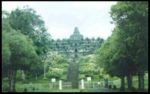
The largest Buddhist monument on this planet is in Central Java:
the Borobudur temple. Made of carved stone blocks, it remains
an awesome architectural job after two thousand years, although
it doesn't really impress the locals.
'Architecture'
means the erection of some walls around and above humans, which,
in Borobudur's case, originally never involved the likes of mortar.
'Locals' means those people who are usually known as 'tour
guides', 'souvenir salespersons' and 'passersby who look bored'.
Well, this is only natural; if you were born in heaven I bet you'd
still want to have holidays elsewhere.
Somewhere near the temple is the town of Magelang, which has a backup
attraction just in case you get tired of Borobudur-browsing: art
collectors. Probably the climate is just suitable to grow
a rather large chunk of persons whose occupation is making lots
of money and whose hobby is to spend them on paintings. The same
climate is also favorable to grow cabbages and tobacco.
A contemporary art gallery and an artistic compound are also located
there, continually holding exhibitions and exhibitionists, dramas
and dramatists, poetry-readings and poets, etc. The compound is
called Studio Mendut (I should have pre-warned you about
pronounceability).
If you're not interested in any of the above, just cross the street,
because Magelang could also offer you the Langgeng ('Eternal')
Park, comprises of among others a large body of water.
Up and down the sun-pestered terraces of Borobudur, or so some ex-tourists
testified, you'd get a dash of the taste of Nirvana, namely the
physical condition usually gotten via aerobics, and/or private
enlightenment such as "I should've listened to Daisy and
took the whole hotel fridge with me".
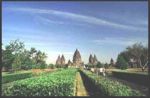
Prambanan (Hindu) temple in Yogyakarta, a structure that
looks like us. It is a collective of lean and relatively
'short' temples, the spread of stone structures built at the time
when modern inconveniences were not even thinkable, let alone
devised.
Borobudur is awe-forcing because it stands way larger than life; Prambanan
isn't like that -- it requires an eye for details.
This temple hosts some heart-wrenching legends, durable myths, and
a once celebrated dance night, in which the many gigabytes of
the Ramayana tale is heavily ZIP-ed so tourists could get back
to the hotels before they begin to fuss about mosquitoes.
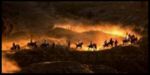
This is Mount Bromo, East Java. The active volcano keeps
emitting stuff like fog, smoke, and the enticing fragrance of
sulphur. The presence of horses might be nostalgic for senior
citizens from Texas, and some parts of the mountain resemble certain
spots of Nevada minus Vegas.
But the main tourist attraction is, as far as I know, the tour
guides.
They make a living selling sunset and sunrise.
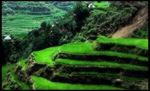
Javanese mountains have this typical look of hosting a large sum
of ecology. The terraces of rice fields on the slopes were probably
a modification of the Balinese agricultural handbook, released
ages ago.
Of course the picture might be a Vietnamese morning, or Cambodian,
or Thai, or Malaysian, or Chinese, or Japanese -- but considering
the presence of artists in the neighborhood, this definitely
is Javanese.
 >
>
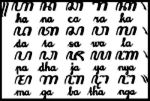
'Hanacaraka', the Javanese alphabet. English sentences
could be written quite easily in this, basing each word on how
it is pronounced. As long as I know, starting from my Mom's generation
up (those who were kicked into adolescence by The Beatles) illiteracy
in hanacaraka is as rare as water in monsoon. Practically none
of the people my age knows how to read and write using this alphabet,
except [cough] me.
Other Indonesian ethnicities also have their own alphabets, plus the
familiar writings of the Chinese-Indonesians, Indian-Indonesians,
and Arabian-Indonesians. The same fate befalls
these other languages and writing-systems, except Arabic -- the
anomaly is caused by the fact that the majority of Indonesian
citizens are Muslims. But all in all, unlike Japan, India, and
China, Indonesia and its 250 million of citizens normally use
Latin characters in and for everything.
Yogyakarta has its roadsigns printed in hanacaraka -- obviously intending
to put forth the not only ethnic but also royal collective soul
(Yogya is at once a republican province and a live kingdom),
although the smaller Latin prints might have been missed by the
consistently getting lost drivers from out of town. But, hey,
the cops speak English, though maybe your semi-amateur tour guide
does not.
A Solonese [Central Java] wedding pic -- this is redundant
but yes, our wedding dresses are in black. Jet black
and golden hues are what the Javanese paint grandeur with; the
newly sociolegally coupled are referred to as 'king and queen
for a day', so their attire imitates the official dress of the
real King and Queen.
Royal couples are not, in Java, to be found in dungeon-and-dragon RPG,
since Solo (Surakarta) and Yogya (Yogyakarta) still have palaces
and kings and queens.
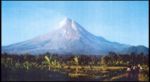
The right side of the pic shows the places that the newlyweds would
not want to go to: Mt. Merapi in its bad mood, the
Affandi Museum of Fine Art, and Sendangsono -- a
place for Catholic pilgrims to browse around, being one of the
official spots on earth that is believed to have once hosted the
apparition of Mother Mary.
THE
PROVINCE OF YOGYA

[phonetix
for the clueless: easiest to spell it
'jog-jah']
Other Indonesian provinces might have oil, timber, goldmines, etc. to
tap; Yogya has never been that lucky. Its residents are mostly
college students, poets, novelists, painters, sculptors, event
organisers, and the like -- although as a matter of course there
also exist laundrypersons and plumbers. Its economy is mainly
sustained by tourism and cultural activities, such as running
colleges, holding poetry-readings, selling paintings and sculptures,
organising events, and the like -- in which laundry and plumbing
contribute much.
Now I must insert a winding note about the
name of this place, because it has been one
heck of a headache not just to European tourists and Japanese
travel agents but also ourselves.
Its original name is [1] Ngayogyakarta (read it as 'Ngayogyókartó',
if you can pronounce this).
As a kingdom, its official name has been, since 1700's until this
minute, [2] Ngayogyakarta Hadiningrat.
In speech, to shorten it up the Javanese used to say [3]
'Yoja' (pronounced 'yow-jaw').
In writing, the shortened name is [4] 'Yogya' (pronounced 'hyog-yah').
That is kind of informal.
Formal namesake is [5] 'Yogyakarta' -- 'karta' is an old Javanese
word that means 'city'.
In 1945, the Republic of Indonesia claimed independence, and this
Central Javanese sultanate was one of the kingdoms that wholeheartedly
supported the Republic in its war for independence that lasted
until 1949. It even became the Republic of Indonesia's capital
city for a while.
In the churning years of Independence, the locals found 'Yogya' and
'Yogyakarta' as being both unpronounceable as far as non-Javanese
Indonesians were concerned. So although the written name stayed
the same, the Yogyanese let the spoken name to mutate into [6]
'Jogja' ('Jog-jah').
But as a province of the Republic, the spot was named [7]
'Daerah Istimewa Yogyakarta' (literal: 'Special
Region of Yogyakarta'), which signifies its status of being a
kingdom still with a lot of space to manage its internal affairs
on its own, as well as a province like the rest of Indonesian
areas.
Indonesians, as I always suspect, love abbreviations just like the Russians
of Stalin's heyday did. So the official republican name was shortened
into [8] D.I.Y., pronounced as 'day-ee-yay'.
Hence addresses and company names have either 'Yogya', 'Yogyakarta',
or 'DIY' on them.
In 2002, Sultan Hamengkubuwono X (the tenth) granted the use of his
very own handwriting to be the font used at official logos put
on tourism-related stuff in this area.
The advertising people asked him to write the name of his territory.
He scribbled this: [9] 'Jogja'.
That is the oral form of the name, and the name of the province/kingdom/city
has never been written like that before, except in the period
between 1945 to 1972, when the Indonesian grammatical rules and
such were still based on the by now archaic system, where 'U'
was written as 'OE' and 'J' written as 'DJ' and 'Y' was 'J' --
back then, of course 'Yogya' was written as 'Jogja', and 'Jogja'
was written as 'Djogdja', while a lot of people
also wrote it as 'Djokdja' and 'Djokja'.
From 2002 on, and in a confusion until today, some people write 'Yogya'/'Yogyakarta',
some others follow the Sultan's old-fashioned Indonesian or alternately
a radically colloquialized 'Jogja' or [10] 'Jogjakarta'.
Still some others are chaotically writing [11] 'Jogya' and [12] 'Jogyakarta'.
There is also [13] 'Yogjakarta' because newer generations
of Javanese born after 1970 have been saying the name as [14]
'Yogja' ('hyog-jaw') when talking in this language,
stressing the letter 'G' that their parents and grandpas had omitted
from being pronounced before.
There. You can't possibly write or say the name of this place wrongly,
because we can't nail down any version as the right one ourselves.
As for me, I stick to the original Javanese pronunciation and spelling
-- it is, after all, Ngayogyakarta Hadiningrat that it
began its laudable existence more than 300 years ago with, so
that despite this messy nomenclatural thing in 21st century, it
is Yogya to me, which means 'hyog-jaw'
in contemporary Javanese, and in Indonesian I spit it out as 'hyog-yah'.
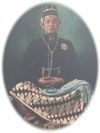
Risking parroting myself, here for the approximately seven billionth time
I say Yogya is a live kingdom, a kingdom means there is
a king, and Yogya is also a province of the Republic
of Indonesia, and a province means there is a governor,
and the Sultan Hamengkubuwono X (the tenth) is both. Here
the Sultan is shown in the most official portrait released by
the Royal PR (or at least I suspect so).
I shouldn't dig the intricate legalities around the collision of
a livelong title (king) and some periodic overthrowing (of governors).
Let's just say things work out so far. The late Sultan Hamengkubuwono
IX (the ninth, this current sultan's dad) is a nationwide hero,
etcetera, and factually loved by the Yogyanese (considering how
the world turns around these past three decades, it is some kind
of a phenomenon).
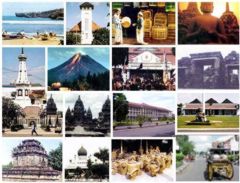
This dizzying pic consists of Baron beach, the biggest Catholic
church in Yogya, the Ngasem 'bird market', Borobudur
temple, Tugu monument, Mt. Merapi in the worst
mood, the Yogyanese Sultan's palace -- built in 1756, ancient
King Boko palace, Dutch leftover Fort Vredeburg,
Sewu temple, Gadjah Mada University, Gedung Agung
-- where the Presidents of Indonesia and foreign heads-of-state
stay when visiting this province, Mendut temple, the Royal
Mosque, Malioboro street, and Kasongan village
in Bantul district whose population is almost entirely potters.
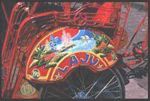
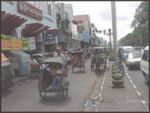
Yogyanese pedicab. A pedicab is a three-wheeled vehicle powered by
a pair of human legs -- the driver sits at the back of this metal,
canvas and wooden contraption. The Indonesian and Javanese word
for it is becak ['bay-chuck'].
In Jakarta pedicabs have routinely been harassed by every official
decree in any administration since the eighties, but here in the
inland Java they still crowd the traffic as bravely as always,
forever challenging all traffic laws, including the law of gravity.
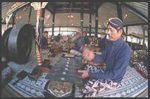
Gamelan ['gah-mel-ahn'], Javanese musical instruments that form an orchestra.
Consists of similar stuff as found at the disposal of Pavarotti,
like the string section, wind section, whack section, and so forth
-- only, of course, they don't look like any sound-producing stuff
known in the North. The most prominent there is probably the set
of gongs -- the largest could reach one meter in diameter.
One of the elements of beauty of these instruments is in the fact
that they never need electricity.
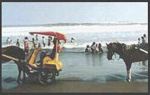
Those are horses @ Parangtritis ['pah-rank-tree-tees'] beach.
Swimsuits must stay in your hotel. Swimming, surfing, snorkeling,
scuba-diving, etc. are strictly prohibited here -- the tide is
nothing tame.
The job of Yogyanese coast guard is mostly to encourage beachgoers
to stay away from the sea.
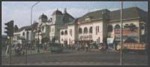
Central Post Office ['kahn-tor-posh'] of Yogyakarta. This colonial
building is, some said, a tourist attraction in itself -- maybe
it is, or perhaps it isn't, but it nevertheless serves as the
landmark to sketch where to go if you want to reach my place and
never get the door opened because I am at the post office.
The Central Post Office is the perfect place to find philatelic objects;
to lose parcels; to tap the Western Union; to have debates with
money changers; to buy garments, perfumes, snack, cold drinks;
and to load this page at a cybercafe.
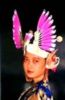
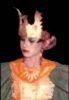
Yogyanese
serimpi dancer ('sah-reem-pee', left) and Solonese
kukila dancer ('koo-kill-aw', right).
Balinese dancers might have been ubiquitous to the point of probable misrepresentation.
Every ethnicity in Indonesia -- and there are hundreds
of them -- has its own distinctive dancing. Java is never a solid
entity; it has many sub-ethnicities, and each, separated from
the others by just a few miles of road, speaks a different kind
of Javanese language and has its own traditional dresses that
set it apart from the rest. The West
Javanese might even be considered as a separate ethnicity
altogether, as is the Madurese
(from the Madura island, a part of East Java).
Yogyanese and Solonese dancing are, according to a tourist I randomly attacked
with the question, "slower and more melodious than Balinese".
This might be the common impression.
'Melodious' is, of course, something heard rather than photographed. The music
itself divorces Java from Bali by several lightyears: to a Javanese
ear Balinese music evokes feelings not so different from what
you got listening to a war; the Balinese meanwhile if being
cornered to honesty would say Javanese music must be some sort
of ancient tranquilizer, so lethargic you'd perhaps never notice
when it ends.
Objectively Javanese dancing involves a lot more than just knowing the exact
time to shake your bon-bon and roll your eyes like mad. Because
it often looks like a slow-mo, a dash of gracelessness would have
ruined the entire show.
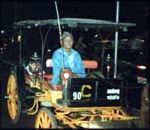
Diehard horsepower can be seen in any Yogyanese street everyday.
Locals would immediately know you're a tourist if you take a ride
in these horsecarts (andhong, 'ahn-dhonk') -- the Yogyanese
themselves prefer Mercedes cabs.
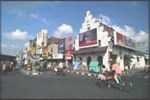
Malioboro ['mah-lee-oh-borrow'] St., the heart of Yogya; built in 1757,
but the overload of commercial air is a recent invention that
started around the decade of vinyl pants and lip-sync, i.e. 1980's.
The government and the cash are both located here.
Malioboro is, actually, its sidewalks; pedestrians made in elsewhere
might find it impossible to actually walk. The famed sidewalks
are overcrowded by people selling anything they can think of.
The Mall sits somewhere nearby, equally crowded, but at least
air-conditioned.
�������