The
glittering that wasn't gold: territory & people of the Indonesian
Maluku, a.k.a 'Spice Isles'.
Maluku
was more or less a Muslim area when the first caucasian arrived,
or at least a good chunk of the elite ruling classes were.
That first caucasian was a Roman Catholic.
Today, the majority of the Malukunese goes to Protestant churches.
Reciprocal disdain between equally militant adherents of the three
religions have been a consistent Malukunese characteristic, seen
through other ethnicities' eyes. Even as late as in 2004, it still
never let the local cops get a nap, while the presence of international
non-governmental organisations, foreign newsmongers, and migrant
Javanese rightwingers complicated the matter.
The actual situation in Maluku isles hasn't been as horrible as it
was portrayed by Time, Inc. -- but it is, however, a gangrenous
conflict that can't get diluted by the typically Indonesian (or,
more precisely, Javanese as always) response: prolific
denial.
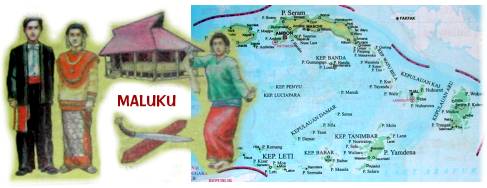
That architectural bit in the picture is the Malukunese traditional
house named baileo, a not-so-spacious construction of woodplanks
shying away from the ground on thin pillars. The female figure
at the right is supposed to be a native dancer performing Maluku's
best known 'handkerchief dance' lenso, an interactive spectacle
in olden days, offering society debutantes a chance to initiate
themselves in romance.
The bent-handled metalwork is the thing with which (besides, of course,
rifles) Malukunese warriors fought the Portuguese and the Dutch
in colonial times: parang sawalaku. Its blade is as heavy
and as wide as an English broad sword, with a slightly longer
wooden end without a handlebar. The length of the entire thing
is similar to a falchion's.
In Java, a parang (it comes with a straight handle, there)
is only considered as a part of armory as much as a scythe was
for Ivanhoe; but in Maluku it got a place comparable to Javanese
keris (the variety of curvy slim blades, as short as a
baselard -- or Japanese katana (samurai sword --)
in traditional manowarism -- i.e. existentially philosophical,
yet practically deadly.
Kingdoms all around Indonesia have never known standardized looks of warriors
-- like, for instance, Japanese and Chinese armory, or what was donned by everyone around when
William the Conqueror was still just a restless Duke of Normandy.
Feudal Indonesia's ironmongers weren't busy smithing metal helmets and
such; a quite sensible idleness in this, since the tropical climate
surely would have wrangled its wearers to dehydration.
Malukunese, like the rest of Indonesians, went to battlefields in the lightest
of all possible attire; the only noticeable addition to daily
wearables were shields.
1511
 Alfonso d'Albuquerque
led an armada from Portugal to Malaka, to -- so he said -- trade.
Alfonso d'Albuquerque
led an armada from Portugal to Malaka, to -- so he said -- trade.
Malaka
marked the orbit of moneymaking in this area. It sat a blink away from
the edges of both Java and Sumatera, and this Muslim bed of roses for
mercantilism was founded by an Indonesian.
Follow-ups of the expedition finally sucked independence off Malaka, and led Portuguese
galleons further and further until they found Maluku, the buzzing thousand
of tiny landmasses irregularly cut by meandering salient water, where
lived several Muslim kingdoms of producers (the word 'thousand' there
wasn't a figure of speech).
This was the historic touch between Indonesians and Europeans that would
end up in all the phantasmagoric salad of political and military vices.
The foreigners' search of glory and gold was also teamed-up with the
wish to enlarge the Christendom, so Catholic missionaries combed the
hinterland for converts as soon as the profane business of buying and
selling spices started at the port.
Said or not said, the marriage of caucasian imperialism with religious aims
totally alien to the natives helped to form the generally negative view
of Christianity all over Indonesia, that would persist until today,
and even under colonialism this obvious intermingling was one of the
reasons why Christianity has never been popular in most Indonesian places.
1512
Roman Catholic priests
Antonio Taveiro and Antonio da Cruz from Portugal had succeeded in bringing
in some converts in East Timor. In the next 50 years thousands would
have been converted, including one of the native chiefs.
By now East Timor wasn't yet colonized, but the priests assumed some worldly
leadership, too (which didn't exclude political and military matters).
Only in 1701 was the Church cut loose from state affairs.
1513
Demak Royal Navy
of Java set forth to Malaka with a hope to yank it off the Portuguese
hands. The expedition ended up in failure.
1521
The greatest of all
kings of Demak, Sultan Trenggana, was coronated. Under his rule
the sultanate had come to include East, Central, and West Java. Conversion
to Islam went rapidly on.
An extraordinary figure, Sunan Kalijaga ('Sunan' means 'Great Teacher
of Islam'), was responsible for the achievement, along with his colleagues
of Javanese Muslim missionaries known as 'the Nine Leaders' (Wali
Songo).
The colossal success of Islamicization was due to the Wali Songo's
subtle trick of fathering the inception of 'Javanese Islam' (we'll encounter
this thing at a closer range later).
These holymen proceeded cautiously without too much emphasis on Islam's characteristic
iconoclast -- something that would certainly have infuriated believers
of indigenous animism and Hinduist population if thrusted on them out
of the blue.
Carefully purging Javanese cultural expressions from the dirtiest elements of
paganism, the priests take these expressions over to the service of
Islam.
So, via the same old traditional theater, folksongs, and assorted arts,
the tenets of Islam started to get planted in the minds of the people.
This method had saved Java from probable conversionist wars that continuously
ravaged other places in this thousand years of 'multilevel marketing'
of different religions..........
Far away in Maluku, there was some escalation in the routine skirmishes
between Ternate and Tidore,
two Muslim/Catholic kingdoms that consisted of a pair of tiny islands
perpetually in hostile mood towards each other, with just a thin salty
waterway between them.
Ternate
was backed up by Portugal, while Spanish soldiers helped manning the
Tidorese lines. They, of course, didn't take sides out of mere whim.
Such a business wasn't beyond the common practice of capitalism of the
day. Maluku was the 'El Dorado' of the Eastern Hemisphere, with its
surplus of spices European kings and admirals seemed to get ever-ready
to spill blood for; all real wars between Europeans around the archipelago
was for nutmegs and mace and pepper and the like -- certainly surreal
to our eyes today.
This time, it was irreconcilable. A 'referee' was called for. This problem-solver
was - guess who - the Pope in Rome.
The Papal See got Spain and Portugal to agree upon the Saragossa Treaty:
the Spanish conquistadores had to sail away to the Philippines and establish
a dominion there, while Maluku was to be left to the Portuguese.
Of the four-parties' war, both Portugal and Spain won, both
the local kings lost. The usual scenario no one get surprised about,
those days.
1527
This year, Java was
more or less completely Islamicized. The Duke of Banten
[pron. 'ban-tayn'], then a vassal of Demak, on
his own initiative took over the port of Sunda Kelapa (later
on it would be the port of Dutch colonial capital Batavia, and
finally of Indonesian capital Jakarta), thereby securing a vital
point of trade in Muslim hands.
Demak itself had annexed the remaining Majapahit territory, and under its
kings Islam came to get a greater part of the Javanese population, via
systematic mission works.
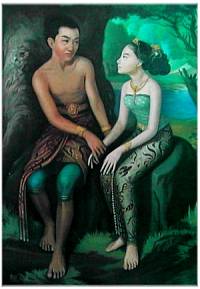
Love,
110x100 cm oil on canvas painting by Gambiranom Suhardi.
Today's artists (even his contemporaries; he was born in 1928) loath
this sort of style,
but I just want to show you what Javanese people were supposed to look
like
before Islam landed in this island. Such luxurious dresses and business
(love) brand
this couple as aristocrats of a Hinduist Javanese kingdom.
1530
The headstrong Islamic
kingdom of Aceh [pron. 'ah-tjah'] was established, its first king was Sultan Ali
Mughayat. Until today, this relatively small area at the edge of
Sumatera retains its initial characteristics; nearly 100% of population
is Muslim, and maintains its nonconformist self-sufficiency throughout
history.
This would prove to be exceedingly hard to solve, as a problem, to the Republic
of Indonesia in 21st century.
1534
This year, Roman
Catholicism had gotten a more or less secure foothold in Halmahera,
Ternate, and Ambon of the Maluku isles in Indonesia.
This was to the credit of a tireless saint, Fransiscus Xaverius, and
the whole regiment of Portuguese missionaries who, with some surgical
exactness, opened up the wilderness for the Gospel.
Xaverius made baptism sort of in vogue even among chieftains and lords. He was
reported to have got a Tidorese Queen christened -- which revived some
interest back home among the diehard wishers of the existence of the
fabulous 'Prester John', a sweet bull about a Christian king of a rich
land of the barbarians, popular during the hopeless Crusade.
But still most of the Ternatenese were Muslims. While Islam didn't smack
of colonialism, Christianity surely did, heavily so; there was no way
to elude the inevitable friction between the two.
After Portugal let go of Maluku, the Dutch evangelists were swarming the region
in the name of Protestantism. Now not two but three different religions
were on the similar mission at once in the area.
The Muslim kings of Ternate tried to check at least the newest invaders;
the Dutch responded with a lot of arsenal.
Until the dawn of the 21st century the inter-religion conflict of Maluku would
be constant, no matter how calm it looked like in certain periods of
the republican life.
Meanwhile, although none suspected so yet, the seeds of a unified empire of Japan
would be carefully and quickly (both are typically Japanese in
that, thrown together, they don't make a self-contradictory statement)
nurtured and realized.
This was the year my personal hero when I was young Oda Nobunaga (1534-1582)
was born.
1546
Banten declared itself
an independent Islamic kingdom, no longer content with being a part
of Demak's territory.
1568
Demak's center of
governance, in this dusk of its life (not that it knew so at the time)
was moved far into the interior of the island of Java, to Pajang
([pron. 'pah-junk'] a very small strip of land,
now a part of Solo) by Hadiwijaya, son in-law of the late Sultan Trenggana.
Hence the realm was called the Pajang sultanate.
But this li'l kingdom didn't survive for long. Less than twenty years later,
after Hadiwijaya's death, his son couldn't keep control while the encroaching
shoreline kingdoms had become too strong for it to resist. He handed
down the throne, in an unprecedented move, to the son of his Grand
Vazier.
This son, Sutawijaya, closed the history of Pajang and opened another, the
new Mataram's. This will stay until today.
Sutawijaya cleared up acres of woods between today's Yogya and Solo, set up a palace
there, exerted control of the surrounding area.
As king he assumed the title of Panembahan Senapati ('the General
of Wisdom') and so founded the last Javanese empire in history.
Unlike the olden days Mataram, this new Mataram was Muslim. But the Mataramese
Islam was smoothly synchretic..........
1570
The disillusioned
Ternatenese Sultan Hairun suddenly waged war against Portugal
in Maluku. With ammo in an alarming scarcity, and not having enough
fingers to pull the triggers, the Portuguese asked for a ceasefire,
followed by invitation to negotiate peace at their base, Fort Santo
Paulo. Hairun came as expected -- and murdered there. This naked crime
surely ignited the Malukunese's wrath. Hairun's son, the next king Baabullah,
fought on and never wanted to hear of negotiations.
1575
Baabulah kept his
vow; he defeated the Portuguese even as he had to pay that with his
life. The survivors sailed away from Maluku, landed in East Timor. There
the Portuguese would remain until 1976, and as a result Roman Catholicism
became East Timorese major belief. Maluku, under the Dutch rule later
on, adopted Protestantism as the majority's religion; so was the case
with West Papua.
1579
Sir Francis Drake
of England landed in Ternate, Maluku. He's the very first Britishperson
ever seen in Indonesia.
This year was also the dawn of the 'Republic of Seven United Netherlands'.
These states were incurably sickened under the constant discriminatory
whacking and random hate-crimes that the deadly duet of Spain's Philip
II and his English 'Bloody Mary' had taken to be their mission in life.
The burning and torturing of Protestants kept going on as far as Spaniards
were concerned, even after Mary's pathetic death, as England was back
to sensible religious toleration and in the meantime was on the way
to glory days under Elizabeth I.
The situation had worn some Dutchmen edgy and this finally stung them to
action. Led by William of Orange, Count of Nassau (1533-1584),
Dutchpersons fought the so-called 'eighty years war'.
'Willem the Silent', as he was also known, went into national history with fanfare
as 'Father of the Fatherland', and the Dutch national anthem 'Wilhelmus'
was composed in his honor as founder of the nation in its current incarnation.
1588
Sultan Alaudin
Riayat Syah ascended in Aceh, to rule until 1604. In his time the
Dutch expedition led by Cornelis de Houtman came to Indonesia,
initiating some increasingly 'serious' business with the locals that
finally would amount to colonization.
1600 This year, when the
English East India Company was founded (it was the first joint
stock company on this planet).

Fleet
of the infamous Dutch VOC & first colonial
Governor-General Jan Pieterzoon Coen
1602
The Generale Verenigde
Geoctroyeerde Oost Indische Compagnie (Company of Eastern Indian
General Trade, VOC) was founded in the Netherlands by
the initiative of Johann van Oldenbarneveldt. Its officers - partly
militias, partly businessmen -- intensified their activities around
the archipelago later known as 'the Netherlands' East Indies'
- Indonesia.
It is inaccurate to say that all of Indonesia was its colony for 350 years,
nevermind that this number has been imprinted on the minds of generations
until today as the mark of national misery. A good chunk of Indonesia
had never been colonized until 1910's. But the number is a more or less
valid guesstimate if the years counted are any with some Dutchmen around.
A noticeable number of Dutchmen had been working for Portuguese vessels
when their own fleet still went nowhere.
1603
Sir James Lancaster
established the first British trading post in Banten, West Java. This
century was to be filled with random British presence (scattered in
various spots like Jambi and Bengkulu in Sumatera, Makassar in Sulawesi,
Ambon and Banda in Maluku).
Though to most Indonesians any caucasian 'guest' was as bad as another, the
particular nation of Sir James' wasn't so utterly keen in making itself
an Indonesian nightmare -- although it was perhaps only because we were
not India.
1605
Daeng (= Chief)
Manrabia of Goa, a maritime estate in Southern Sulawesi (an Indonesian
island as big as North Dakota), was converted to Islam and took the
name of Sultan Alaudin. From the beginning he was against the Dutch
that started to press on trade concessions. From one generation to another,
the Goanese sultans kept this policy and attitude of anti-colonialism
intact.
1607
The greatest of all
Acehnese kings, Sultan Iskandar Muda (the name is the exact Islamic
synonym of 'Young Alexander'), ascended. During his reign until 1636,
Aceh grew to be an important transit port that linked the West and the
East in the busy trade of the time.
1613
Sultan Agung
(he's never referred to by any name but this general title that means
'The Glorious Sultan'; his name when ascended was Hanyokrokusumo) had
been, by now, known as the greatest Mataramese king of all times.
The sickeningly rusty and redundant phrase 'greatest king' is suspicious
in every case -- what, actually, 'greatest kings' do?
In trying to make sense of the history of Indonesia, even until today,
a chronic indigestion awaits if we don't have any idea what the Javanese
politics is all about. We better start from the beginning..........
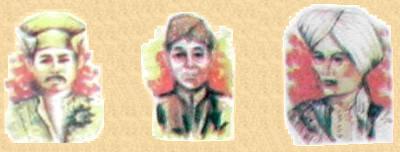
Greatest
Muslim leaders of Indonesian kingdoms:
Sultan Agung of Mataram,
Sultan Ageng Tirtayasa of Banten &
Prince Diponegoro of Yogyakarta
1619
Prince Jayakarta,
a minor duke of West Java, lost the war he waged against the fresh crowd
of Dutch mariners seeking to land in his territory.
Over the ruins of Jayakarta's duchy, the first Governor-General of the 'East
Indies', Jan Pieterzoon Coen, built a whole new city he named
Batavia.
Seriously wanting in manpower to finish the job as quickly and perfectly as he
hoped it to be, Chinese immigrants were recruited. This fortified place
of moneymaking was to be the Indonesian capital Jakarta
[pron. 'jah-car-tah'].
1628
Sultan Agung of Mataram,
recognizing the mounting danger now that the Dutch has gotten its defensible
homebase, decided to strike before too late, while they were still far
enough (around 275 miles away) from his land. He
led his soldiers westward himself, and they besieged Batavia twice
in the same year.
This campaign to kick the Dutch out of Java failed, but it was remembered
as a good try.
The Sultan's forces were never defeated by gunpowder and cutlasses; in both
attempts they were forced to retreat by more natural causes such as
shortage of food and rampage of diseases.
In both cases, too, the Dutch had come to the point of nearing surrender
when, right under their disbelieving eyes, the enemy retreated for seemingly
no reason whatever.
The only significant casualty of war was freedom.
With the last of the Sultan's men retreating, Mataram was to face the darkest
clouds over it.
1645
Sultan Agung died.
The Prince Regent of Mataram ascended, calling himself Amangkurat
I (the first).
With the kind of personality and characteristics not dissimilar with pre-Revolution
French kings, the new sultan immediately allied himself with the Dutch,
reversing every policy his father painstakingly built up.
Amangkurat would be remembered as the cruelest Javanese king ever, encapsuled within
a paranoia nearly matching that of the Roman Nero's.
In his time, thousands had died for whatever (slight or great, real or
imagined) mistake committed against the king. Payback in blood didn't
exclude royal princes and such of his own family.
His son, the Prince that would be King Amangkurat II, was no better,
though some historians apologetically forwarded the idea that he started
out as a sanely likeable young man, and would perhaps have stayed so,
if not for his dear papa's intervention.
This is meant to refer to an incident when Amangkurat Junior was eighteen
or nineteen, and eloped with the freshest mistress of his father's Minister
of War. The king, pressed by the Minister, managed to drag the lovers
back to town; but the Minister killed the woman when she was returned
to him, upon which the Prince got a nervous breakdown from which he
had never ever recovered since.
1648
Declaration again
from the Netherlands. This time the Dutchpersons decided that they were
now independent from Spain. After such a slow, labyrinthine and generally
unclear process to arrive at that, naturally this announcement made
no difference whatever overseas where Dutch merchants and militia were
busy making fortunes.
1651
Sultan Ageng Tirtayasa
(the Javanese word 'Ageng' is politically synonymous with 'Agung', but
denoting more of size rather than magnitude) became Banten's
greatest king and brought it up against the Dutch.
Sadly, his own son, Prince Regent Haji, resented the father's anti-colonialist
politics. In the height of the domestic dispute -- in which both father
and son summoned soldiers to their sides -- the Prince appealed for
the Dutch's help. The help desperately solicited was generously granted.
Then the Dutch put him on the throne.
1652
The first of the
wars between the Netherlands and England, a mere 'preface' to the wasted
years from now until the far end of the century.
No perceptible effect upon the colonies, but each of the Anglo-Dutch wars
left their masters poorer than before. Once in a while some exchange
of cannonballs seemed necessary whenever some Dutch and English colonial
voyagers accidentally met.
The fate of the Netherlands itself kept on flowing along its usual course
since prehistory.
In 1672 Holland's condition was so devastating that the Dutch referred
to it as 'The Disaster Year'; economy slumped, anxiety mounted, casualties
piled up.
At the end of these wars, when England stopped shooting at it, the Netherlands
was invaded by France, Cologne and Münster.
1654
The most famous of
all sultans that ever reigned in Goa (Makassar), a Southern Sulawesinese
kingdom of mariners, Sultan Hasanuddin, took to the throne.
Those days, fame wasn't so easily achieved; most subjects of any kingdom in
Indonesia never even heard of other kingdoms' kings even if one of these
kings' palace was just a glance away across the street, so to speak.
Hasanuddin was different.
His men were seafarers, his royal armed forces were backboned by Admirals
rather than Generals of cavalry; in times of peace they still took to
the sea and dropped anchor in whichever friendly area they found.
Long before Hasanuddin ascended, the naval warriors of Makassar had already
been legendary. Their adventures were told far and away as awe-inspiring
epics, much like the British Royal Navy (or alternately Spanish pirates)
were legendary to their contemporary Europe.
Some of the Makassarese were soldiers of fortune in other kingdoms, like
the famous group that lent their service to the Yogyanese sultanate.
In this business, usually the Makassarese formed an elite force within
the client's army. They were given an area to stay at their own way
-- since the Javanese custom is lightyears away from their cultural
traits. In Yogya, the sub-district of Bugisan used to be their HQ; the
name came from exactly that fact.
Hasanuddin, the long-haired, heavily-moustached Muslim king who, people said, feared
no one but God, spent his entire life fighting the Dutch as did the
kings before him.
His son Mappasomba continued the constant resistance after Hasanuddin's
death.
1669
Makassar fell after
the super-long struggle. It wasn't a clean victory for the Dutch, nor
it was a honorable defeat for the Indonesians, for in it the ugly monster
of fratricide (as far as seen through a nationalist point of view) presented
itself in the nude.
Finding themselves exhausted in the endless war, suddenly the Dutch got a native
army to their relief.
These soldiers' commander was Prince Palaka, ruler of Bone, neighbor
and rival of Goa.
Palaka had been eyeing Goa for long, dreaming of a united kingdom of the two
under his control. Although Goa so far was always busy killing Dutchmen,
Palaka still couldn't find his chance -- until he decided to assist
(and extract assistance from) the Dutch.
After the war, he was made king of both realms. Not a really spiffy job, this,
as he soon found out what he was demanded to give to the former ally.
Meanwhile, Britain, China, Portugal and Denmark were forced to get out of business
in Makassar by the Dutch victors. VOC began its monopoly around the
area. It has managed to destroy so much of the Malukunese Muslim kingdoms
earlier -- some historians said it was the bloodiest campaign it ever
raised, and historians don't swear, so that was literally gory.
1682
The kingdom of Banten,
West Java, lost its freedom for good; getting under the Dutch rule.
This was kind of sudden -- only a year ago the Sultan, Abdul Fatah, sent
his Ambassadors to London, where they actually met King Charles II who
personally handed a letter to the Sultan. All seemed sort of well then.
But when the next Ambassadors got back home this year (after seeing
Shakespeare's The Tempest at a theater), they found a new king
had been waiting for them. The same ugly old story was unrolled in their
absence: Prince Abdul Kahar had seized the throne from his dad, assisted
by the Dutch, with the usual payback.
In the times of the VOC, native kingdoms generally retained their cultural
status and to some degree the political one; the thing being surrendered
to the Dutch was especially and in some cases solely sovereignty over
trade and economy.
Only when the administration of the colony was taken over by the Dutch government
an active colonization faithful to theory was to be had; in which Java,
for example, was governed (previously only administered)
by a tentacle of the Netherlander government; territorially it was rearranged
accordingly into units of governance that did not necessarily conform
to the native map.
1684
The British East
Indian Company (EIC) erected the Marlborough Fort in Bengkulu, South
Sumatera, from where it hoped to drive the Dutch out of its strict monopoly
in spice trade.
1697
German naturalist
Georg Everard Rumpf (better known simply as 'Rumphius')
launched Het Amboinsch Kruid-boek (The Ambonese Herbal Book),
to be followed in 1705 by D'Amboinsche Rariteitenkamer (The Ambonese
Treasure of Curios), which was magically told of in Maria Dermôut's
beautifully eerie novel De tienduizend dingen (The Ten Thousand
Things, 1955).
Blind in later years of his life, Rumphius was Beethoveny in senses -- in
this case visual. He dictated detailed accounts of shades of colors
of the botanical specimens he had gathered around Maluku -- his residence
until his death -- with remarkable accuracy.
His books weren't passable as leisure reading materials, but the gigantic
bulk of notes on Malukunese plants and underwater creatures were masterpieces
of their own kind. Some historians nailed him as the one responsible
for the first spark of non-financial interest the colonial regime showed
towards Indonesia.
In this Rumphius was backed up by the Governor-General Johannes Camphuis
(1634-1695), who had no mentionable record of political or economic
success in office but was known as a devoted 'scientific' man -- meaning
that he was prone to get enchanted by some dirty details of vegetative
nature.
Camphuis saved Rumphius' manuscripts from being committed to oblivion; he had
them copied in Batavia when they were on the way to the Netherlands.
Therefore the manuscripts still saw print when the ship that carried
them was plundered and destroyed by pirates.
Among Camphuis' laudable actions as Governor-General,
as was told by Nicolaus de Graaf in his series of travel books published
since 1701, here is one that could upset sensibility of our times.
There was a European woman in Batavia who, upon some homemaking error by an
Indonesian servant, punished the latter by letting her to be eaten alive
by ants.
The mistress with this creative evil mind was then arrested, and Camphuis
had her nose and ears cut in public; a sentence that spoke of his legendary
abhorrence of domestic crimes against slaves and servants in colonial
Dutch homes -- a warning to the rest of slave-abusers in the language
they knew well.
I guess I forgot to mention slavery although it was alive in colonial
Indonesia.
But, disgustingly subhuman this practice is always, the slaves didn't constitute
the lowest level of existence there; the free populace was.
I'm not kidding.
There were two kinds of slaves, one was a few sighs away from being okay,
while to the other even a sigh was a luxury..........

1.)
Tan Eng Goan,
2). Tan Cheng Bo,
3). Kwik Kian Gie,
4). Agnes Monica,
5). Agus Suwage
Instead of being referred to as 'Chinese', Indonesian Chinese prefer to
be called 'Tionghoa'. In this sample of prominent Tionghoans
of their own times and in their own fields here is Major Tan
Eng Goan of Batavia in full formal dress of his clan
(1837). Then the most famous Tionghoan actor in the first few
decades of last century, Tan Cheng Bo,
in what was supposed to be some Shakespearean costume (1930's).
Indonesian history consistently overlooked the parts played by individual
Tionghoans in struggles for independence since colonial times;
only after 2002 a little effort to unearth Tionghoan literature
and biographies slowly started. In 2003, Ca Bau Kan, the
first Indonesian movie that starred by Tionghoans and the first
that featured Tionghoans' roles in Indonesian war of independence
was made an instant box-office, even got critical attention in
the Cannes Festival.
The re-writing of the official Indonesian history that promised a
'new perspective' is still unfinished today. Tan Cheng Bo's Dardanella
theater was one of the persistently forgotten pieces of history.
Since before Indonesia existed as an independent nation, mobile
theater bunches (they played dramas, performed acrobats, presented
singers and dancers in some kind of variety shows) had already
been demonstrating what it's like to be Indonesian. All ethnicities
were represented there, including Tionghoans and Eurasians.
The third pic is of Kwik Kian Gie, politician of Megawati
Sukarnoputri's Indonesian Democratic Struggle Party since
a long time ago when Megawati was Suharto's heavily-oppressed
nemesis, and her Minister when she was President (2002). Kwik
is an example of professional homo politicus that is a
rare species in Indonesia regardless of race and ethnicity, because
Suharto's regime never let anyone to learn of the game in a true
sense.
The fourth pic shows Agnes Monica, the most popular Tionghoan
actress between 2003-2004, who got up from being a popular kid
singer to teenage idol via TV series she starred in, Pernikahan
Dini ('Too Young To Be Married'). Tionghoan kids inundated
Indonesian TV screens around 2000, when out of the blue there
was a boom of junior singers. A lot of them were perfectly devoid
of talent, but it was not a roadblock to visibility (and unlistenability),
since the recording and airtime were probably financed by their
own dads. Monica accidentally belonged to the better class than
those, when she was a kid.
The fifth picture is a snapshot of Agus Suwage, one phenomenal
star in fine arts after 2000; another wonder of the world as far
as art-illiterates like me are concerned: by obsessive self-preoccupation
(he seems to have been painting virtually nothing but his own
face and body) in twisted realism he has snatched critical acclaim
and obese bank accounts at once -- personifying the new down-to-earth
ideal of Indonesian artists of this century.
His noted female counterpart is Ay
Tjoe Christine, an unusually good-looking painter, a fairly
recent addition to the Indonesian list of artists, who in her
splashing debut got one prestigious national award in 2002. Ay
Tjoe arrests attention mainly because of her innovative transfer
of printing techniques to canvases using oil paint, and for her
visualizing style that somehow evokes ancient Confucian sketches
in their sublimest form (although they all remind me of John van
Buuren's illustrations of children's books.
Most of the best and biggest Indonesian art galleries and collectors
are Tionghoans, but the number of Tionghoan artists is probably
less than 5% of the total couple of hundred or so of the ever-heard-of.
(there's never been a census, and it would wreck nerves to try
to do one).
1740
This was one of the
goriest years in colonial history. Around ten thousand Chinese people
were massacred in Batavia, following a day of riot that was said to
be induced by some Chinese illegal immigrants resisting deportation.
Chinese-Indonesians
(the Tionghoans) have always been victims of the worst kinds
of mobocratic violence in Indonesia regardless of the issue -- the latest
plethora of which sticks to the collective memory of 1998.
And as far as the Indonesian national history was concerned, nothing
whatsoever happened, that related to Tionghoans.
For 800 years they'd been sensationally ignored by domestic historians and
only very cautiously hinted at by friendly foreign researchers rummaging
through Indonesian history.
It's a very long story..........
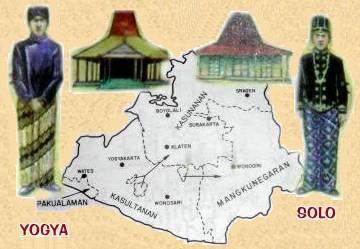
The
Javanese kingdoms that last until today.
The picture above is supposed to offer a glance at the last empire
of Java, Mataram, after being squeezed and sliced into
the anomalous colonial 'land of the kings' (see that map).
At the left is the Kingdom of Yogyakarta under the Hamengkubuwono
sultans and the Pakualam dukes.
At the right is the Kingdom of Surakarta (Solo) under
the Pakubuwono kings and autonomous Mangkunegoro princes.
Springing from one and the same aristocracy, the two territories only differ
(but greatly) in personality of their rulers and governmental
styles as related to the people and the Dutch.
The specimental picture of a Solonese aristocrat above also represents
one of Yogya's, and the picture of the Yogyanese man could fairly
serve as that of a Solonese, although details of their formal
dresses are very different if observed by the initiated (how the
men wear their headgears alone is a lot different between the
two kingdoms, even as the headgears in question look similar to
foreign eyes).
The Javanese architectural genre of joglo houses (whose main
halls and antechambers comprise of some high-vaulted ceiling supported
by slim cubic pillars shading vast open spaces without walls)
is, without marked difference, characteristic of both realms.
The joglo at the right is typical of dwellings of ordinary mortals,
made of Kalimantanese wood or local bricks, while the one at the
left is the Yogyanese Palace's Golden Hall (Bangsal Kencana),
which follows the same architectural basics except that it is
done in tough (and headachingly expensive) Javanese teak and marble,
mercilessly carved to perfection, and meticulously gilded at the
right spots.
Javanese kings hold audience in that sort of hall since the day they got
to the throne. Actually Javanese kings don't have thrones
as Europeans and Chinese take them to mean -- i.e. a more or less
immovable extravagantly decorated massive chair for each. But
chairlessness isn't practiced as in Japan either. Kings, queens,
great councillors (or grand vaziers), and guests whose status
is equal to them sit on what could be just any best chairs around,
while everybody below those ranks must sit on the floor.
Similar furniturial arrangement and court etiquette is applied in every
level of aristocracy (so a Duke sits on a chair while his Regents
sit on the floor in a duchy audience, then a Regent sits on a
chair while his advisors sit on the floor in regency meeting,
and so on, down to the arrangement of personal living rooms at
home). Alternately, several sorts of chairs are set for those
in an audience, differentiated by height of legs and whether or
not they are furnished with backs (stools in this case serve as
signifiers of lesser political ranks). But, in all scenes and
in all levels, servants and regular soldiers can get no higher
seat than the floor, including in noblepersons' houses.
We can't afford to dismiss a seemingly trivial fuss like that from
studies of history; it characterizes a 'theater state' as Javanese
kingdoms (and for that matter also Indonesian republic) have been
known as. A breach of such an arrangement had brought grim consequences
in the past, and in many cases led to wars.
1746
Prince Mangkubumi
(the name means, literally, 'on whose lap the world rests'), Duke of
today's Yogyakarta, for some personal reasons and a political grudge
(he lost patience with the king of Mataram over the latter's cooperative
tendency regarding the Dutch, and thought him unfit to rule, plus he
was also in the line of heirs to the throne) waged war against the king
who, naturally, was backed up by the Dutch. This civil war raged for
nine years.
1755
The war ended when
the Dutch decided to relent to Mangkubumi's conditions for peace. Mataram
was cut in two. The last king of Mataram, Sunan Pakubuwono II
(the name means 'axis of the universe'), became sovereign only over
Surakarta (Solo), namely half of his previous domain. Mangkubumi got
himself free from tributary chains -- his former lord was now a mere
colleague on equal footing.
Mangkubumi's share of territory was to be the kingdom of Yogyakarta, which he ruled
as Sultan Hamengkubuwono ('guardian of the universe') I.
The two kingdoms would be, of course, in no warm relationship after
this, and the ensuing cold war would be kept almost intact until Indonesia's
independence.
Therefore no joint-venture would spring out of the palaces.
That's why the Dutch agreed to Mangkubumi's demands anyway.
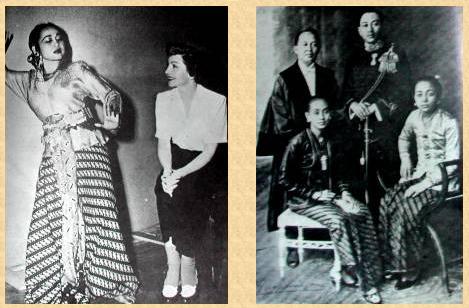
Glances
at the spotlighted natives in colonial times: the dancer & the Prince.
The pic above shows Indonesian professional dancer Dewi Dja
of the famous Dardanella theater, one of the first divas of this
Republic. Here she was instructing Hollywood's Claudette Colbert
in the making of 20th-century Fox' Three Came Home [left].
At the right is family portrait of Prince Mangkunegoro VII
(the seventh). He's the one leaning on the sword, in his usual
military uniform, since he was also a Colonel of the Royal Dutch
Colonial Forces. The woman at his right, in light-colored kebaya,
is his wife Princess Timur (if Mangkunegoro were a king, she would
be queen, that's why her chair is taller). The man in academic
toga at the left is the Prince's son in-law, and the woman in
dark kebaya, seating on the shorter stool, is Mangkunegoro's
eldest daughter from a concubine. This pic was taken in 1925.
1757
Immensely dissatisfied
with the way Mataram was going (meaning, that he was left out of the
bargaining process), Lord Said of Solo [pron. 'sah-eed'] declared
war against the sultan of Yogya, the king of Solo, and the Dutch of
both areas, all at once.
According to contemporary records, his motives were for the greater part 'nationalist';
he got utterly disappointed to see his father in-law Sultan Hamengkubuwono
I of Yogya getting strayed from his former anti-Dutch policy and betrayed
his own initial target of a 'Java United' (i.e. some nostalgic aspiration
for sovereignty as in Sultan Agung's heyday).
Yet it was just as true that Said, quite loudly anti-colonialist, got prosaic
aims as well.
The war that went on for nearly two years ended with a further cut upon
the Solonese kingdom. Almost half of it became Mas Said's estate, himself
getting the highest rank possible nearing a king's, enabling him to
build a dynasty and assume kingly habits and royal trappings, without
being a king.
He took the name of Prince Mangkunegoro ('holder of the state')
I.
This was cruelly ironic to the Yogyanese Sultan. He maintained that it was
because of Mangkunegoro's uprising then he had no choice but
to reconcile with the Solonese Pakubuwono II and in effect also with
the Dutch garrisons in both kingdoms. No matter what Mangkunegoro thought
of him, actually he wasn't about to retreat from his former position
as a menace to colonialism. But nothing could be done now that it was
over -- especially while Mangkunegoro himself was well on the way of
revising his own anti-colonialism.
The next princes of the same pedigree would apply their own further 'correction'
to the initially anti-colonialist creed, until one day it would stand
upside-down.
At any rate Mangkunegoro I would still retain his own image as a flamboyant
Dutch-fighting prince even though it was plain to see that nobody else
enabled him to get the duchy, made it easy for him not just to maintain
the new dynastic power but also to increase its influence, but the Dutch.
Even the lethal Daendels, Governor-General until 1815 who insulted everybody
in his spare-time and sent thousands of Javanese men to die in forced-labor,
increased the subsidy for Mangkunegoro's guards twice its former
sum..........
1789
General George Washington
was inaugurated as the first President of the United States of America.
In Europe, things would never be the same again as this year marked the
eruption of the French Revolution.
Both events infiltrated a good part of Indonesian nationalists' conscience;
later the emerging leaders of the country like Sukarno, Sjahrir, and
so on would find the American and the French revolutions stimulating
their own patriotism, despite the very different characteristics of
the three -- it wouldn't be 'settlers' or mestizos that liberated Indonesia,
but its own 'Indians'; Indonesian republicans wouldn't guillotine kings
and queens, but got some of them firmly by its side and the rest of
them peacefully and irreversibly subordinated.
1795
King William of the
Netherlands fled to England. There he handed over his kingdom's colonial
affairs to the Brits. That's why the British military got very busy
in and out of their own lands; they cannon-balled the Dutch strongholds
in Indonesia (like in Padang, West Sumatera; and all over their favorite
isles Maluku).
Having gotten rid of William, the Netherlands declared itself 'democratic'
as Napoleon Bonaparte's France got increasingly warlusty within and
outside its original boundaries. Seemed like the seeds of French Revolution
found the best bed under the sea level.
The Netherland was practically a vassal state of France until 1810.
Luckily, most Indonesians never even knew this.
It would have been beyond unbearable to have been colonized by some conquered
colonists.
And the Hollanders were too frequently in this funny position -- getting
in and out of subordination to, at least, Spain, French and Germany
in some alarming regularity.
The so-called 'Batavian Republic' would live a life shorter than the time
needed to explain what this was all about.
1799
The VOC, beyond any
repair, was declared bankrupt. Cancerous corruption had been rendering
it virtually lifeless enough to warrant the last departure of soul uneventful.
Later vulgarists would say that the acronym of its name stood better
for Vergaan Onder Corruptie (Fallen Under
Corruption) -- and this wasn't too unreasonable.
From the beginning, the only motive shared by thousands of the colonial Dutchmen
was how to get rich as quickly as possible, which was fine to the Crown,
only in this case the 'getting rich' part was meant to be applied to
themselves individually, and not at all for the benefit of the VOC or
the Netherlands.
The mark of worldly success was social titles such as 'sugar lord' in Central
Java, 'tea squire' in West Java, or 'big boss' (of tobacco) in Northern
Sumatera, if one wasn't in the government.
So the common mode of operation was 'each to his own loot' -- robbing the
Netherlands, their own Trade Union, and Indonesians, all at once...........
1801
British forces, assisted
by the Tidorese under Sultan Nuku's command, attacked and captured the
Dutch fort in Ternate.
For this victory, the chief of British affairs around Maluku, Robert
Townsend Farquhar, was instantly fired.
1805
The Netherlands declared
itself a kingdom again, no longer a republic -- not that it mattered
to anyone in the colony.
It was done for the French anyway -- Napoleon Bonaparte put his brother
Louis (written as 'Lodewijk' if Dutchified) on the throne as the king
of the Netherlands in 1806.
As I said, Louis or no Louis, there was no important effect on the colonies.
But, as the VOC no longer existed and yet to consider its colonies as also
inexistent was out of the question, administration of them were taken
over by the Government.
1809
Napoleon Bonaparte's
Marshall Herman Willem Daendels took over Java. This republican
Dutch Governor-General would have infamy tailing his name as far as
Indonesians are concerned.
Javanese aristocrats, whose culture disallowed expressions of unbecoming emotions
(hatred is among these), found it increasingly hard not to take offence
at every move made by 'that cheesy boar' substantially enmeshed in golden
medals and epaulettes.
Single-handedly Daendels had managed to insult every native Javanese in his own brand
of democratic venom regardless of social ranks, although monarcy was
his pet victim.
This went so far that his officers were, to their own mortification, ordered
to assume all the native aristocratic trappings -- resulting in ridiculous
spectacles such as some apparently ill-at-ease caucasians in heatstroke-inducing
regalia being tailed everywhere by literally platoons of little servants
who stoically bore the ordeal of manning giant gilded umbrellas over
their masters' towering figures, who couldn't even walk in natural steps
because they got to go behind another score of paraphernalia-bearing
servants, that these tortured masters couldn't dismiss because their
presence must get preceded by the appearance of these elaborate signals
of (Javanese) power.
Daendels would be especially remembered for the most horrific insult
he had hurled, this time his target was nothing less than humanity itself.
He was the one whose order for forced-labor to open 'the French road' across
Java (from Anyer in the West to Banyuwangi in the East, comparable to
one across the New York State from edge to edge) claimed as many casualties
as a war -- the thousands of unpaid, underfed, diseased, overworked
Central Javanese males who were marched to the job never came back.
1810
The man who would
be Sir Thomas Stamford Raffles was ordered to sail away to Malaka
with the mission to plan British invasion of Java. Sending open letters
to non-Javanese monarchs nearby, such as the king of Buleleng
(Bali) and the king of Madura island, plus the more or less British-friendly
shoreline Javanese kings, like the sultans of Cirebon (West Java),
but not to those that had been 'too Dutch' like the Mataramese deeper
inland, Raffles elicited support for his campaign.
At least those kings I've just mentioned replied favorably.
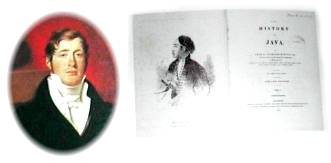
Sir
Thomas Stamford Raffles and his History of Java.
The Javanese man portrayed on the flyleaf of Raffles' book is Sir
Ronodipuro,
who went to England with him in 1816 after the island was given back
to the Dutch.
1811
Java was handed over
to the British under Thomas Stamford Raffles when Europe finally got
decisively sick of hearing about Bonaparte.
It wasn't so loud as to be called a war, the invasion; in less than two
months the British had conquered all of Java.
Raffles would maintain relations with the native rulers who had been amiable
prior to the invasion, and with some others like Sultan Syarif Kasim
of Pontianak (West Kalimantan), and Sultan Abdul Rahman of the
Riau isles (near Sumatera), to the joy of the British Museum
(later when he dragged his Indonesian royal letters and ancient manuscripts
back to London and published his book The History of Java in
1817).
Raffles' first words to Indonesians after the invasion were characteristic. He
told the natives that from now on they would be dealing with Britain.
And he challenged them to compare what life was like under the Dutch
and under the Brits. He said it would be proven that the latter was
incomparably better. Then he told them to get back to work.
As chief administrator of the colony, Raffles was rather well-liked here,
at least Indonesians would remember him without rancor and even in occasional
thankful note around a century later, although this Englishman had his
own blots of un-virtue.
A few nativepersons actually lamented his departure when Java was handed
back to the Dutch five years later, because the British way was, as
Raffles had confidently predicted, felt as a great deal more endurable
compared to the Dutch colonialism.
Sure, Raffles was closer to Singapore because he had found it, but not until
after he helped unearthing Borobudur,
the largest Buddhist temple on this planet, in Central Java. His first
wife was buried in Jakarta, too; that made him something of a 'permanent
resident' in some romantic minds.
And as Raffles went away, gone, too, our chance to make sense of the English
language. A century later this would still be regretted, at least by
my grandmother. (Indonesians have been famous as the third-worst Asians
in matters related to the English language. Today they seem like aspiring
to be on top of the list currently led by the Japanese).
Anyway, this year, when Raffles started to work, he found that the Dutch colonial
community he must govern consisted of some semi-barbarian landowners
whose ultimate form of enlightenment, peak of arts, and scientific achievement
was a newspaper -- which to a whole lot of them even remained mysterious
behind the fog of illiteracy.....
1816
The Brits gave Java
back to the Dutch, whose first action was to cancel projects started
by Raffles, that were detrimental to their tightfisted policy.
Although times had changed, and the previous view of the natives in colonies
as some strange exotic subhuman population had been altered into the
characteristic 'noble savage' attribute, this was in the realm of the
abstract, not of real life.
Education was promptly reversed to the way it used to be -- namely, none.
The return of the Dutch brought grim consequences to the Javanese kings,
who were treated the worst by Daendels and got their trials to hatch
mutinies -- when Raffles was still around -- put down.
The Sultan of Yogya, Hamengkubuwono II, was to suffer retaliation for his
part in a plot of rebellion, said to be planned since 1812. He was forced
to abdicate and exiled, his treasury confiscated, and a small chunk
of his territory was taken away, to be given to Prince Notokusumo who
would be Duke Pakualam I.
The Dutch intended to make Pakualaman a 'kingdom within kingdom' truly in
the Solonese Mangkunegaran fashion, but this particular Yogyanese Duke
wasn't as ambitious as the Solonese was, although from now on the head
of the Pakualam clan would automatically be the Sultan's Grand Councillor,
and in the events of vacancy of the throne (when the Sultan has died
but his heir is underage) the Duke would rule as Regent until the new
sultan ascends, a convention that has been observed until today. The
relation between Pakualams and Sultans of Yogya, then, would be very
different from the one between the Pakubuwonos (Solonese kings) and
Mangkunegoros; while the Solonese would keep trying to 'kill' each other
until 1950, the Yogyanese always work together in the name of one realm.
This solidity ushered the kingdom smoothly into republican times, while
history left Solo behind. In 2004, while the Sultan is Governor of Yogya,
the Pakualam is his Deputy, as usual. The palaces in Solo are by now
nothing but museums of wrong steps in the past.
1819
One of the 'best'
Governor-Generals for the colony, Godart Alexander Gerard Philip,
Baron van der Capellen, was sent to Java to start his term in office.
It was a bad choice for the Dutch. Van der Capellen was just as Rafflesian
as Raffles had been, and the issue of miseducation was brought back
to the realm, as well as forced labor that repulsed him.
He even lowered taxes and abolished the loony habit of dispatching 'ghost
boats' to terrorize Maluku in 1824 when, driven to the frayed ends of
misery, a rural insurrection erupted, led by Captain Pattimura
(real name was Thomas Matulesi)...........
1825
While his Sultan
thought it unwise to openly resist the encumbering Dutch, Prince Diponegoro
of Yogyakarta [pron. 'jog-jah-car-tah'], on
some personal pretext (that the Dutch had cut through
his duchy to build a road without even bothered to tell him that they
would do that) declared war.
One of the most famous of Indonesian heroes, the pious Prince in his all-white
Arabian turban and dramatic flowing robes, soft-spoken Islamic creeds,
pronounced anti-colonialist principle, tested concern about general
welfare, and indifference towards the usual luxuries, personified goodness
in the eyes of the people. This was to be the first 'popular' resistance
against colonialism in Java...........
�������

