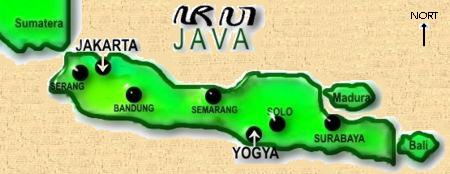
The island of Java today is sliced down into several provinces. Those provinces
don't matter at this page and in this topic; what do are the cultural
regions of the island, which are West, East,
and Central Java, plus the area of the natives of Jakarta.
The FAQ that bugs: Why does the Central Javanese stuff matter so?
Because the greatest kingdoms in this island had been born and thriving
in Central Java.
The kingdom of Mataram, which shaped most of today's Javaneseness,
had its capital city in-between Solo and Yogya, and the Mataramese
culture, in 21st century, still exists within its former territory
that had been cut into two separate kingdoms.
So, as is the case anywhere in any country in this Milky Way, whosoever
rules the territory his culture predominates.
That's how come Indonesia today is so much Javanized.
While among the Javanese themselves, the Central Javanese have been
occupying the (uh, well) central place.
East Java had its own heyday during the rise of the short-lived Kediri
Kingdom. In Majapahitan times, they shared the glory with the
Central Javanese.
 | | 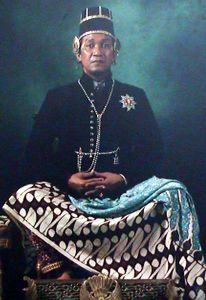 |
| Hamengkubuwono X |
| Hamengkubuwono X |
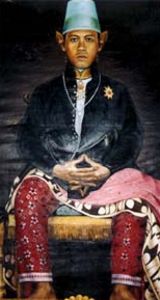
The pictures above are of the kings of the Kingdom
of Yogya, Sultan Hamengkubuwono IX (the ninth; left) and his
son and heir and today's king Sultan Hamengkubuwono X (the tenth;
not left).
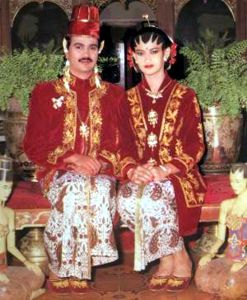
The apparel denoting kingly and queenly habits is black velvet embroidered
with golden thread, to the Javanese since time immemorial. That's
why the traditional wedding dresses of Central Java are
black, like these:
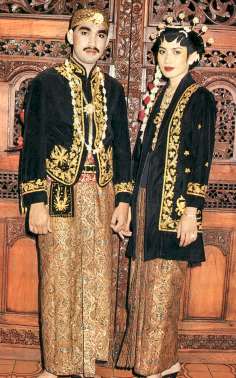
The Solonese ordinary wedding dress
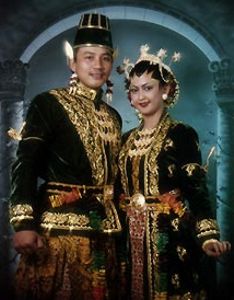
The Yogyanese grand wedding dress, which is a direct imitation
of the formal dresses of the Sultan and his Queen
The groom doesn't wear pants but the Sultans do, because the Sultans
in the pix above happen to be kings at kingly occasions.
The other wedding dresses of Java, which is more regal and more formal,
include pants like the Sultan's for the groom, in the 'basahan'
style ('basah' means 'wet', and implies 'bathing'; in
this style the groom appears bare-chested, and the bride in 'kemben',
i.e. with bared shoulders).
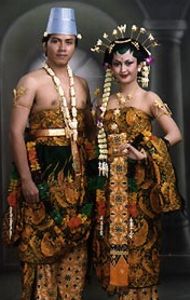 | | 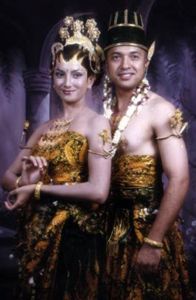 |
| Solonese 'basahan' wedding dress |
| Yogyanese 'basahan' wedding dress |
But the wedding dresses above are most often seen in Java. They're
much cheaper to rent, and the Javanese beauticians specializing
on applying makeups on brides, who always fuss a lot and need
some 'spiritual preps' such as fasting for several days and meditating
and such, don't have to bother that much if 'just' for a wedding
in black.
That is so because until 19th century no ordinary Javanese was allowed
to get married in 'basahan' style, which was reserved
for family members of the Sultanate. The black wedding dresses,
on the other hand, have been 'ordinary people's.
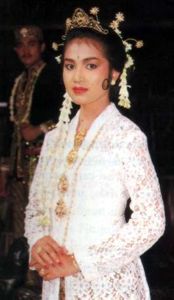
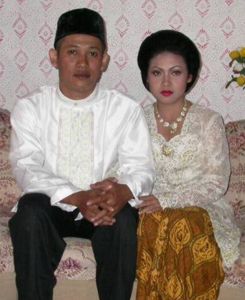
In West Java, whose
native people are called the Sundanese, wedding
dresses are more mundially recognizable: white kebaya.
The pictures above show a Sundanese bride in full dress (left),
and my friend Revy
Hermina in her simplified Sundanese wedding dress (right).
 | | Eastern Javanese people alternate between the black
wedding dresses of Central Java and their own colorful array
of choices. You could see weddings in which the bride and
groom wear the same wedding dresses as the black ones above,
but in other colors, such as red or green or blue.

|
|
| |
As far as wedding dresses go, actually there is a rather vast array
of varieties among the Javanese people, plus the hybrid wedding
dresses that force a combination of the traditional ones with
some insignias of Muslimness that only got in vogue since 1990's.
Some subcultures have their own traditional wedding dresses that are
as strange to the dominant culture (i.e. Central Javanese) as
they must be to you. In the little tobacco-exporting town named
Kudus, for instance, brides and grooms wear the
darkest sunglasses they could find (I don't make this up), along
with their traditional dresses that are markedly different from
the mainstream Central Javanese style. The headgears resemble
that of some Madurese, which look like the picture
at the left below, or the Betawinese, at the right:
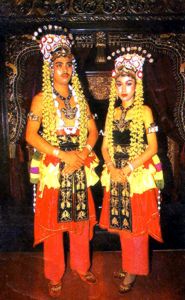
Wedding
dress of Madura
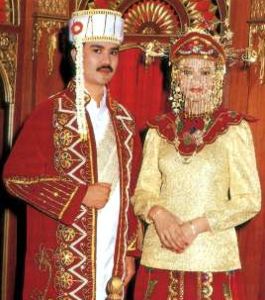
Wedding
dress of Betawi (Jakarta natives)
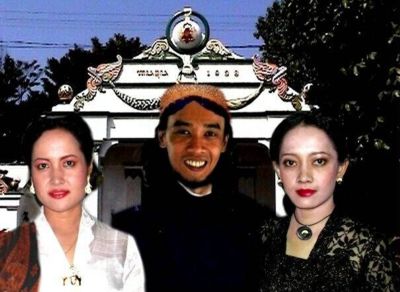
A Javanese woman in formal occasions wears kebaya,
i.e. a rather tight long-sleeved V-necked shirt, that follows
the curves of the body, whose length varies from reaching just
an inch below the waist, to the ones as far down as reaching the
knee.
The white kebaya at the left is donned by my younger sister
Bunga (an Indonesian word that means 'flower'). Her kebaya
is of the Yogyanese style, i.e without a square 'interval' in
the neckline (so it is straightly 'V'-lined, and closed with a
brooch). The kebaya I wear is the Solonese style, that
needs no brooch to keep it together since it's equipped with 'invisible'
buttons inside the collar, and the neckline is 'V' alternated
by a square piece.
My sister's husband Andang
(that name is an Indonesian word that means 'torch';, wears a white shirt and a black jacket above
a batik jarik, with a batik headgear, all of which are
bound together by one name: beskap.
It is the formal male dress for a grown-up Javanese.
At Andang's waistband, at the left side on the back, he wears the
Javanese equivalent of a samurai's sword to a Japanese: keris.
A kebaya is usually made of brocade or embroidered silk,
and usually is somewhat see-through. Only after the revival of
Muslim fashion in 1980's some kebayas are 'solid' and
made of other materials, including plain cotton.
Kebaya
is normally worn with a selendhang (long thin scarf)
put on whichever side of the shoulder that you choose.
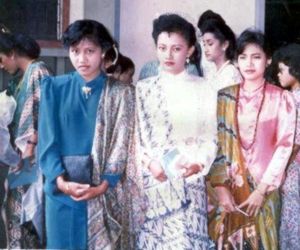
These
are the so-called 'modern kebaya', which could be anything.
Selendhang is made of silk of any color, or made of batik whose color and
motifs are exactly like the jarik (cloth worn like a
sarong, but pleated and wrapped tighter) that a Javanese woman
wears below the kebaya. It can be worn like Beejay does,
i.e. spread all over the side of the shoulder and let to hang
there loosely, or neatly folded several times and put there in
a rather stiffer way. Older women (i.e. 50 years old up) wear
the scarf around both shoulders, like you do woolen winter shawls.
Males wear batik jarik, too, but much more casually, i.e. it
is not supposed to keep you from walking at all (well, most Javanese
women born after 1960 can't walk in jarik!).
Cultural FAQ's always drive me mad, but here I must answer one of them:
the difference between sarong and jarik
is that the latter can't be worn that loosely, one of its end
shown at the front is pleated (like when you make an origami
fan), and must be kept in place by a waistband, named 'stagen',
which is worn like the one you see on people in tuxedo, for the
same purpose like the Japanese obi,
but not that showy (click the red words if you want some pictures
and explanation of the thing). Men and women alike wear stagen.
Just
a note: if you are a woman and wearing the Javanese formal
dress, you won't even be able to move your feet without high-heeled
slippers (we wear slippers with the dress, not shoes). Jarik
is binding you down to two inches below your ankles,
that's why.
Another note: The Javanese kebaya (complete with all
its accessories) has been made the Indonesian formal
dress encompassing every other ethnicities since 1970's.
This happened because the Javanese has been the dominant part of Indonesians
as a whole, and the loudest of all the cultures pronounced in
the 'national culture'.
So the most that other ethnicities can do is just to alter the materials,
for instance discarding 'jarik' made of Javanese batik,
and wear their own woven cloth.
One more note: The traditional Javanese male formal dress,
beskap, remains Javanese only.
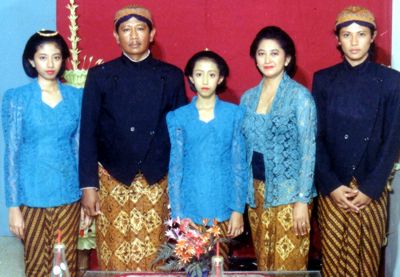
Btw, beskap doesn't have to be black. As you can see in the
snapshot of Mr. Gatot Soetomo's family, above, the male family
members could yield to the female choice of color; so both Mr.
Soetomo and his son Sonny
wear blue beskaps. All the Soetomos wear the Solonese-style
dresses in the pic.
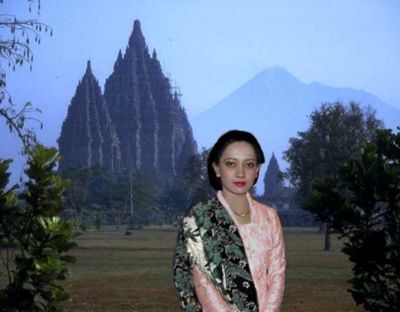
The formal hairdo for Javanese women to wear in formal
occasions is correctly like this. It's called 'gelungan';
i.e. a rather big chignon right at the center of the back of your
head, which will feel like a magnet pulling you backward if you
are born after 1940.
Gelungan is, for ordinary Javanese women, to get decorated with just one
or two fresh jasmine flowers on top of it (unseen from the front),
or a pair of 'susuk', i.e. hair ornaments, made of whatever
(ivory, horn, silver, gold).
Originally these 'susuk's had some functional existence: they keep
the hair from falling back down. But since the dawn of wig companies
(1970's, in the case of Indonesia) the 'susuk's stay
as nothing but decorative items over artificial chignons.
By the way, that's the Hinduist temple of Yogya at the background,
the Prambanan.
We consider this temple to look like....us,
i.e. the Javanese people.
�������