
All leaders are definitely not alike. They may share certain
traits to a degree, but they differ greatly in terms of personal style
or approach.
While there are as many different styles of leadership as there are leaders,
research on leader's behavior or style suggests that in fact, most leaders can
be placed along a number of dimensions relating to their overall approach to
leadership.
Some of the major dimensions along which leaders differ in terms of their style
are as follows :
i) TASK ORIENTATION -refers to the extent to
which the leader focuses on getting the work done and gives primacy to task
achievement .
ii) RELATIONAL DIMENSION - refers to the leader’s
interest in creating friendly relations and satisfying group members.
But, is one of these contrasting styles of leadership superior to
the other in terms of encouraging excellent performance?
This complex issue was the focus of a famous investigation on leader style
conducted by Levin ,Lippit & White (1939).They arranged for 10-11 yr
old students , to meet in 5 member groups , after school , to engage in hobbies
such as woodworking and painting . To investigate the possible effects of
leaders' style on boys' behavior , each group was led by an adult who assumed
one of the three contrasting styles of leadership : autocratic , democratic and
laissez-faire.
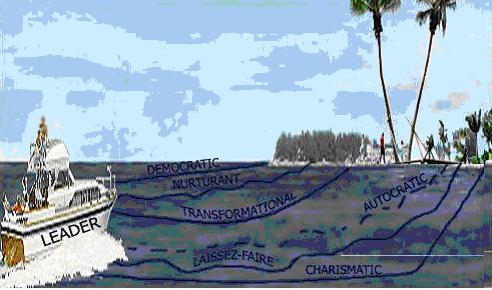
STYLES OF LEADERSHIP
The AUTOCRATIC leader tends to yield absolute power.
Such a leader tends to make all decisions and gives orders alone. Individual
members are often discouraged to set personal goals. The goals are imposed on
them. The autocratic leader guarantees that his guidance is indispensable for
proper functioning of the group though he remains aloof from the group; never
participating in its activities. He is keystone of the group without whom the
group may collapse.
A DEMOCRATIC leader may have the same amount of power as an autocratic leader,
but differs greatly in the way power is used. This leader allows the members to
participate in reaching decisions and often sought their input. He encourages
greater involvement in activities and in setting up of group goals .He rarely
gives orders or commends and permits the members to approach their work in
whatever way they wish. Democratic leader participates in the group's
activities but does not tries to dominate activities in any way. His
success lies in how well the group can function without him.
The LAISSEZ-FAIRE leader adopts a 'hands-off'
approach and his role is primarily that of an interested observer who is there
to provide technical information about the activities if requested to do
so by some group member. The French words "laissez-faire" means
“let people do what they choose “. Hence, the leader does not intervene in the
group functioning in any-way.
The major difference in autocratic & democratic styles
is that the democratic leader tends to be the group "dictator "while
the autocratic leader acts as the "facilitator”.
There are some interesting differences between democratic, autocratic and
laissez-faire styles of leadership.
For
e.g.: Members in the autocratic and democratic groups spent about equal amounts
of time working when the leader is present, those in laissez-faire groups work
less .When the leader leaves the room, however, work drops off sharply in the
autocratic groups but remains unchanged in the democratic groups, it actually
increases in the laissez-faire groups. Members in autocratic groups express
more discontent and make more aggressive demands for attention. Those in
democratic groups tend to be friendlier.
Leaders, as we have seen, vary in the extent of their emphasis on task
achievement and their relationship with members. In western cultures
task achievement assumes more significance in group functioning whereas in many
non-western cultures a nurturing relationship of the leader with group members
is considered important. In between the two styles is the NURTURANT TASK STYLE .It has been proposed by Jai B.P.
Sinha.
This type of leadership has two main components:
i) Concern for task,
ii) Nurturing orientation.
Such
a leader defines his and his subordinates role clearly so that communications
are explicit, structured and task relevant. He creates a climate purposiveness
and goal orientation. His task orientation, however, has the mix of nurturance.
He cares for his subordinates, shows affection, takes a personal interest in
their well being and is committed to their growth. Under such leader the work
is performed diligently as a part of "sneh-shradha” i.e. affection-deference relationship between a
subordinate and his nurturing superior.
In INDIAN organizations, nurturing task leadership is found to be effective.
Modern research suggests that leadership styles created by Lewin
and his colleges are, though sharply different but, these actually represent
two different and largely independent aspects of leadership styles -the extent
to which leaders make all the decisions themselves or allow participation by
other members and the extent to which the leaders try to run the show by
closely directing the activities of all group members, a directive-permissive dimension.
Leaders can either direct the group's discussion in such a way as to insist
that all possible views and perspectives be heard i.e. the leader can show a
high level of process- directiveness or they can state their own position and try to
ram it down the throats of their group i.e. a high level of outcome- directiveness.
When leaders play a directive role by insisting that all views be discussed and
that all members have a chance to participate, the groups' effectiveness is
enhanced.
CHARISMATIC leaders: Leaders who change the world.
Personalities like Mahatma Gandhi, Indira Gandhi, John F Kennedy, Franklin
Roosevelt and many such others exerted powerful effects on many millions of
persons and by doing so, changed their societies. There is something different
about these leaders. Such leaders are called Charismatic leaders. (Charisma in Greek means
"gift")
according to "the great man theory "
certain
traits, personal strengths and motives of individuals make some people
charismatic leaders. With respect to their relationship with followers,
charismatic leaders seem to generate
1) High levels of
devotion and loyalty
2) High levels of enthusiasm for leader and his/her ideas
3) Willingness to sacrifice their own interests for sake of the group's goals
4) Levels of performance beyond those that would be expected
This type of leadership involves a special kind of leader-follower relationship
in which the leader inspires the followers to make personal sacrifices in their
devotion to causes.
As one expert in this area puts it, Charismatic leaders somehow "make
ordinary people do extraordinary things".
TRANSFORMATIONAL leaders exert considerable
influence over the followers by proposing an inspiring vision. They describe in
vivid, clear, emotion-provoking manner, an image of what the group can-and
should-become. They also offer a route for reaching and attaining the goal.
These leaders engage in framing: they define the goals
for their group in a way that gives extra meaning and purpose both to the goals
and the actions needed to attain them.
A clear illustration of this is given by the story of two stone-cutters working
on a cathedral in Middle ages. When asked what they were doing, one replied
"cutting the stone, of course!" The other answered,” Building the
world's most beautiful temple to the glory of god." Which person would be
likely to work harder? The answer is obvious and it is also clear that any
leader who can induce such thinking in his followers can also have profound
effects upon them.
Other facets of these leaders are high level of self confidence,
high degree of concern for followers, excellent communication skills and a
stirring personal style.


|
|
In sum, there is no
single style which is effective in all situations. The distinction between different
styles of leadership is in
terms of the kind of
relationship that exists between leader and the group members and the degree of
emphasis on task accomplishment
However, a rigid leadership style is not always the best. The effectiveness of
any style of leadership depends on the specific circumstances in which a group
operates.
In short, the optimal leadership style is the one that suits the situation.
"GREAT PERSON
THEORY" - A view of
leadership suggesting that great leaders possess certain traits that set them
apart from most human beings , traits that are possessed by all such leaders no
matter when or why they lived.
