
Writing of Krishna's flute, calls it the "carnival
of joy"; a carnival that expresses the union of human's with Nature in
love, sex, wildness, spontaneity, primal animal joys. It is a vision calculated
to appeal to the Romantic soul: to dance, to escape into the natural landscape
and become one with it. And the beautiful piper leads the dance.
Krishna's flute is an extension of his beauty. Not only is it the most beautiful sound imaginable, but it also imparts the essence of Krishna's intoxicating nature. While Krishna is also adept at singing, it is the sound of his flute, not his voice, that echoes throughout Vrindavana, beckoning all to join him in the forest. ...Amid the sounds of the humdrum world, the flute, especially Krishna's flute, is sweet and pure, prancing along to nowhere in particular. It comes from and belongs to that world of abundance and bliss that Krishna rules.
In the myth of Krishna, it is not children, but their wives that the men lose, for his flute breaks through all their propriety and reserve. The gopis are not, is important to note, loose women; they are virtuous, but are jarred loose from their self-control. Says Radha, the chief consort of Krishna,
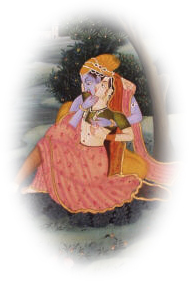
At the first note of his flute
down came the lion gate of reverence
for elders...
I was thrust to the ground as if
by a thunderbolt...
How can I describe his relentless
flute,
which pulls virtuous women from
their homes
and drags them by their hair to
Shyam
as thirst and hunger pull the doe
to the snare?
Chaste ladies forget their lords,
wise men forget their wisdom,
and clinging vines shake loose
from their trees,
hearing that music.
The abandon of the cowherds' wives symbolizes something bigger: a universal power of music and imagination. For even the other gods cannot ignore Krishna's flute:
By means of his flute, Krishna fills himself and the universe with bliss. He distracts everyone and everything from normal activity and enchants them to revel in ecstasy. His flute sends shudders of delight to the very foundations of the world. Natural laws fall away as rocks and trees respond to his call and stars wander from their courses. The sound of his flute puts an abrupt end to man's mechanical, habitual activity as well as to the predictable movements of nature.
His music explodes upon the world and society insisting that all else be forgotten. It is time, it proclaims, to join in his symphony of joy, to frolic in the forest, to scamper in play, to realize every dream that one has ever dreamed in his world of infinite possibility.