 |
|
Switch
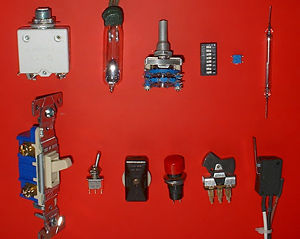
A switch is a mechanical device used to connect and disconnect a circuit at will. Switches cover a wide range of types, from subminiature up to industrial plant switching megawatts of power on high voltage distribution lines.
In applications where multiple switching options are required (e.g., a telephone service), mechanical switches have long been replaced by electronic switching devices which can be automated and intelligently controlled.
The prototypical model is perhaps a mechanical device (for example a railroad switch) which can be disconnected from one course and connected to another.
The switch is referred to as a "gate" when abstracted to mathematical form. In the philosophy of logic, operational arguments are represented as logic gates. The use of electronic gates to function as a system of logical gates is the fundamental basis for the computer�i.e. a computer is a system of electronic switches which function as logical gates.
Types of Switches
| Electronics abbreviation |
Expansion of abbreviation |
British mains wiring name |
American mains wiring name |
Description
| Symbol |
| SPST |
Single pole, single throw |
One way |
Two way |
A simple on-off switch: The two terminals are either connected together or not connected to anything. An example is a light switch. |
 |
SPDT |
Single pole, double throw |
Two way |
Three way |
A simple changeover switch: C (Common) is connected to L1 or to L2. |
 |
SPCO |
Single pole changeover
or Single pole, centre off |
|
|
Equivalent to SPDT. Some suppliers use SPCO for switches with a stable off position in the centre and SPDT for those without. |
DPST |
Double pole, single throw |
Double pole |
Double pole |
Equivalent to two SPST switches controlled by a single mechanism |
 |
DPDT |
Double pole, double throw |
|
|
Equivalent to two SPDT switches controlled by a single mechanism: A is connected to B and D to E, or A is connected to C and D to F. |
 |
DPCO |
Double pole changeover
or Double pole, centre off |
|
|
Equivalent to DPDT. Some suppliers use DPCO for switches with a stable off position in the centre and DPDT for those without. |
|
|
Intermediate switch |
4-way switch |
DPDT switch internally wired for polarity-reversal applications: only four rather than six wires are brought outside the switch housing; with the above, B is connected to F and C to E; hence A is connected to B and D to C, or A is connected to C and D to B. |
 |
Back