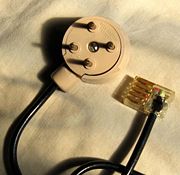
| Place |
Plug or Plugs |
| Algeria |
F-010 |
| Argentina |
RJ11 |
| Australia |
610 or RJ11 |
| Austria |
TDO |
| Barbados |
RJ11 |
| Belarus |
RJ11 or Polish 5-pin WT-4 in older installations |
| Belgium |
Tetrapolar |
| Bolivia |
RJ11 |
| Bosnia |
RJ11, or older 3-pin plug used in countries of former Yugoslavia |
| Botswana |
BS 6312 |
| Brazil |
Telebr�s plug or RJ11 |
| Canada |
RJ11 |
| Cayman Islands |
RJ11 |
| Chile |
RJ11 |
| China |
RJ11 |
| Colombia |
RJ11 |
| Costa Rica |
RJ11 |
| Croatia |
RJ11 or older 3-pin plug used in countries of former Yugoslavia |
| Cyprus |
BS 6312 With RJ11 used for ADSL |
| Denmark |
RJ11 in newer installations, but mainly the national 3-prong standard. |
| Ecuador |
RJ11 |
| Faroe Islands |
RJ11 |
| Finland |
RJ11, 3-prong national standard in older installations. |
| France |
F-010 |
| Germany |
TAE, or RJ45 for ISDN |
| Gibraltar |
BS 6312 |
| Greece |
RJ11 although other types can also be found |
| Hong Kong |
RJ11 in newer installations, or BS 6312 |
| Hungary |
RJ11 |
| India |
RJ11 |
| Indonesia |
RJ11 |
| Iran |
RJ11, older installations may be CEI 23-16/VII or CEE 7/16. |
| Ireland |
RJ11, RJ45 for ISDN, Digital PBX and office systems |
| Israel |
BS 6312 or RJ11 |
| Italy |
Tripolar plug or RJ11 |
| Japan |
RJ11 |
| Lithuania |
RJ11 |
| Liechtenstein |
Reichle-connectors (4-pin Swiss telephone plugs in old installations) |
| Luxembourg |
RJ11 (sometimes older 4-pin luxembourgish telephone plug can be found) |
| Macedonia |
RJ11, or older 3-pin plug used in countries of former Yugoslavia |
| Malaysia |
RJ11 |
| Mexico |
RJ11 |
| Montenegro |
RJ11, or older 3-pin plug used in countries of former Yugoslavia |
| Morocco |
F-010 |
| Netherlands |
RJ11 and the Dutch standard plug/socket |
| New Zealand |
BS 6312 |
| Norway |
RJ11 in newer installations, 3-prong national standard in older installations |
| Philippines |
RJ11 |
| Poland |
RJ11 or Polish national 5-pin (WT-4) coupled with RJ11 socket in older installations |
| Portugal |
RJ11 (also known as R.I.T.A.) |
| Romania |
RJ11, 3-pin triangular plug or 5-pin circular plug |
| Russia |
RJ11 |
| Serbia |
RJ11, or older 3-pin plug used in countries of former Yugoslavia |
| Singapore |
RJ11 |
| Slovenia |
RJ11, or older 3-pin plug used in countries of former Yugoslavia |
| Slovakia |
RJ11 |
| South Africa |
RJ11 or Protea, RJ45 used for ISDN |
| Spain |
RJ11 |
| Sri Lanka |
RJ45 |
| Sweden |
SS 455 15 50 or RJ11 |
| Switzerland |
Reichle-connectors or older 4-pin plugs |
| Taiwan |
RJ11 |
| Thailand |
RJ11 |
| Turkey |
RJ11 |
| United Arab Emirates |
BS 6312 |
| United Kingdom |
(431A and 631A) With RJ11 used for ADSL British Telephone Sockets |
| United States of America |
RJ11 |
| Venezuela |
RJ11 |
| Zimbabwe |
BS 6312 or RJ11 |