 |
|
Operational amplifier
 |
An operational amplifier, often called an op-amp , is a DC-coupled high-gain electronic voltage amplifier with differential inputs and, usually, a single output. Typically the output of the op-amp is controlled either by negative feedback, which largely determines the magnitude of its output voltage gain, or by positive feedback, which facilitates regenerative gain and oscillation. High input impedance at the input terminals and low output impedance are important typical characteristics.
Op-amps are among the most widely used electronic devices today, being used in a vast array of consumer, industrial, and scientific devices. Many standard IC op-amps cost only a few cents in moderate production volume; however some integrated or hybrid operational amplifiers with special performance specifications may cost over $100 US in small quantities.
Modern designs are electronically more rugged than earlier implementations and some can sustain direct short-circuits on their outputs without damage.
History
The operational amplifier was originally designed to perform mathematical operations by using voltage as an analogue of another quantity, hence the name, "operational amplifier", shortened to the term "op-amp".
Although op-amps were originally developed in the vacuum tube era they are now normally implemented as integrated circuits (ICs), though versions with discrete components are used when performance beyond that attainable with ICs is required.
The op-amp circuits are the basis of the electronic analog computer, where op-amps were used to model the basic mathematical operations (addition, subtraction, integration, differentiation, and so on). An operational amplifier is a versatile circuit element with many applications beyond performance of mathematical operations.
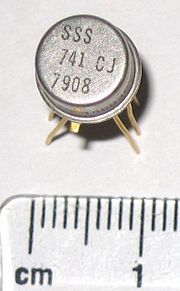
The first integrated op-amp to become widely available, in the late 1960s, was the bipolar Fairchild �A709, created by Bob Widlar in 1965; it was rapidly superseded by the 741, which has better performance, stability, and is easier to use. The �A741 is still in production, and has become ubiquitous in electronics � many manufacturers produce a version of this classic chip, recognizable by part numbers containing "741." Better designs have since been introduced, some based on the FET (late 1970s) and MOSFET (early 1980s). Many of these more modern devices can be substituted into an older 741-based circuit and work with no other changes, to give better performance.
Op-amps usually have parameters within tightly specified limits, with standardized packaging and power supply requirements. With only a few external components op-amp circuits can perform a wide variety of analog signal processing tasks.
Basic Operation
The amplifier's differential inputs consist of an inverting input and a non-inverting input, and ideally the op-amp amplifies only the difference in voltage between the two. This is called the "differential input voltage". In its most common use, the op-amp's output voltage is controlled by feeding a fraction of the output signal back to the inverting input. This is known as negative feedback. If that fraction is zero, i.e., there is no negative feedback, the amplifier is said to be running "open loop" and its output is the differential input voltage multiplied by the total gain of the amplifier, as shown by the following equation:

where V+ is the voltage at the non-inverting terminal, V- is the voltage at the inverting terminal and G is the total open-loop gain of the amplifier.
Because the magnitude of the open-loop gain is typically very large and not well controlled by the manufacturing process, op-amps are not usually used without negative feedback. Unless the differential input voltage is extremely small, open-loop operation results in op-amp saturation (see below in Nonlinear imperfections). An example of how the output voltage is calculated when negative feedback exists is shown below in Basic non-inverting amplifier circuit.
Another typical configuration of op-amps is the positive feedback, which takes a fraction of the output signal back to the non-inverting input. An important application of it is the comparator with hysteresis.
Back