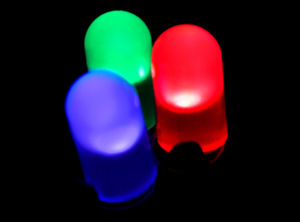
A light-emitting diode, usually called an LED, is a semiconductor diode that emits incoherent narrow-spectrum light when electrically biased in the forward direction of the p-n junction, as in the common LED circuit. This effect is a form of electroluminescence.
A LED is usually a small area light source, often with extra optics added to the chip that shapes its radiation pattern. LEDs are often used as small indicator lights on electronic devices and increasingly in higher power applications such as flashlights and area lighting. The color of the emitted light depends on the composition and condition of the semiconducting material used, and can be infrared, visible, or ultraviolet. LEDs can also be used as a regular household light source. One of the most important applications for society is the sterilization of water and disinfection of devices.
In the early 20th century, Henry Round of Marconi Labs first noted that a semiconductor junction would produce light. Russian Oleg Vladimirovich Losev independently created the first LED in the mid 1920s; his research, though distributed in Russian, German and British scientific journals, was ignored. Rubin Braunstein of the Radio Corporation of America reported on infrared emission from gallium arsenide (GaAs) and other semiconductor alloys in 1955. Experimenters at Texas Instruments, Bob Biard and Gary Pittman, found in 1961 that gallium arsenide gave off infrared radiation when electric current was applied. Biard and Pittman were able to establish the priority of their work and received the patent for the infrared light-emitting diode. Nick Holonyak Jr., then of the General Electric Company and later with the University of Illinois at Urbana-Champaign, developed the first practical visible-spectrum LED in 1962 and is seen as the "father of the light-emitting diode". Holonyak's former graduate student, M. George Craford, invented in 1972 the first yellow LED and 10x brighter red and red-orange LEDs.
Shuji Nakamura of Nichia Corporation of Japan demonstrated the first high-brightness blue LED based on InGaN, borrowing on critical developments in GaN nucleation on sapphire substrates and the demonstration of p-type doping of GaN which were developed by I. Akasaki and H. Amano in Nagoya. The existence of the blue LED led quickly to the first white LED, which employed a Y3Al5O12:Ce, or "YAG", phosphor coating to mix yellow (down-converted) light with blue to produce light that appears white. Nakamura was awarded the 2006 Millennium Technology Prize for his invention.
The first known report of a light-emitting solid-state diode was made in 1907 by the British experimenter H. J. Round. However, no practical use was made of the discovery for several decades. Independently, Oleg Vladimirovich Losev published "Luminous carborundum [silicon carbide] detector and detection with crystals" in the Russian journal Telegrafiya i Telefoniya bez Provodov (Wireless Telegraphy and Telephony). Losev's work languished for decades.
The first practical LED was invented by Nick Holonyak, Jr., in 1962 while he was at General Electric Company. The first LEDs became commercially available in late 1960s, and were red. They were commonly used as replacements for incandescent indicators, and in seven-segment displays, first in expensive equipment such as laboratory and electronics test equipment, then later in such appliances as TVs, radios, telephones, calculators, and even watches. These red LEDs were bright enough only for use as indicators, as the light output was not enough to illuminate an area. Later, other colors became widely available and also appeared in appliances and equipment. As the LED materials technology became more advanced, the light output was increased, and LEDs became bright enough to be used for illumination.
Most LEDs were made in the very common 5 mm T1-3/4 and 3 mm T1 packages, but with higher power, it has become increasingly necessary to get rid of the heat, so the packages have become more complex and adapted for heat dissipation. Packages for state-of-the-art high power LEDs bear little resemblance to early LEDs
Back