 |
Lamps
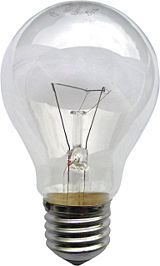 |
Lamps emit light when an electric current passes through them. All of the lamps shown on this page have a thin wire filament which becomes very hot and glows brightly when a current passes through it. The filament is made from a metal with a high melting point such as tungsten and it is usually wound into a small coil. Filament lamps have a shorter lifetime than most electronic components because eventually the filament 'blows' (melts) at a weak point.
This is the supply voltage required for normal brightness. If a slightly higher voltage is used the lamp will be brighter but its lifetime will be shorter. With a lower supply voltage the lamp will be dimmer and its lifetime will be longer. The light from dim lamps has a yellow-orange colour.
Torch lamps pass a relatively large current and this significantly reduces the output voltage of the battery. Some voltage is used up inside the battery driving the large current through the small resistance of the battery itself (its 'internal resistance'). As a result the correct voltage rating for a torch lamp is lower than the normal voltage of the battery which lights it!
Lamps may be connected either way round in a circuit and the supply may be AC or DC.
Most lamps are designed to be used in a lampholder but the small 'wire ended' and 'grain of wheat' lamps have wires which may be soldered directly onto a circuit board.
Lampholders usually have screw terminals or solder tags to attach wires. Some small holders have contacts which may be soldered directly to a circuit board.
Several lamps can be successfully connected in series provided they all have identical voltage and power (or current) ratings. The supply voltage is divided equally between identical lamps so their voltage rating must be suitable for this. For example Christmas tree lights may have 20 lamps connected in series to a 240V supply, so each lamp will have 240V � 20 = 12V across it.
A disadvantage of connecting lamps in series is that if one lamp blows all of them will go out because the circuit is broken. Christmas tree lamps have a special feature to overcome this problem; they are designed to short circuit (conduct like a wire link) when they blow, so the circuit is not broken and the other lamps remain lit, making it easier to locate the faulty lamp. Sets also include one 'fuse' lamp which blows normally.
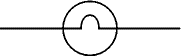
Lamp (lighting)
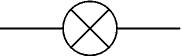
Lamp (indicator)