 |
|
Inductor
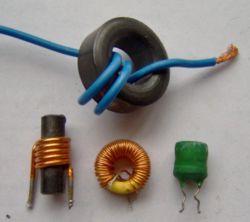 |
An inductor is a passive electrical device employed in electrical circuits for its property of inductance. An inductor can take many forms.
Inductors are used extensively in analog circuits and signal processing. Inductors in conjunction with capacitors and other components form tuned circuits which can emphasize or filter out specific signal frequencies. This can range from the use of large inductors as chokes in power supplies, which in conjunction with filter capacitors remove residual hum or other fluctuations from the direct current output, to such small inductances as generated by a ferrite bead or torus around a cable to prevent radio frequency interference from being transmitted down the wire. Smaller inductor/capacitor combinations provide tuned circuits used in radio reception and broadcasting, for instance.
Two (or more) inductors which have coupled magnetic flux form a transformer, which is a fundamental component of every electric utility power grid. The efficiency of a transformer decreases as the frequency increases but size can be decreased as well; for this reason, aircraft used 400 hertz alternating current rather than the usual 50 or 60 hertz, allowing a great savings in weight from the use of smaller transformers.
An inductor is used as the energy storage device in some switchmode power supplies. The inductor is energized for a specific fraction of the regulator's switching frequency, and de-energized for the remainder of the cycle. This energy transfer ratio determines the input-voltage to output-voltage ratio. This XL is used in complement with an active semiconductor device to maintain very accurate voltage control.
Inductors are also employed in electrical transmission systems, where they are used to intentionally depress system voltages or limit fault current. In this field, they are more commonly referred to as reactors.
As inductors tend to be larger and heavier than other components, their use has been reduced in modern equipment; solid state switching power supplies eliminate large transformers, for instance, and circuits are designed to use only small inductors, if any; larger values are simulated by use of gyrator circuits.
Inductor construction
An inductor is usually constructed as a coil of conducting material, typically copper wire, wrapped around a core either of air or of ferromagnetic material. Core materials with a higher permeability than air confine the magnetic field closely to the inductor, thereby increasing the inductance. Inductors come in many shapes. Most are constructed as enamel coated wire wrapped around a ferrite bobbin with wire exposed on the outside, while some enclose the wire completely in ferrite and are called "shielded". Some inductors have an adjustable core, which enables changing of the inductance. Inductors used to block very high frequencies are sometimes made with a wire passing through a ferrite cylinder or bead.
Small inductors can be etched directly onto a printed circuit board by laying out the trace in a spiral pattern. Small value inductors can also be built on integrated circuits using the same processes that are used to make transistors. In these cases, aluminium interconnect is typically used as the conducting material. However, practical constraints make it far more common to use a circuit called a "gyrator" which uses a capacitor and active components to behave similarly to an inductor.
Back