 |
|
Electrical Fuse
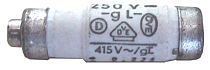 |
electronics and electrical engineering a fuse (short for fusible link), is a type of overcurrent protection device. Its essential component is a metal wire or strip that melts when too much current flows, which breaks the circuit in which it is connected, thus protecting the circuit's other components from damage due to excessive current.
A practical fuse was one of the essential features of Thomas Edison's electrical power distribution system. An early fuse was said to have successfully protected an Edison installation from tampering by a rival gas-lighting concern.
Fuses (and other overcurrent devices) are an essential part of a power distribution system to prevent fire or damage. When too much current flows through a wire, it may overheat and be damaged, or even start a fire. Wiring regulations give the maximum rating of a fuse for protection of a particular circuit. Local authorities will incorporate national wiring regulations as part of law. Fuses are selected to allow passage of normal currents, but to quickly interrupt a short circuit or overload condition.
Characteristic parameters
Rated current IN : This is the maximum current that the fuse can continuously pass without interruption to the circuit, or harmful effects on its surroundings.
The I2t value : This is a measure of the energy required to blow the fuse element and is an important characteristic of the fuse. It is an indication of the "let-through" energy passed by the fuse which downstream circuit elements must withstand before the fuse opens the circuit.
Voltage drop : The values of the voltage drop across a fuse are usually given by the manufacturer. A fuse may become hot due to the energy dissipation in the fuse element at rated current conditions. The voltage drop should be taken into account particularly when using a fuse in low-voltage applications.
Breaking capacity : The breaking capacity is the maximum current that can safely be interrupted by the fuse. Some fuses are designated High Rupture Capacity (HRC) and are usually filled with sand or a similar material.
Voltage rating : The voltage rating of a fuse should always be greater than or equal to the circuit voltage. Low-voltage fuses can generally be used at any voltage up to their rating. Some medium-voltage and high-voltage fuses used in electric power distribution will not function properly at lower voltages.
The speed at which a fuse operates depends on how much current flows through it and the material of which the fuse is made. In addition, temperature influences the resistance of the fuse. Manufacturers of fuses plot a time-current characteristic curve, which shows the time required to melt the fuse and the time required to clear the circuit for any given level of overload current.
Where several fuses are connected in series at the various levels of a power distribution system, it is very desirable to clear only the fuse (or other overcurrent devices) electrically closest to the fault. This process is called "coordination" and may require the time-current characteristics of two fuses to be plotted on a common current basis. Fuses are then selected so that the minor, branch, fuse clears its circuit well before the supplying, major, fuse starts to melt. In this way only the faulty circuits are interrupted and minimal disturbance occurs to other circuits fed by the supplying fuse.
Where the fuses in a system are of similar types, simple rule-of-thumb ratios between ratings of the fuse closest to the load and the next fuse towards the source can be used.
Fuses are often characterized as "fast-blow", "slow-blow" or "time-delay", according to the time they take to respond to an overcurrent condition. The selection of the characteristic depends on what equipment is being protected. Semiconductor devices may need a fast or ultrafast fuse for protection since semiconductors may have little capacity to withstand even a momentary overload. Fuses applied on motor circuits may have a time-delay characteristic, since the surge of current required at motor start soon decreases and is harmless to wiring and the motor.
Markings
Most fuses are marked on the body, or end caps to markings show their ratings. Surface mount technology "chip type" fuses feature little or no markings making identification very difficult.
When replacing a fuse, it is important to interpret these markings correctly as fuses that may look the same, could be designed for very different applications. Fuse markings will generally convey the following information;
- Ampere rating of the fuse
- Voltage rating of the fuse
- Time-current characteristic ie. element speed
- Approvals
- Manufacturer / Part Number / Series
- Breaking capacity
Back