 |
Diode
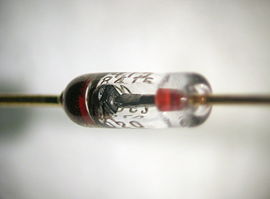 |
 |
where I is the diode current, IS is a scale factor called the saturation current, VD is the voltage across the diode, VT is the thermal voltage, and n is the emission coefficient, also known as the ideality factor. The emission coefficient n varies from about 1 to 2 depending on the fabrication process and semiconductor material and in many cases is assumed to be approximately equal to 1 (thus the notation n is omitted).
The thermal voltage VT is approximately 25.85 mV at 300 K, a temperature close to �room temperature� commonly used in device simulation software. At any temperature it is a known constant defined by:
 |
where q is the magnitude of charge on an electron (the elementary charge), k is Boltzmann�s constant, T is the absolute temperature of the p-n junction in kelvins
The Shockley ideal diode equation or the diode law is derived with the assumption that the only processes giving rise to current in the diode are drift (due to electrical field), diffusion, and thermal recombination-generation. It also assumes that the recombination-generation (R-G) current in the depletion region is insignificant. This means that the Shockley equation doesn�t account for the processes involved in reverse breakdown and photon-assisted R-G. Additionally, it doesn�t describe the �leveling off� of the I�V curve at high forward bias due to internal resistance.
Under reverse bias voltages the exponential in the diode equation is negligible, and the current is a constant (negative) reverse current value of -IS. The reverse breakdown region is not modeled by the Shockley diode equation.
For even rather small forward bias voltages the exponential is very large because the thermal voltage is very small, so the subtracted �1� in the diode equation is negligible and the forward diode current is often approximated as
 |
The use of the diode equation in circuit problems is illustrated in the article on diode modeling.