 |
|
Capacitor
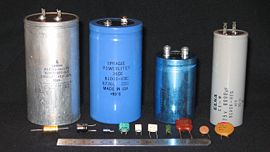 |
A capacitor is an electrical/electronic device that can store energy in the electric field between a pair of conductors (called "plates"). The process of storing energy in the capacitor is known as "charging", and involves electric charges of equal magnitude, but opposite polarity, building up on each plate.
Capacitors are often used in electric and electronic circuits as energy-storage devices. They can also be used to differentiate between high-frequency and low-frequency signals. This property makes them useful in electronic filters.
Capacitors are occasionally referred to as condensers. This is considered an antiquated term in English, but most other languages use an equivalent, like "Kondensator" in German, "Condensador" in Spanish, or "Kondensa" in Japanese.
A capacitor consists of two conductive electrodes, or plates, separated by a dielectric.
Capacitance
The capacitor's capacitance (C) is a measure of the amount of charge (Q) stored on each plate for a given potential difference or voltage (V) which appears between the plates:
In SI units, a capacitor has a capacitance of one farad when one coulomb of charge is stored due to one volt applied potential difference across the plates. Since the farad is a very large unit, values of capacitors are usually expressed in microfarads (�F), nanofarads (nF), or picofarads (pF).
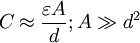
The capacitance is proportional to the surface area of the conducting plate and inversely proportional to the distance between the plates. It is also proportional to the permittivity of the dielectric (that is, non-conducting) substance that separates the plates.
where e is the permittivity of the dielectric, A is the area of the plates and d is the spacing between them.
Stored energy
As opposite charges accumulate on the plates of a capacitor due to the separation of charge, a voltage develops across the capacitor due to the electric field of these charges. Ever-increasing work must be done against this ever-increasing electric field as more charge is separated. The energy (measured in joules, in SI) stored in a capacitor is equal to the amount of work required to establish the voltage across the capacitor, and therefore the electric field. The energy stored is given by:
where V is the voltage across the capacitor.
The maximum energy that can be (safely) stored in a particular capacitor is limited by the maximum electric field that the dielectric can withstand before it breaks down. Therefore, capacitors made with the same dielectric have about the same maximum energy density (joules of energy per cubic meter), if the dielectric volume dominates the total volume.
Back