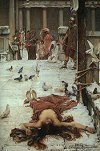
St. Eulalia
1885, oil on canvas.
*Prudentius says that the body of St. Eulalia was shrouded by a miraculous fall of snow when lying exposed in the forum after her martyrdom.*
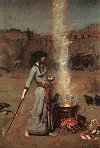
1886, oil on canvas.
* "A magic circle was cast to purify and create a perimeter of space wherein evil magic could not enter. Goddesses and good spirits were invited into the circle, which sometimes had powerful, protective stones placed at North, South, East, and West points. Each point was associated with the Four Elements. North was the most powerful direction. It represented the element of Earth, the celestial bodies revolving around the North Star, and encompassed all secrets, darkness, and the unknown. South was the element of Fire and therefore associated with the sun. This point signified the meeting of East and West - intuition, insight, reason, and logic - and the channeling of the powers of intellect, clairvoyance, and nature. East was the direction for the element of Air, symbolizing clarity, spiritual awareness, and mysticism, West represented impagination and inspiration, as well as emotions and reason. The circle itself was a mark of infinity and eternity.
A witch would cast a magic circle by turning clockwise, beginning at East, following the revolution of the sun. The magic circle was drawn with either a magic wand or an athame. (a black handled ceremonial dagger). A charm or spell was recited as the witch cast the circle, asking the presence of friendly or helpful spirits to attend."
Quoted from 'Witches: A Book of Magic and Wisdom."
1889, oil on canvas.
1892, oil on canvas.
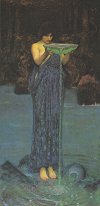
* Waterhouse took the subject of this painting from Ovid's Metamorphoses. Scylla, a water nymph, was loved by Glaucus, a sea deity. She rejected his advances, and he turned for aid to Circe, the enchantress. Circe, however, fell in love with Glaucus herself, and to destroy Scylla, her rival, poisoned the stream where the nymph was accustomed to bathe. When Scylla entered the water she was transforemed into a hideous monster, whereupon she threw herself into the sea which separates Italy from Sicily and was changed into the rock, so perilous to sailors, which bears her name.
Waterhouse shows Circe pouring poison into the stream in which Scylla was accustomed to bathe.
1893, oil on canvas.
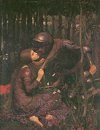
* This painting is based on La Belle Dame Sans Merci by John Keats.
It illustrates the lines:
' She took me to her elfin grot,
And there she gaz' d and signed deep,
And there I shut her wild sad eyes -
So kiss'd to sleep.'
1896, oil on canvas.
1897, oil on canvas.
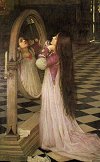
* The character Mariana in William Shakespeare's 'Measure for Measure' is the jilted lover of Angelo, the acting governor of Vienna. Angelo abuses the powers of government invested in him by the duke, by offering to pardon Isabella's brother, Claudio, who has been sentenced to death for seduction, if she will sacrifice her honour to him. The duke, disguised as a friar, learns of Angelo's terrible conduct and contrives Claudio's escape. The ruse is for Isabella to consent to attend Angelo's house at midnight, but to send Mariana in her place, thereby foiling Angelo's designs whilst liberating Claudio. Alfred Lord Tennyson, made Mariana the subject of two poems, 'Mariana' and it's sequel 'Mariana in the South', dwelling on her abject despair as she waits in the lonely moated grange for her lover to return, while her surrounding decay around her. Her tears fall night and morning and she cannot draw pleasure from anything in heaven or on earth. Tormented by haunting voices from her past, she is overcome by weariness and yearns for death.