
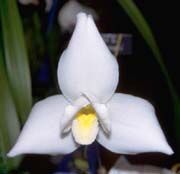
 Some Cultural Notes on Lycaste skinneri
 Larry M. Heuer
The late Larry Heuer lived in Santa Barbara, California. He was an accomplished grower of orchids in general, and particularly loved Lycastes. This article is reproduced courtesy The Orchid Digest, from their issue of Sept.-Oct., 1979
I consider Lycaste skinneri the king of all the lycastes, as well as the best known and the one most often used in breeding. Some of the finer clones are better (in my opinion) than some of the complex hybrids. I�ve seen flowers with a sepal width of 5 cm and a natural spread of 15 cm. When I see a flower like that on a well-grown plant I wonder why more people aren't growing this truly remarkable species.
I pot the plants up in the standard mix and place them in a shadier location than the established plants. I keep them on the dry side until they show signs of active root growth at which time I move them into the section with my established plants and care for them as I do for the others.
L. skinneri plants have stout pseudobulbs and large plicate leaves. the flowers are produced, usually singly, from the base of the most recent pseudobulb on an erect spike at about the same time as the new growth is initiated. The individual flowers measure between four and seven inches in natural spread. In most cases the sepals and petals are varying shades of pink or white with a shaded pink lip. There are a great number of named varieties, most of which for one reason or another seem to have been lost to cultivation. Most plants found in present-day collections do not carry a varietal name even though they may be one of the described varieties. A mature plant will produce from four to twelve flowers during the flowering season, which for me is from November through April with the peak around late January to early February. Each flower will last perfectly for six to eight weeks depending on your growing conditions. If I leave the plants outdoors during the blooming season the blooms will not last nearly as long as in the greenhouse where they are not subjected to the elements. The heavy substance of the blooms also enhances their lasting qualities if used in a corsage or flower arrangement. The long blooming season combined with the extraordinary beauty of the individual bloom makes me wonder why more amateurs don't grow this species.
I grow my lycastes near a valley which runs from the mountains to the Pacific ocean. In this type of location there is a constant movement of air either up or down the valley, so that the plants are not subjected to the hot summer temperatures which occur in some parts of southern California. My plants growing outdoors also have the benefit of the natural humidity from the ocean. During our recent cold weather it did not get below 35� F in my outdoor area, while other people in the Santa Barbara area recorded temperatures in the mid 20's. I received no frost damage at all during this time, possibly because I kept the plants on the dry side. I've found that if the plants are dry or nearly dry during very cold spells they do not suffer as badly as if they are wet.
In my area root growth normally begins in late March or early April, at which time repotting and dividing should be done. Usually back bulbs will break new growth within a month to six weeks. I�ve found a good way to start back bulbs is to place some moist live sphagnum moss in a plastic bag, lay the bulbs on top of the moss, seal the bag, and hang it under the bench in a shady location. with the new growths started the plants should be watered heavily until the new growth has fully matured. Special care should be taken when watering to ensure that water never remains in the new growth overnight as it is very susceptible to rot. The foliage can be very beautiful but unless care is taken when watering it will become spotted and not look very attractive. Remember that L. skinneri backbulbs will eventually lose their leaves. When they start burning back at the tips and eventually fall off, this is a natural cycle in the plant�s growth habit and is no reason for alarm. The die-back usually occurs some time after flowering. I tend to keep my plants on the moist side all year round, with heavy watering only during the growth cycle.
I pot my plants with enough room in the pot for about two years' growth at most. Because the plants are kept moist at all times the mix will break down fast. I use a mixture of 70 parts fine bark, 20 parts of pea-sized perlite, five parts of sand, and five parts of shredded sphagnum moss. I fertilize every other watering with a balanced fertilizer when the plants are in active growth, but do not fertilize during the rest period. I grow them outdoors during the summer months when the temperature is usually in the 70's or low 80's during the day and the low 60's at night. During the flowering season, I move them into the cool greenhouse which has a minimum temperature of 55� and a maximum of 70�. I�ve found for best results that the plants need somewhere between 1,50 and 2,000 foot candles. If too much light is given, the growths will not mature with as big a bulb as is possible. If too little light is given, growths will be weak with the result that the leaves will fall over and the bulbs will be succulent and susceptible to rot.
CULTURE IN LIVE SPHAGNUM MOSS
When it comes to growing lycastes from seed it took me some time before I hit upon a way that was successful, at least under my growing conditions. When you see some very good crosses dying, and no mater what you do they just keep right on dying, you start to try new potting mixes. After having tried all the so-called sure things, I came upon live sphagnum moss. It doesn't seem to matter if you break the flask and gently remove the seedlings or if you use a fork and scoop them out that way; once they're in the moss they just take off. I�ve had very few if any die once they are in the moss. If at all possible you should use distilled or deionized water, as the moss is very susceptible to any salts, which will kill it. Normally what I do is take the seedlings from the bottle with a fork and place them in flats, in rows, with the moss between the rows. Within a very short time the plants will have rooted in the moss. One thing to remember is that the Lycastes are deciduous even while in the flasks I�ve found that the best time to remove them is when they are in active growth before the first bulbs are formed, or after the bulbs have formed and new growth has started. After you have removed the plants from the flask and planted them up in flats, place the flats in a shady location until the plants have had time to adjust to your growing conditions. Another trick is to open the flask in the greenhouse but leave the plants in the flask for a few days, which allows them to adjust to the greenhouse environment before they are disturbed by being taken out of the flask and planted in the flats or pots. Once out of the flask I leave them in the sphagnum until they produce a bulb about 1/4 inch across, at which time I pot them up in the standard mix. However, they can be left in the flats for as long as you like provided they are not too crowded. I know a few growers on the east coast who grow their mature plants in live sphagnum and are very successful.
Remember when removing plants from the moss to individual pots that they should be in active growth at this time, as they will establish much faster with less chance of losing them.
I never fertilize plants while in the flats, but as soon as I have them in their individual pots or compots and see active new roots, I start fertilizing them regularly. If you keep the seedlings warm (at least 65�) and water them regularly, they won't go into a dormant period. By keeping them in active growth you get them up to size in a much shorter time. An added benefit of growing them in the moss is that there is little or no damp-off or rot.
Whether growing in live sphagnum or any potting mix, quantities of pure, sodium free or low sodium water and rest from excess moisture when not in active growth are very important for success. If cultivation is attempted in areas of high-sodium water, the delicate, plicate foliage will first become finely spotted with necrotic areas of dead leaf tissue, the roots lost and then death will ensue.
INSECT DAMAGE
There are a few insect pests that can cause you trouble from time to time. The two main ones are aphids and scale. they usually attack the buds as they are developing. As the new growths are very tender and have a tendency to hold water, care must be taken when spraying with any chemicals. If at all possible use only wettable powder plus a wetting agent when spraying your plants. I've found malathion to be effective on the aphids, and Diazinon seems to work on the soft brown scale. Occasionally, false spider mites will attack the leaves. An indication that you may have mites is if your leaves is if your leaves start showing virus-like markings or brown spotting. If you will look carefully at the leaves (usually the underside) you will notice a sooty mold growing or drops of a clear sticky liquid. When this is detected I�ve found that spraying with wettable powder Kelthane plus wetting agent will eradicate them very effectively. The only other pest I�ve come across is mealybugs, which can be controlled with malathion. The mealybugs usually attack the new growths or the buds.
The natural distribution of L. skinneri is from southern Mexico through Guatemala and El Salvador and into Honduras. The largest concentration is found in Guatemala. It is the national flower of Guatemala and appears on the Guatemalan 50-centavo piece. Although we grow it more or less as a terrestrial, in nature it is found as an epiphyte growing in the forks of the larger trees, usually at around 5,000 feet elevation. At this high elevation it is not subjected to high temperatures during the summer, but it does not grow high enough to be in the frost zone during the winter. Also, because of the elevation, there is often cloud cover during the day which increases the humidity during the dry season.
Like many orchids, L. skinneri is becoming an endangered species. There are two reasons: 1) Over-collecting has left its mark on the native populations and hopefully these plants have found homes in someone's greenhouse or yard where they are being taken care of; 2) more distressing, and much more important, is the destruction of their native habitat. The forests are being cut and burned for charcoal or the land cleared for farming at an ever-increasing pace as the native populations explode. The only hope we have of preserving this species (along with many others) is by selfing or sibbing the better clones and raising new populations in our greenhouses. If we do this, future generations will be able to enjoy this outstanding species as we have.
After having said all that, I feel rather strange telling you how to care for newly imported plants. But if we do import some I can tell you what I've done in the past with good success.
When the plants arrive I look each one over for disease, which I remove immediately; insects, which I spray for; and any with a different type of vegetative growth habit, which I will put aside and keep until it flowers. The collectors don�t always know what they're collecting or shipping, and at times I have received some very rare plants in shipments of rather ordinary things. The only clue I had upon receiving the plants was that one or two had a different growth pattern, different shape or size of bulb, or some other vegetative clue that it perhaps was different But one can�t always tell by this means, as one plant may just have been growing in full sun while another was in shade
.
Lycastes are not particularly difficult to grow, but like other orchids they require care and understanding. If you will just look at your plants they will tell you if they are happy or not. Study them, learn their needs, care for them and they will respond and reward you.
RETURN to the Maxillaria Tribe Home Page.