Hey - guess what? No nifty formatting today. I'm too excited and this really can't be put to song. So you'll get the nice spacing and that's it. But yeah. It'll be exciting to read about, I promise! Just not in song and dance format like before.
Okay. Let's start with Star Birth. Do you know where baby stars come from?
Why yes, the Universal Stork comes and drops them into the lap of the nearby galaxies and-
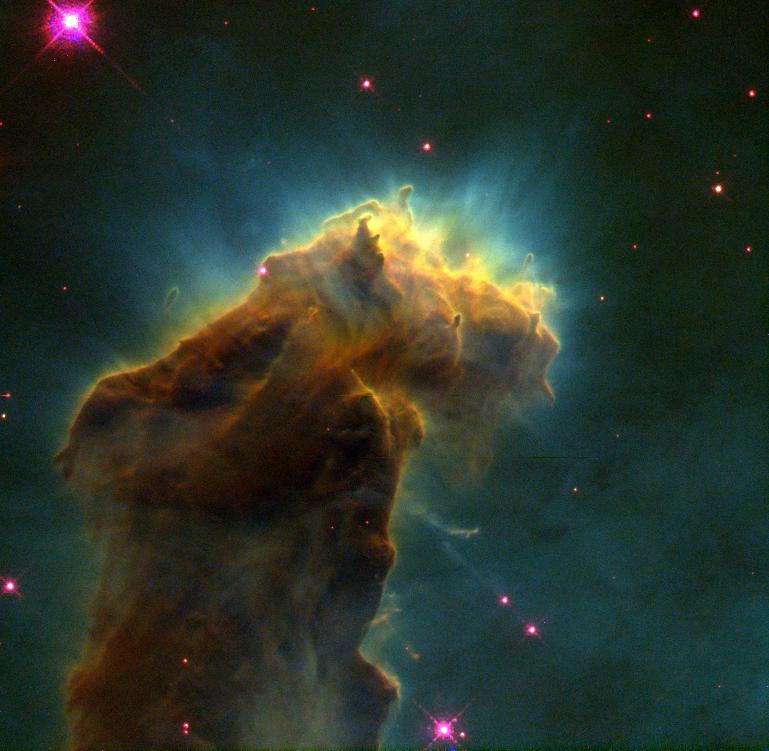
Right. Not. I'm sure this picture
Yeah - that's the Eagle Nebula. That's tens of light years across - and there are baby stars forming in there. Basically, it goes as such. Gravity causes clouds of molecular matter ((Typically only about 30 Kelvin in temperature - barely above absolute zero)) that are generally hydrogen, but not everything in a molecular cloud is gaseous. About half the atoms of elements heavier than helium are found in tiny grains of interstellar dust. ((Now, I'm completely ignoring information on interstellar reddening as it has nothing to do with star birth, but rather, what happens when we view clouds with this dust.)) But continuing on...
Stars form for a very simple reason. Gravity. Gravity causes the cloud to contract and the contraction goes on and on until the central object beomes hot enough to sustain nuclear fusion in its core - and then it is a star. ... I made that really simple, didn't I?
Okay - lemme draw some stuff again. I labelled it with 1 - 4, and you can read below to figure out what goes on.
1.)A protostar stars to form with the collapsing cloud of molecules and dust - this is concealed by a shroud of gas.
2.) The protostar shrinks and heats as gravitational potential energy is converted into thermal energy. The surface temp is about 3000 K. During this stage, gravitational contraction leads to a decrease in its luminosity because its surface temperature remains constant while its radius becomes smaller. This actually drops its life track down on the H-R diagram. Which is a good thing.
3.) Surface temperatures rise when radiation becomes the dominant mode of energy flow within the protostar.
4.) The fusion rate increases until it balances the energy radiated from the stars surface over tens of millions of years and voila, we have star!
Yeah, I really still simplified it. I didn't even MENTION the tiem it takes. Which I am going to do right now.
Stars that are really big? Blue giants? They form in about 60,000 years. Their mass is up to 150x the mass of the sun. Things like our yellow sun take about 50 million years to form. Things like red dwarfs take over 150 million years to form.
Now - most stars fall in the red and yellow area. There's about 200 red stars to every one blue star. So there are VERY few really huge stars, and plenty upon plenty of smaller stars.
Now. Onto the really fun part. The life and death of a star. I'm morbid, okay?
So - a low mass star. Its life is roughly 10 billion years. We're about halfway through that for our star. However - it will eventually exhaust its hydrogen and start its dramatic death.
1.) Our sun fuses hydrogen into helium in its core, regulating with a solar thermostat which basically means the gravity/core energy work together to keep our sun stuable. So. This sun will burn for about another 5 billion years in its 10 billion year life.
2.) Then it enters the red giant stage. So when the core hydrogen is depleted, there is no fusion to supply thermal energy and maintain equilibrium. Our star cannot resist the crush of gravity and it shrinks. However - the outer layers will expand while the core shrinks. It will actually grow in size to be a subgiant. Then - as the expansion inceases, it will turn into a red giant as its size and luminosity grows. It will be 100x larger in radius and 1,000 times brighter in luminosity than it is today. The sun will not engulf us when it does this. It will pretty much just burn up all our water and turn our planet into a scorched wasteland. However - we hypothesise right now that when it expands - we might be able to move to, say, Jupiter's moons because although they are frozen, the expanded sun would melt them enough for us to sustain life there.
Why will the sun expand? Because after the core exhausts its hydrogen, it will have only helium, since helium is left behind after hydrogen fusion. But the gas surrounding the core will still contain fresh hydrogen that has never undergone fusion. But since gravity will shrink the inert helium core and the surrounding shell of hydrogen, the shell will become hot enough to sustain fusion of its hydrogen. It will be so hot that the shell burning will proceed at a higher rate than core hydrogen fusion does today - explaining both the expansion and luminosity change. But most of its mass will still be in the shrunken stellar core.
3.) The situation will get worse while the helium core remains inert. See, thermal energy in a hydrogen burning shell of a red giant cannot do anything to inflate the inert core that lies underneath, and so newly produced helium keeps adding to the mass of the helium core, amplifying its gravitational pull and shrinking it further. The hydrogen shell shrinks with the helium core, growing hotter and hotter. The fusion rate in the shell rises, feeding even more helium to the core. Very vicious cycle.
4.) Finally, the temperature of the inert helium core will reach about 100 million K. At that point, helium nuclei will begin fusion. Now - it gets weird. Theoretical models that we have show that the thermal pressure in the inert helium core is too low to counteract gravity. Instead - the pressure fighting against gravity is degeneracy pressure. It does not increase with temperature, and so the onset of helium fusion heats the core rapidly without causing it to inflate. The rising temperature causes the helium fusion rate to soar upwards in a helium flash.
It releases an enormous amount of energy into the core. In a matter of seconds, the temperature rises so much that thermal pressure again is dominant and degeneracy pressure is no longer important. In fact, it will push AGAINST gravity and the core begins to expand. This pushes the hydrogen burning shell outward, lowering its temperature and fusion rate. The result is that, although the star is now burning core helium and shell hydrogen at the same time, the total energy falls from its peak in the red giant phase. This reduces its luminosity, allowing its outer layers to contract from its peak size during the red giant phase. As the outer layers contract, the stars surface temperature also increases somewhat. It will start to regulate somewhat again as it shrinks with helium fusion pushing outward on gravity pushing inward.
5.) Guess what? We're not done yet! So now, we've gotten to the exhaustion of core helium. This time, it will expand again. The trigger will be helium fusion in a shell around the inert carbon core ((hydrogen makes helium, helium makes carbon, right? There ya go.)) So now the hydrogen shell will burn atop the helium shell. It will be a "double shell burning giant". Both shells with contract with the inert core, driving the temperature and fusion rates so high that the Sun will expand even greater and the luminosity will be even higher than during its red giant phase. This can only last maybe a few million years at most. ((THIS IS WHERE WE GET ENGULFED BY THE SUN AND BURNED TO A CRISP YAYE.))
6.) However - the end of the star will be gorgeous in a way. See, it will expel planetary nebula. This is not actually anything to do with planets, but viewed through a telescope, it looks like a planet. It ejects its outer layers into space. Again, another picture.
Isn't that pretty? So then we'll have a white dwarf left. Now - this is really cool. We know that a white dwarf will eventually cool off and fade from sight but we have never seen this because the universe hasn't been around long enough for it to happen. So all white dwarfs that ever have come about? They're still visible. Some are very faint, but they are all visible. So that's the life and death of a smaller star such as ours.
Also - the coolest and smallest stars, red stars? They haven't even died yet, because their process of birth and life is SO long - since our sun is 10 billion and its yellow - that red stars are probably 15 or 20 billion years long, and our universe has only been around for 14 billion! So we have no clue what a red star's death is like!
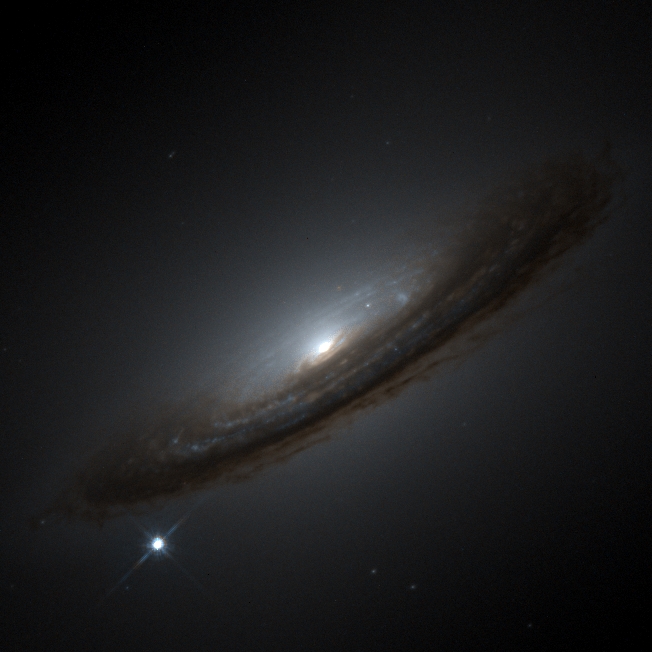
So the death of a larger star now. See, we need them as much as we need the smaller ones. The low mass stars allow evolution to happen for billions of years, but only the high mass stars produce the full array of elements on which we depend. Our sun's core will never get hot enough to produce the elements since it can't fuse more than helium. The early stages of a high mass star's life are pretty similar to that of the Suns, except they are much more quickly. In the final stages, they will continue to fuse increasingly heavier elements until they have exhausted all possible fusion sources. And then in a split second - the core implodes. It's called a supernova. Picture!
See that tiny dot to the left bottom of the galaxy? That's a supernova star. It would shine BRIGHTER than a galaxy.
So. With hydrogen fusion proceeding at a fast rate, they run low very quickly. A star with 25 times the mass of our sun can only last a few million years as a main sequence star, as compared to our 10 billion year star. So then it expands and turns into a supergiant. It burns helium like our star, but there is no helium flash because the core temperatures are high enough that thermal pressure is strong enough to prevent degeneracy pressure. Then the shrinking occurs and gravity happens until carbon starts burning. It goes through that - goes through carbon, oxygen, neon, magnesium, and silicon finally. And finally the silicon leaves an iron core. however - it is the one element that cannot generate nuclear fusion. Iron has the lowest mass per nuclear particle of all nuclei and therefore cannot release energy by fusion or fission - so iron keeps piling up until even degeneracy pressure cannot support the core. Then- BOOM. Supernova.
An iron core with a mass of that of our sun and a size larger than our Earth collapses into a ball of neutrons just a few kilometres across. Neutrons have a degeneracy pressure of their own, so the collapse does stop eventually. This releases an enormous amount of energy, a hundred times more than what the Sun will radiate over its entire lifetime. However - if the star is large enough, it can turn into a black hole. More on that later, I promise. That's the most exciting bit.
Guess what? There's more still to read! Now we're getting to the good stuff. The bizarre! So. White dwarfs. ((I keep writing that as drawfs. Sorry. XD Or rather X{D for you. *tugs your mustache* Which I want to pronounce as "moo-stah-shee". I dunno why.))
Many white dwarfs are members of a binary star system. And in that - it can gain mass if its companion is a main-sequence or giant star. When that happens, a clump of mass spills over from the companion to the white dwarf with a small orbital velocity. The law of conservation of angular momentum dictates that it must orbit fast and faster as it falls towards the surface of the white dwarf. This is called an accretion disk. So this can provide the white dwarf with new energy. But the dwarf is dead since it has no hydrogen left to fuse. This changes from the accretion disk. The gas spilling on it comes up the upper layers of the companion star and is so mostly hydrogen. The strong gravity of the white dwarf compresses this hydrogen until it starts nuclear fusion again. It blazes black to life for a few weeks as a nova. It can shine as brightly as 100,000 suns. This can repeat itself many times as long as the gravity is strong enough. However, each time a nova occurs, the white dwarf ejects some of its mass. And then it truly is over for the white dwarf,where it undergoes a white dwarf supernova. See, the interior temperature will rise as its mass falls and gravity keeps crushing it down. Carbon fusion will begin and light almost instantly throughout the star and release far more energy than the helium flashes. The dwarf explodes in a white dwarf supernova. This is called a type I supernova, while a larger star's supernova is a type I. And this white dwarf supernova will leave a mass of pretty much 5 tons per teaspoon.
Now - neutron stars. They have densities even higher! Since a neutron star is created by the collapse of an iron core in the massive star supernova, they are only about 10 kilometres across and yet more massive than the sun. They're pretty much giant atomic nuclei made entirely of neutrons and held together by gravity, holding it off with degeneracy pressure. Escape velocity of a neutron star is about half the speed of light. A paper clip with a density of a neutron star would outweigh Mount Everest. It would fall through the Earth and then fall back again.
Now - if an entire neutron star came to visit us, it would literally turn us to dust. The former Earth would be a shell no thicker than your thumb.
Neutron stars were discovered in 1967 when Jocelyn Bell discovered a strange source of radio waves. She actually called them "LGM - Little Green Men" until they figured out that the pulses coming at 1.3 second intervals were pulses of radio waves called pulsars. The pulsations occure because the neutron star is spinning rapidly as a result of the conservation of angular momentum. As an iron core collapses into a neutron star, its rotation rate must increase as it shrinks in size. It also shrinks the magnetic field lines running through the core. The neutrons star's magnetic field is a trilion times as strong as Earth's.
There are actually binary systems in which both objects are neutron stars. Also - there are planets orbiting neutron stars. It's just insane. And in fact, the planets formed after the explosion. The pulsar had a stellar companion that was too close, the tidal forces ripped it apart, and the debris forced a protoplanetary disk that coalesced into a planet. And for a binary system that pours gas from a main sequence star to the neutron, it will emit X-ray emissions. Some will actually devour their companion and instead of pulsing every 1.3 seconds, they will have enough energy to pulse every millisecond.
And finally - Black Holes. Sometimes the gravity in a stellar corpse is so strong that nothing can prevent it from collapsing under its own weight. It collapses endlessly, crushing itself out of existance and forming a black hole. THIS IS WHERE NEWTON BROKE FUCKING PHYSICS AND THE SPACE TIME CONTINUUM. BASTARD. Okay. The objects gravity is so strong that light cannot escape. The black bit comes from the fact that no light can escape - the hole is like a hole in the observable universe since you will never return. It's NOT an actual hole. Just an endless pit into spacetime. Yeah. I don't understand it completely myself - if you don't, don't worry.
Okay. So - the boundary between the inside of a black hole and the universe is called the event horizon. It marks basically the point of no return for objects entering a black hole. It is the boundary for which escape velocity equals speed of light. Space and time near the event horizon are very strange. Space and time are not distict as we usually think of them, but are instead bound up in spacetime. And Einstein's general theory of relativity ((NOTHING IS AS FUCKING EVIL AS FUCKING GENERAL RELATIVITY. I MEAN IT.)) tells us that what we perceive as gravity arises from the curvature of spacetime. It's hard to think about that because we can't picture the four dimensional spacetime. So I will use an analogy.
Throw a bowling ball onto a pool cover. It'll bend near the middle, right? Well - that's what a black hole does, except its mass and gravity are so strong that space and time are incredibly distorted. The size of a black hole can be from 3 to 30 kilometres.
It forms when a collapsing stellar core becomes smaller than its Schwarzchild radius ((This is the radius of the event horizon, named after some famous dude, so, whatever.)). So the core is smaller than its event horizon and it disappears within it. The black hole still contains all its mass and gravity but its outward appearance tells us nothing about what fell in. So not only can we tell the mass of a black hole, we can tell other things. If it had any positive or negative charge, it woudl attract opposity charged particles to make it neutral. And finally its massive rotation will drag neighbouring regions of spacetime in circles around it.
Time runs more slowly as gravity gets stronger. If you had a clock that had blue light glowing from it, it would go through gravitation redshift and turn red. Two clocks at opposite ends of the room would tell different times, the closer you get, the slower time runs. If you did go to a black hole - from your viewpoint, you'd get sucked in in a split second. But from someone else watching from earth, you will NEVER cross the event horizon. Time will come to a stop for you as you vanish from view due to the gravitational redshift of light being so huge. ((THIS IS WHY I HATE GENERAL RELATIVITY. ;____;))
But you wouldn't get to feel the crossing of the event horizon. See, the gravity would pull on you so hard that it would stretch you lengthwise and squeeze you from side to side. This is actually called spaghettification. I am going to kill myself for that.
I'd talk about gamma ray bursts but nobody really knows about them. It's a very unknown science and the book only covers about a page or so of material and it just kind of speculates. It's not enough to explain. Maybe I'll do some research on my own and write something up.
So. I hope you enjoyed that lesson. Confusing and weird. Yaye!

 1.)A protostar stars to form with the collapsing cloud of molecules and dust - this is concealed by a shroud of gas.