Note - I cannot draw, however, there is a good chance this MIGHT contain some craptastic art to help you understand. ... Plz do not laugh as I will be forced to hurt you. That is all. Oh - and I fixed the formatting, yaye!
Discovering The Universe For Yourself
Hi again! It's me, Universe! So, it's time for a bit of more information about me. I'm about 14 billion years old, and over that 14 billion years, stars, galaxies, nebulas, and planets have evolved within me. But as pretty as galaxies are and amazing as nebula can be, the things that inspire most people are the stars, and the constellations that they make. Most people think of Ursa Major or Gemini or the Pleides as constellations. Sure, patterns of stars are constellations, but the precise meaning of the term is a region of the sky with clearly defined borders.
The official borders of the constellations were set in 1928 by members of the International Astronomical Union. These people divided the sky into 88 constellations, which I won't list here as that would take too long, and they named them, using names mostly European or American. Almost every constellation in the Northern Hemisphere has a name that traces back to ancient Middle East, while the Southern Hemisphere traces back to seventeenth-centery European explorers.
Beth: *wanders in* I'd like to say something. In the book, they say learning the constellations is no more difficult than learning your way around your neighbourhood, and recognizing the patterns of 20-40 constellations is enough to make the sky seem familiar. ... THAT IS A LIE.
...Right. Anyways. To get on with what we were going about, let's explain how the stars are set.
Aristotle: In nested crystal balls!? *is bitchslapped by modern astronomers* Ow.
Modern Astronomers: Fule, fuck no. They are aligned on a celestial sphere.
Aristotle: Exactly what I said! A crystal ball!
Modern Astronomers: Oh, would you shut up? It's a metaphor. Here, let's use some art to explain.
Beth: *whines pitifully* You're really gonna make me draw?
Aristotle: I'm almost certain that it's in a crystal ball.
Modern Astronomers: *gag Aristotle and pull him off stage* Now that we've got him out of the way...
[Beth, at this point, pulls out her pentab and attempts to create a way to show what these astronomers mean. It does not work very well. She therefore gives up and instead does her damn best to explain it.]
Beth: The north celestial pole is directly above our North Pole. The south celestial pole is directly over Earth's South Pole. The celestial equator is a projection of Earth's equator into space, and it makes a complete circle around the celestial sphere. And finally, the ecliptic is the path that the Sun follows as it appears to circle the celestial sphere each year. The ecliptic crosses the celestial equator at a 23 1/2 degree angle.
Sun: Yeah, you suck.
Beth: Yeah, well, this is a hard chapter to be funny with. Fine, I did some artwork.
Beth: BTW - that equator should be up more. But I was doing this with fingers that were greasy from pizza and a tempermental pentab, so excuse the badness of the art. Anyways. So within this celestial sphere is all the stars. So imagine that you were looking up at the stars in an ancient culture long ago.
Ancient People: ZOMG! The earth! It is flat! And stuff! And the sky! We live under a great dome! And the stars, they are pastede on yaye!
Kevin Murphy, Beth's Astronomy Teacher: *is future rolling in his future grave as Beth butchers astronomy with internet memes!*
Beth: *dies and is ded a million times over*
Universe: *weeps for Donnie* I'm sorry. This is pathetic.
Beth: *revives, and continues teaching* Anyways. Well, the half of the celestial sphere that we can see is called the local sky - the sky as seen from wherever you happen to be standing.
Earth: Can I add in?
Beth: Sure!
Earth: I like cheese.
Beth: ... Donnie I apologise. I don't know what's going on in my brain, but it definitely is not astronomy. Anyways. Guess what? More terms to know!
Terns: Did you call us? *flutter wings*
Beth: *gives up and starts creating a noose to hang herself with*
Universe: Oh, be a dear and at least finish what you were saying before you kill yourself, yeah?
Beth: *sighs* So. You know what the horizon is. It's the boundary line between Earth and the sky, where the sun sets, yadda yadda. Well, you've heard of a climax of a story, right? And a synonym is the zenith? Well, guess what? The zenith refers also to the point directly overhead and the meridian as the imaginary half-circle stretching from the horizon due south, through the zenith, to the horizon due north.
Earth: If you stand on me and you want to pinpoint an object, you can use its direction along the horizon, and it's altitude above the horizon. For example, you could locate a star as in the direction of east at an altitude of 50 degrees.
Beth: At about this point, the book discusses arcminutes and arcseconds. Aren't you glad I covered them? Mostly because they literally don't tell anything at all. So let's see. Hummm... this chapter is incredibly boring. How about we talk about stars?
Angelina Jolie: *smiles and waves*
Johnny Depp: *is broody and pirate-y, yarrr!*
George Clooney: *oozes sex appeal*
Anna Nicole Smith: *is just damn annoying*
Beth: NOT THOSE!
Stars: You mean us? *twinkle prettily*
Beth: Thank you. Basically, it goes like this. Stars appear to rotate east to west because we rotate west to east. Again, I'm sure you know this. The book says it's important. The book is phooey. If I taught astronomy, children would learn that there were giant cockroaches called Venusian Roaches. The Venusian Roach is very tough against heat, and very cute.
Universe: While she babbles, I'll take over and continue talking about the stars. Those that are near the north celestial pole, they don't really rise or set. Just circle counterclockwise daily around the north celestial pole. They are circumpolar, in other words. And stars by the south celestial pole never rise at all.
Earth: But the constellations that you can see, they depend on the latitude and time of the year! ((We're assuming you understand latitude and longitude because if you don't, I am frightened.)) So when you move to somewhere else on earth that is a different latitude, you move your horizon and zenith on the celestial sphere, and what you'll be able to see will change.
Beth: But here's a very important nagivational tip, and helped all of us on our first test. The altitude of the celestial pole in your sky is equal to your latitude. We all got the latitude questions right. Go us.
Sun: My turn! Now the variations with the time of the year. The night sky changes throughout the year because the Earth orbits me. Over a year, I appear to move against the background of stars in the constellations. The Sun gradually moves eastward along the ecliptic, going completely around once a year. This is our path along the zodiac.
Zodiac: I really have thirteen constellations, with Ophiuchus. But someone kicked him out of astrology.
Ophiuchus: *cries emo-tears and slits his wrists*
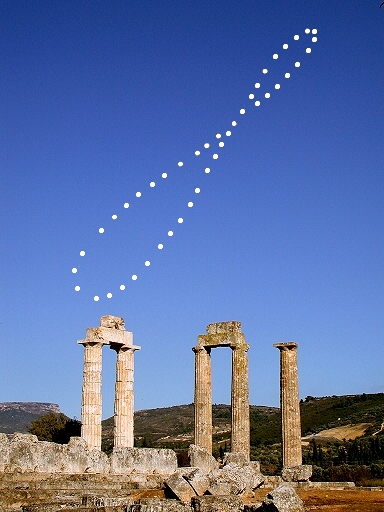
Sun: Basically, if it's late August, you won't see Leo since I'm in front of Leo in the path of the zodiac. And a really cool thing? If you photograph me over the course of a year, maybe once a week, always from the same spot and same time of day, you can see a figure eight that I make. It's called an analemma.
Beth: What does that have to do with the stars?
Sun: ... Nothing. But I thought it was interesting. Here, have a picture!
Beth: After this, it discusses the seasons and what causes them and why our orbit around the sun is slightly closer on one side than the other, but that this doesn't affect our seasons. However, the next bit is pretty interesting.
Disembodied Anouncer: Polaris - Or: The Little Star That'll Be Gone Soon Enough
Have you ever looked up in the night sky and wondered why we have a North Star? Well, that's because we're alive at a point in time that's pretty darn lucky. See, there's precession that occurs with Earth. Just spin a top, and see the way it spins rapidly, you'll notice that the axis more slowly makes a circle, called precession. Each cycle takes about 26,000 years on Earth! Right now, our axis points towards Polaris. But, again, thanks to precession, it's only been a good North Star for about five hundred years, and in five hundred years, it'll be no good. In fact, in about 13,000 years, Vega will be our north star!
The sun used to appear in Cancer on the day of the summer solstice, but now apears in Gemini, which is why the Tropic of Cancer is called that!
And in a few billion years, the Sun will grow huge and encompass us, burn us to death. And if we survive that, there'll be an ice age when it shrinks. And if we still survive that, there'll be a solar shock wave and that'll kill us! And if that doesn't, there'll be a later one. And if you're STILL not dead, eventually, the entire universe is going to be nothing but black holes.
Beth: *interrupts* AND THAT'S ALL VERY NICE AND LOVELY. BUT WHY DOES IT OCCUR?
Precession: *wanders in*
Beth: *boggles at the idea of a concept having physical form*
Precession: Well, I'll write you a little poem. *coughs* Earth is not a perfect sphere
So you can see what happens here
If you try to stand a nonspherical top on its tip
It's like watching somebody trip
And down they go, with a boom
This won't happen if the top goes zoom
Spinning objects keep their spin
around the same rotation axis where they begin
So gravity can't pull them down
Where they would rudely hit the ground
Instead, gravity suceeds in making sure
That through it all, precession will occur
As friction slows the top's spin
The circles of precession widen until the end
Where the top clunks down and it's all done
Let's be glad that in the battle against friction, Earth won!
Beth: *cannot believe this*
Universe: My poems are shorter.
Beth: Not by much.
Comet: *OH LOOK CHANCE ORBIT AT BETH'S HEAD AGAIN*
Beth: *yawns, again sidesteps* Keep it up, Universe. I'm not too worried.
Earth: Basically, I precess because of tugs from the Sun and Moon. I'm slightly bulgy at the center, I can't lose that extra baby fat I got when I was developing. Because my equator is tilted 23 1/2 degrees to the ecliptic plane, the Sun and Moon are gravitationally trying to pull the bulge, straightening my axis tilt. But since I'm rotating, I keep rotating around the same axis. Therefore, gravity loses, and it doesn't change my axis tilt, just makes the axis precess.
Moon: Hey, you mentioned me! Which is good, because I'm about to come along.
Beth: *snerks* You said come.
Universe: *boggles* This is the person who called everyone else immature?
Moon: Can I do a tap number?
Beth: ... Uh... sure.
Moon: *Tappity tapp tapp!* *takes off top hat and gives a little bow* I'm the moon and I'm big and bright
I travel across the sky at night
Or sometimes in the early morn'
You can see my face adorn
your sky
I live in your sky
*taptaptap*
My orbit lasts for twenty eight days
Throughout which I reflect sun rays
And then I've got my lunar phase
In which you can see my face
in your sky
My face is in your sky
*taptaptappitytaptap!*
And throughout these phases you can see
a little bit more or less of me
each day, in your sky
*taptaptappitytaptap*
The new moon is when I'm in front of the sun
You can't see me, I'm all gone
Then comes the waxing crescent
first quarter follows in ascent
waxing gibbous almost filled
And then I'm completely full and thrilled
In your sky, I'm full in your sky
*tappitytaptappitytaptap*
After that, my phases are reversed
Waning gibbous comes first
Third quarter, I'm half out of view
Waning crescent and I'll leave you
When I'm a new moon again, in your sky
*taptaptaptappity* *dances across stage, strikes a pose* But that's not all!
*dances back across stage, strikes another pose* How about when I rise?
When I'm a new moon, I come at morn,
Six o' clock is when I'm born
I'm highest at noon, and set in six more
Add three hours per phase before
I'm a new moon again, in your sky
In your sky, I'm in your sky, I'm IN YOUR SKY-IY-IY!
*tapdances to finish*
Beth: *blinks* Now that was an award-worthy performance. You could take a lesson, Universe - AH! *dives away as several meteors miss her by about two feet* *swears quietly*
Moon: There's something else really cool with me. I'm locked in a synchronous rotation with the Earth. We're gravitationally locked.
Earth: Sounds romantic! *blushes*
Moon: ... Basically, I rotate once on my axis in the same time that I orbit Earth, so I always show the same face. It wobbles by about 6%, but you only have ever seen one face, really.
Beth: I'll talk about synchronous rotations in a shorter, separate lesson, as it's very interesting, but at this moment, I can't be arsed to look it up.
Universe: Lazy git.
Beth: Arrogant prat.
Universe: Slut.
Beth: Tramp!
Universe: Five-cent hooker!
Beth: SON OF A BLACK HOLE!
Universe: *GASPS* OH YOU DID NOT!
Beth: *watches in horror as about a hundred meteors come shooting at her* Do that - and you'll destroy all sorts of things. In fact, there's a good chance that some of them will go off course and rip a hole in you! Do you really want to destroy yourself?
Meteors: *suddenly shoot off in the other direction*
Beth: Hey, planets, we need you again!
Planets: *wander back in* Yes?
Beth: Explain why people used to think you were mysterious?
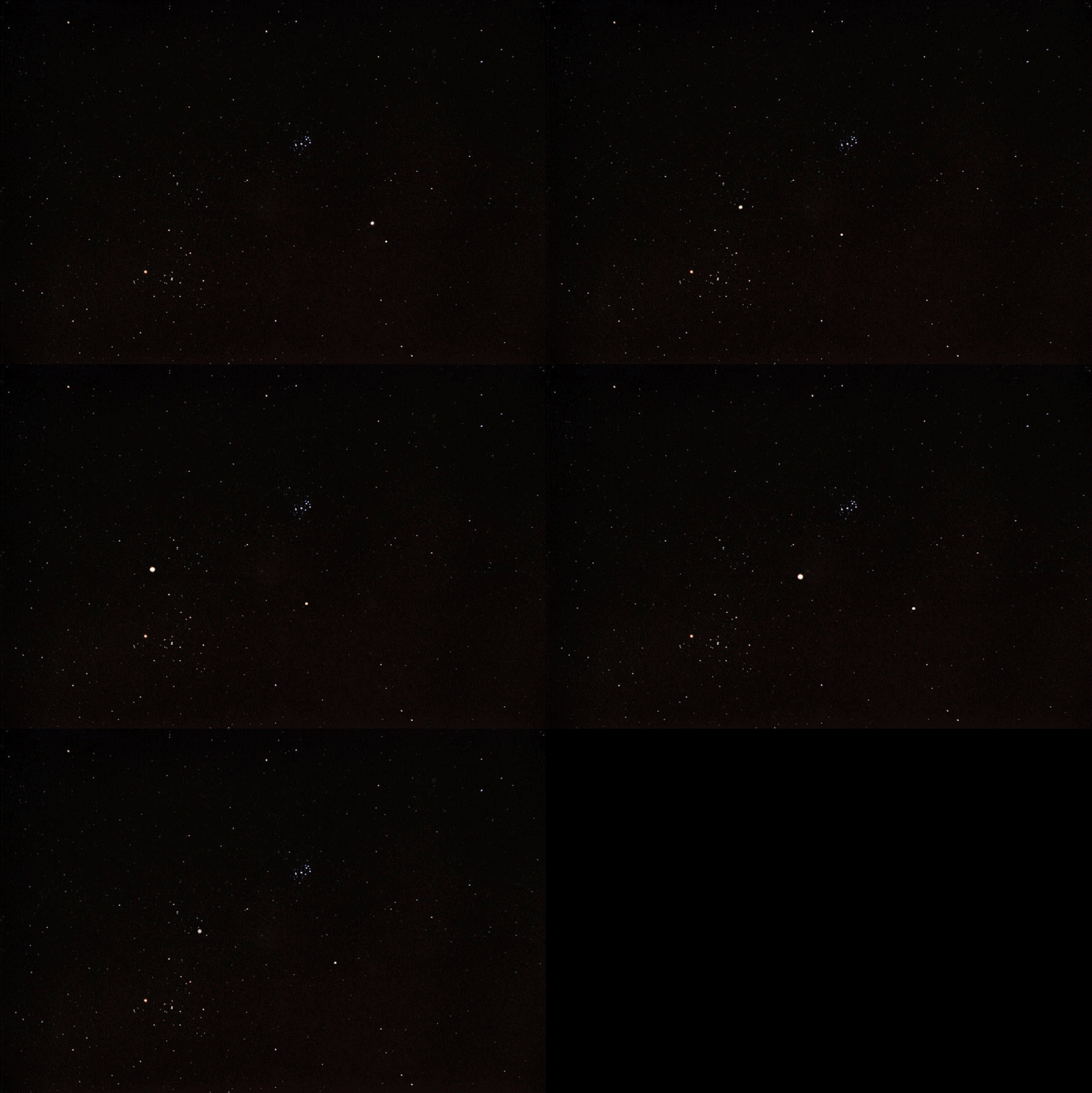
Mercury: Sure! Well, our name actually comes from the Greek for "wandering star". See, unlike the moon and sun, which move in a fairly steady eastward motion relative to the stars, we planets seem to vary in speed and brightness quite substantially as we travel.
Venus: Except sometimes, while we usually move eastward relative to the stars, we occasionally reverse course completely, going westward! Or at least we appear to.
Mars: This is called apparent retrograde motion. This can last for a few weeks to a few months.
Jupiter: Hey, I found a picture! Here's one of me and Saturn! We're BFFs!
Beth: *boggles* ... WTF?
Saturn: Yeah, notice the way that we seem to trace backwards acros sthe sky? It's a fairly simple explanation, actually. Since Mars takes about two years to orbit the Sun, it covers about half its orbit in the time that the Earth makes one orbit.So if you trace the lines of sight from Earth to Mars from different points in their orbits, you'll see that the line usually moves eastward but when Earth passes Mars in its orbit, it moves west!
Uranus: So what did the ancient Greeks think was the explanation for retrograde motion?
Neptune: Well, they couldn't understand a non-Earth-centered universe, and so they couldn't undertsand stellar parallax. Everyone knows what happens when you hold something up in front of your face and then alternatively blink. It shifts. For closer objects, it shifts more, and further ones, it shifts less. That's parallax. It depends on distance, and so stars would shift back and forth, except because Greeks thought all stars lie on the same celestial sphere, they wanted to see stellar parallax slightly differently.
Pluto: *is not a planet and cannot explain* *weeps*
Earth: *jumps in hastily* They thought that if Earth orbited the Sun, at different tiems of the year, we would be closer to different parts of the celestial sphere, and so we would notice changes in the angular separations of stars. But they never saw stellar parallax.
Greeks: OMG ONLY TWO ANSWERS. EARTH ORBITS THE SUN BUT THE STARS ARE TOO FAR AWAY AND SO THE STELLAR PARALLAX IS UNDETECTABLE TO THE NAKED EYE. OR THERE IS NO STELLAR PARALLAX BECAUSE EARTH IS STATIONARY AT THE CENTER OF OUR UNIVERSE!
Universe: I have such high hopes.
Greeks: IT IS THE SECOND!
Universe: And they are gone. But now, with your telescopes, you can prove that stellar parallax exists!
Beth: And so basically, we have learned a lot over the years. Basically, the Greeks are morons, Aristotle was a bigger moron, and I'm going to be destroyed in my sleep by a meteor, I'm sure of it.
Universe: *smirks and closes curtains*
Well, I hope you enjoyed another lesson. I'm sorry that you had to see that side of me, usually I'm quite nice and beautiful. It's just that problematic author. She thinks she's all that. But just you wait, I'll show her. Come back next time when we discuss how to make sense of the universe, or - astronomy bitchfighting on Philosophy Deathmatch.